Essential Tax Forms: A Guide for Investors

Every dollar an investment account earns reaches your federal return through a small set of forms. Banks, brokers and funds report what they paid you on information returns in the Form 1099 family, and you carry those figures onto Form 1040 and its schedules. Knowing which form reports what, when it arrives, and where each figure goes removes most of the confusion of tax season. This guide follows the IRS's own topic pages and form instructions through dividends, interest, sales of securities, the additional tax on investment income, foreign taxes, record keeping and where to find help, and closes with how the Journal in Quant Charts keeps the trade record those forms are built from. It describes federal rules only and is not tax advice; a return with unusual items belongs with a credentialed preparer.
How Investment Income Reaches Your Return
The system has two halves. Payers file information returns with the IRS and send you a copy: Form 1099-DIV for dividends, 1099-INT for interest, 1099-OID for original issue discount and 1099-B for sales through a broker. You then report the same amounts on your return, and the IRS matches the two. Because the match is automatic, the IRS notes on its interest and dividend topic pages that you must report all taxable income even when a form never arrives, for example when a payer's total was below the $10 reporting threshold.
| Form | Who sends it | What it reports | Where it goes on your return |
|---|---|---|---|
| 1099-DIV | Corporations, funds, brokers | Ordinary and qualified dividends, capital gain distributions, nondividend distributions, foreign tax paid, federal tax withheld | Form 1040 dividend lines; Schedule B if over $1,500; Schedule D for capital gain distributions |
| 1099-INT | Banks, brokers, Treasury | Taxable interest, Treasury interest, tax-exempt interest, early withdrawal penalties | Form 1040 interest lines; Schedule B if over $1,500 |
| 1099-OID | Issuers and brokers | Original issue discount accrued on discounted bonds and notes | Interest lines; Schedule B for adjustments |
| 1099-B | Brokers | Proceeds, cost basis, dates, holding period and wash-sale adjustments for each sale | Form 8949, then Schedule D |
| Schedule K-1 | Partnerships, trusts, estates, S corporations | Your share of the entity's income including dividends and interest | The lines the K-1 specifies |
When the Forms Arrive
The IRS General Instructions for Certain Information Returns set the dates by which payers must furnish recipient statements. Most 1099 statements are due to you by January 31. Form 1099-B, and consolidated statements that combine a broker's 1099-B with its 1099-DIV, 1099-INT and 1099-OID information, are due by February 15. Brokers use the later date because the tax character of some distributions is not final until issuers report it, and for the same reason corrected statements can follow weeks later. If a corrected form arrives after you have filed, the IRS process is an amended return on Form 1040-X.
The IRS interest topic also notes that 1099-INT and 1099-OID figures may reach you inside a broker's composite statement rather than as separate forms. The reporting is the same; only the packaging differs.
Dividends: Form 1099-DIV
IRS Tax Topic 404 explains that you should receive Form 1099-DIV from each payer that distributed $10 or more. Dividends are classified as ordinary or qualified. Ordinary dividends are taxed as ordinary income. Qualified dividends, which meet holding-period and issuer tests set out in Publication 550, are taxed at the lower long-term capital gains rates, and the payer is responsible for identifying which of your ordinary dividends are also qualified. The form also reports capital gain distributions from funds, which go to Schedule D, nondividend distributions, which reduce your basis rather than count as income, and any foreign tax withheld, which feeds the foreign tax credit.
Two details trip up filers. Payments labelled dividends by credit unions and similar institutions are interest for tax purposes, as Tax Topic 403 explains, and appear on 1099-INT. And if your taxable interest or ordinary dividends exceed $1,500, the IRS requires Schedule B, which lists each payer.
Interest and Original Issue Discount
Tax Topic 403 states that most interest credited to an account you can draw on without penalty is taxable in the year it becomes available. Form 1099-INT reports it by type: taxable interest in Box 1, interest on Treasury securities in Box 3, which is exempt from state and local income tax, and tax-exempt interest from municipal bonds in Box 8. Original issue discount, the difference between a bond's face value and its discounted issue price, is treated as interest and accrues each year; Form 1099-OID reports the annual accrual when it is at least $10. Schedule B is also where you adjust OID or bond premium if the form's figure needs correction.
Sales of Securities: Form 1099-B, Form 8949 and Schedule D
Selling a stock, bond, fund share, option or futures contract through a broker generates Form 1099-B. The IRS describes it as the form a broker must file for each person for whom it sold stocks, commodities, regulated futures contracts, debt instruments, options and similar assets for cash. It carries the proceeds, the cost basis where the broker has it, the acquisition and sale dates, whether the gain is short-term or long-term, and any wash-sale adjustment.
Those figures move to Form 8949, which the IRS describes as the form used to reconcile amounts reported on Form 1099-B with the amounts you report. Each sale is a row: description, date acquired, date sold, proceeds, basis, an adjustment code and amount if the broker's basis is wrong or missing, and the resulting gain or loss. Form 8949 is split into short-term and long-term parts, and within each part into transactions where basis was reported to the IRS, where it was not, and where no 1099-B was received. The instructions allow one shortcut: if basis was reported to the IRS and no adjustments are needed, the totals for that group can be entered directly on Schedule D without listing every row.
Schedule D collects the subtotals, nets short-term against short-term and long-term against long-term, adds capital gain distributions from 1099-DIV, and produces the figure that flows to Form 1040. Tax Topic 409 gives the rules behind it:
- Holding period. An asset held more than one year produces a long-term gain or loss; one year or less is short-term. The count runs from the day after acquisition through the day of sale.
- Rates. Net long-term gains may be taxed at 0%, 15% or 20% depending on taxable income. For 2025 the 0% rate applied to taxable income up to $48,350 for single filers and $96,700 for joint filers, with 15% up to $533,400 and $600,050 respectively and 20% above. Short-term gains are taxed as ordinary income. Thresholds are indexed each year, so check the current topic page.
- Losses. If losses exceed gains, up to $3,000 of the excess ($1,500 if married filing separately) reduces other income each year, and the rest carries forward. The Capital Loss Carryover Worksheet in the Schedule D instructions tracks the amount.
- Estimated tax. A large taxable gain may require estimated payments during the year rather than a single payment in April.
The Net Investment Income Tax
Tax Topic 559 describes an additional 3.8% tax on net investment income for individuals whose modified adjusted gross income exceeds $250,000 for married filing jointly, $125,000 for married filing separately or $200,000 for single and head-of-household filers. The tax applies to the lesser of net investment income or the amount by which income exceeds the threshold, and it is computed on Form 8960. Interest, dividends, capital gains, rents and royalties are all within its scope, so an unusually good trading year can trigger it for someone who does not normally pay it.
Foreign Taxes: Form 1116
Dividends from foreign companies often arrive with foreign tax already withheld, reported in the foreign tax box of Form 1099-DIV. The IRS's Form 1116 page states that the form is used by individuals, estates and trusts to claim a credit for certain foreign taxes paid or accrued, which prevents the same income being taxed twice. The Form 1116 instructions describe an election for taxpayers whose creditable foreign taxes are small and consist entirely of passive income reported on payee statements, allowing the credit to be claimed directly on Form 1040 without the form. Unused credits can be carried to other years, and Schedule B of Form 1116 reconciles the carryover.
How Long to Keep the Paperwork
The IRS's record-keeping page ties retention to the period during which a return can be amended or examined. The general rule is three years from the date you filed. Records for a claim involving worthless securities or a bad debt should be kept seven years. Records connected to property, which for an investor means every purchase confirmation that establishes basis, should be kept until the limitations period expires for the year in which the property is sold, which can be far longer than three years for a position held for a decade. Broker basis reporting has reduced the burden for shares bought since the reporting rules took effect, but positions transferred between brokers, inherited shares and reinvested dividends still depend on your own records.
Getting Help
Anyone paid to prepare a federal return must hold a Preparer Tax Identification Number, and the IRS Directory of Federal Tax Return Preparers with Credentials and Select Qualifications lists preparers who hold recognized credentials or an annual filing season record of completion. Enrolled agents, certified public accountants and attorneys have unlimited rights to represent taxpayers before the IRS. For straightforward returns the IRS Free File program provides guided software at no cost to taxpayers under its income limit, and the Volunteer Income Tax Assistance program prepares basic returns free for those who qualify. Situations that usually justify a professional include multiple brokerage accounts, foreign holdings, partnership K-1s, frequent trading with wash sales and any year with a corrected 1099-B after filing.
Where Quant Charts Fits
Quant Charts is not tax software and does not produce tax forms; your broker's 1099-B and your preparer's or software's Form 8949 do that. What the platform contributes is the record underneath those forms. The Journal in Quant Charts is a trading log that lives on your account and is included on every plan. It stores fills, rebuilds each round trip from them, and keeps notes and review fields that survive a re-import.
Keep every fill in one place. A Journal account can be synced from a connected broker, built by importing a broker or journal export in CSV, TXT or HTML form, or kept manually with a starting balance you set. Recognized imports include Interactive Brokers activity statements and Flex Queries, thinkorswim and Charles Schwab, NinjaTrader, Tradovate, Webull and others. Each fill records symbol, side, quantity, price, fee and execution time, which are the same fields a 1099-B row and a Form 8949 line are built from.
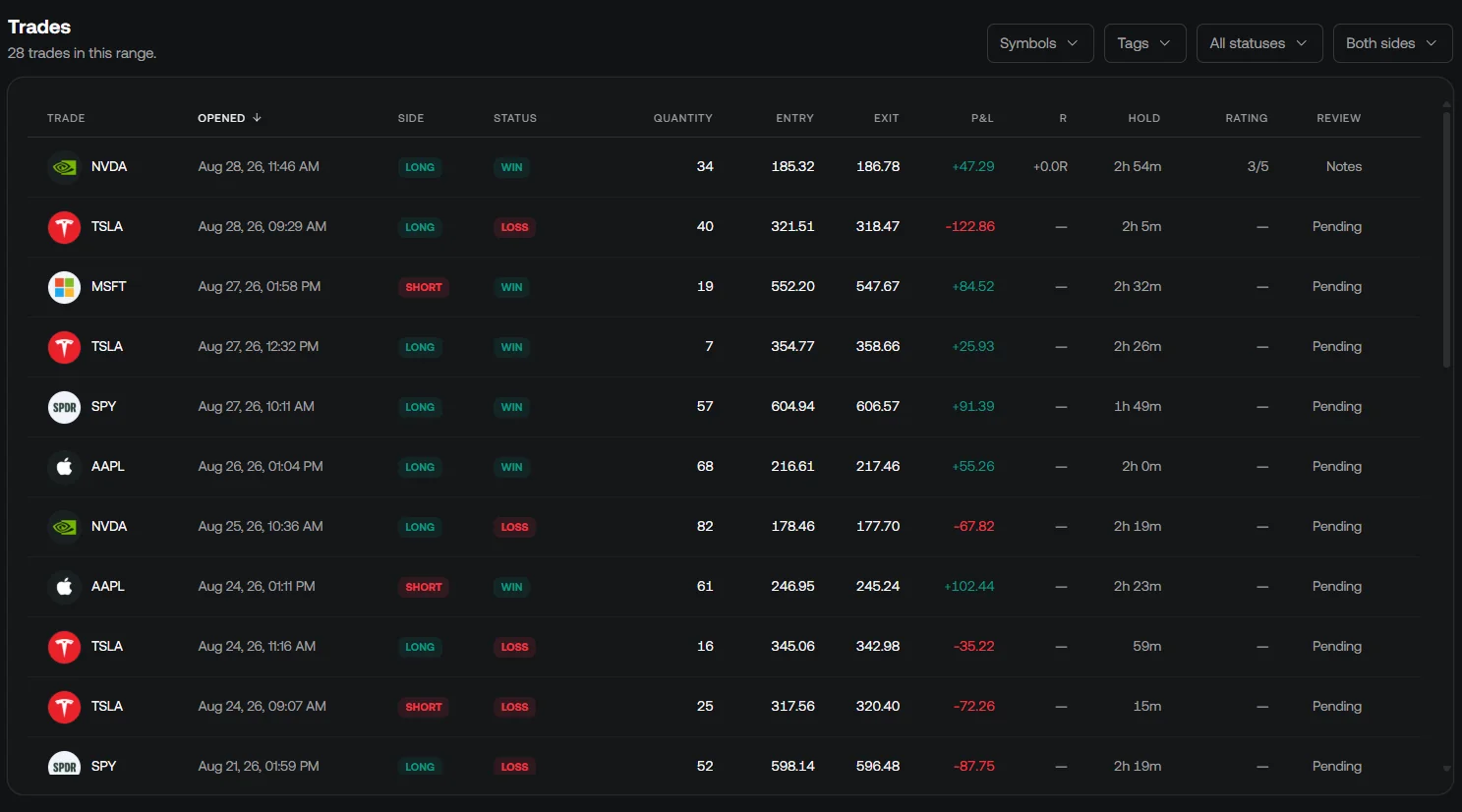
See the holding period before you sell. A trade's detail view shows when it was opened and closed and its duration, and the Breakdown page slices net profit and loss by hold time. That is the information that decides whether a sale lands in the short-term or long-term part of Form 8949, and seeing it in the Journal before closing a position is easier than discovering it on a 1099-B in February.
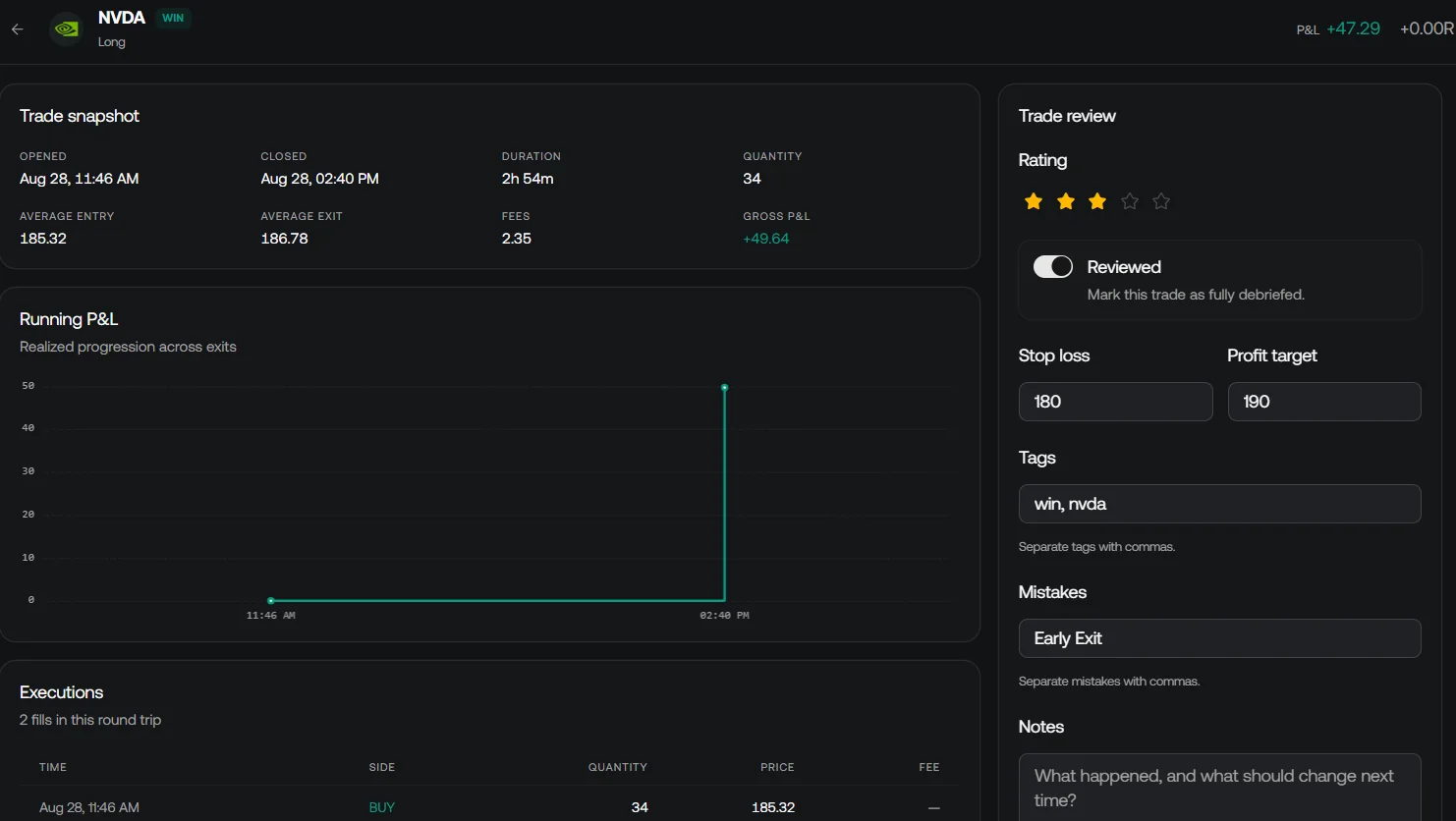
Reconcile against the broker. Because the Journal reports gross and net profit with fees per trade, and the dashboard totals win rate, profit factor and net profit for any date range, a year-end comparison with the broker's realized gain and loss report will surface missing or duplicated fills before they become a mismatch with Form 1099-B. The Journal's figures are not a substitute for the broker's statement, which is what the IRS receives, but they are the fastest way to check it.
The video below shows how indicators are added to a chart in Quant Charts.
Backtests create no tax events. When you describe a rule to Quant, our coding agent, and click Run, the Backtest Summary's net profit, trade count, win rate, max drawdown and profit factor describe hypothetical trades. Nothing is bought or sold, so nothing is reported. Only fills placed with a broker appear on a 1099-B, and only those belong in the Journal account you reconcile at year end.
FAQs
Which tax forms do investors receive?
Form 1099-DIV for dividends and capital gain distributions, 1099-INT for interest, 1099-OID for original issue discount and 1099-B for sales through a broker, often combined in one consolidated statement. Holders of partnership or trust interests receive Schedule K-1. You report the figures on Form 1040 with Schedule B, Form 8949 and Schedule D as needed.
When should I receive my 1099s?
Under the IRS General Instructions for Certain Information Returns, most recipient statements are due by January 31, while Form 1099-B and consolidated broker statements are due by February 15. Corrected statements can arrive later, and a correction after filing is handled with an amended return.
What is Form 8949 for?
It reconciles the sales your broker reported on Form 1099-B with what you report, listing each sale with dates, proceeds, basis, any adjustment and the gain or loss, separated into short-term and long-term parts. Its subtotals flow to Schedule D. If basis was reported to the IRS and no adjustments are needed, totals may be entered directly on Schedule D.
How is short-term separated from long-term?
Assets held more than one year are long-term; one year or less is short-term. The IRS counts from the day after acquisition through the day of sale. Long-term gains may be taxed at 0%, 15% or 20% depending on taxable income, while short-term gains are taxed as ordinary income.
What happens if I lose money?
Capital losses offset capital gains first. If losses still exceed gains, up to $3,000 a year ($1,500 if married filing separately) reduces other income and the remainder carries forward, tracked with the Capital Loss Carryover Worksheet in the Schedule D instructions.
Does Quant Charts prepare tax forms?
No. Quant Charts is a charting and AI platform, and Quant backtests are hypothetical, so they create no tax events. The Journal keeps fills, round trips, durations, fees and net results from synced, imported or manual accounts, which helps you reconcile your broker's 1099-B and see holding periods before you sell.
References
LuxAlgo Resources
- Journal overview, Accounts and Trades (LuxAlgo Docs)
- Journal dashboard and Breakdown (LuxAlgo Docs)
- Making strategies with Quant and Reading a strategy backtest (LuxAlgo Docs)
- Expectancy and Win Rate concepts (LuxAlgo Library)
External Resources
- Topic No. 409, Capital Gains and Losses, Topic No. 404, Dividends, Topic No. 403, Interest Received and Topic No. 559, Net Investment Income Tax (IRS)
- About Form 1099-DIV, About Form 1099-INT, About Form 1099-OID and About Form 1099-B (IRS)
- About Form 8949, Instructions for Form 8949, About Schedule D and Instructions for Schedule D (IRS)
- About Schedule B, About Form 1116, Instructions for Form 1116 and About Form 8960 (IRS)
- General Instructions for Certain Information Returns and Publication 550, Investment Income and Expenses (IRS)
- How long should I keep records?, Choosing a tax professional and IRS Free File (IRS)
Read next