Concept
In-sample / Out-of-sample Split
In-sample / Out-of-sample Split, also known as validation set, is a Performance, Backtesting & Validation concept. The Library holds 1 implementation, a working definition you can pull into Quant.
Top In-sample / Out-of-sample Split indicator
The top custom implementation, built on the original standard In-sample / Out-of-sample Split formula.
1 total
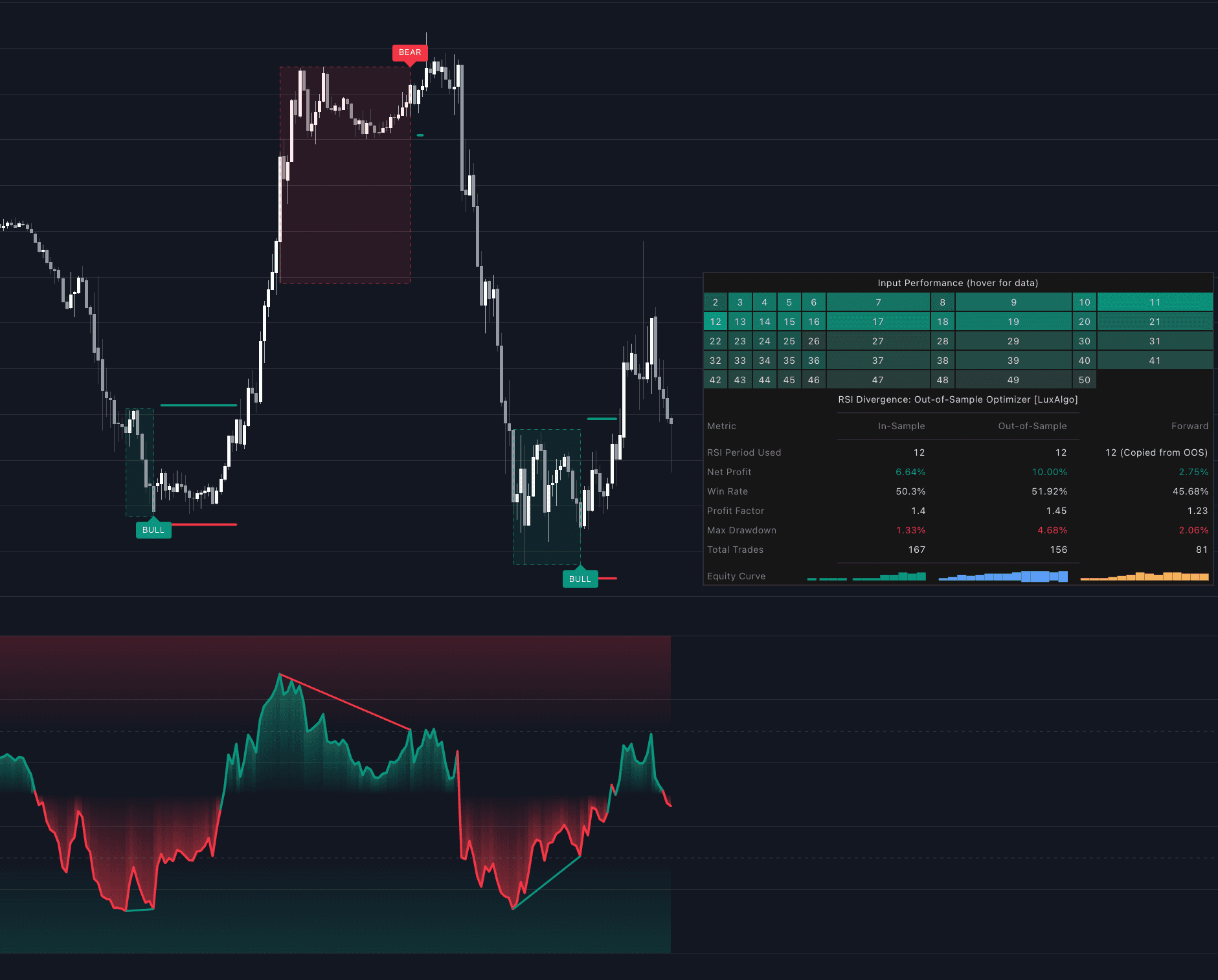
From studying In-sample / Out-of-sample Split to trading it: take the implementation below into Quant and backtest it instantly.
What is an In-sample / Out-of-sample Split?
An in-sample / out-of-sample split partitions historical data into a segment used to build and tune a strategy (in-sample) and a later segment kept untouched until the design is frozen (out-of-sample). The logic is simple: parameters optimized on a stretch of data will always look good on that same stretch, because the optimizer fits noise as readily as signal. Data the strategy has never seen is the cleanest test of whether an edge is real or curve-fit, and the performance drop from in-sample to out-of-sample is a rough gauge of how much of the backtest was overfitting.
The discipline is imported from statistics and machine learning, where holdout validation is the standard defense against overfitting. Trading adopted it as computerized backtesting spread: Robert Pardo's 1992 book on designing, testing, and optimizing trading systems formalized walk-forward analysis, the rolling version of the split, and later work on data-mining bias showed how reliably an edge can be manufactured by testing enough variations on one history.
In trading the split is chronological rather than random: the holdout is typically the most recent block, because shuffling time-series data leaks information across autocorrelated bars, and because the practical question is whether parameters chosen then would have worked next. Machine-learning workflows slice further into train, validation, and test sets; the validation set steers tuning, the test set is scored once at the end, and trading usage often loosely calls the out-of-sample block a validation set.
The holdout has one strict rule: it can only be spent once. Each time its results prompt another round of re-tuning, it quietly becomes in-sample, which is why practitioners ration how often they look and back the split with parameter stability checks and walk-forward variants. Some degradation is expected even in honest work; the question is degree. A Sharpe ratio that merely softens out-of-sample tells a different story from one that halves, and a win rate that collapses toward a coin flip says the in-sample figure was mostly noise.
How to run an in-sample / out-of-sample test
The mechanics matter less than the discipline: decide everything before touching the holdout, and treat it as spendable exactly once.
- 1Split the history chronologically and reserve the most recent block, commonly 20-30%, as the holdout; check it will contain enough closed trades to be worth scoring.
- 2Develop entirely in-sample: choose rules, tune parameters, and iterate as freely as you like, but only on the earlier block.
- 3Freeze the design, writing down every parameter, filter, and discretionary rule before the first pass over the holdout.
- 4Run the frozen system across the out-of-sample block once, recording the same statistics you tracked in-sample.
- 5Compare the two profiles. Modest softening is normal; wholesale collapse is a verdict. Above all, resist re-tuning and re-testing against the same holdout.
How traders use it
- The core backtest workflow: optimize on the in-sample window, freeze every parameter, then run one pass over the out-of-sample block and compare the two performance profiles.
- Walk-forward analysis rolls the split through history, re-optimizing on each window and testing on the next, then stitches the test segments into a single out-of-sample equity curve.
- As an overfitting audit alongside resampling tests: the smaller the degradation from in-sample to out-of-sample, the more of the backtest survives contact with unseen data.
- As a vetting gate before capital: many traders require the holdout to clear absolute thresholds, rejecting any system whose out-of-sample win rate and average payoff no longer cover costs, however good the in-sample equity curve looked.
- As an arbiter of optimizer output: when several parameter sets score similarly in-sample, preference goes to values from broad, stable plateaus, with the holdout testing whether that preference was justified.
In-sample / out-of-sample split vs related concepts
Parameter Stability: A complementary overfitting probe. Stability asks how performance changes as parameters are nudged around the chosen values, all within the same data; the split asks how the chosen values fare on data they have never seen. A strategy can pass one test and fail the other, so careful validation runs both.
Sharpe Ratio: A metric, not a method. The Sharpe ratio, like any performance statistic, is what gets measured; the split decides which measurement deserves belief. An in-sample Sharpe rewards curve-fitting as generously as edge, so the out-of-sample figure, noisy as it is, carries the evidential weight.
Concept family
Performance, Backtesting & Validation
30 concepts mapped · 30 in the Library
In-sample / Out-of-sample Split FAQ
Turn In-sample / Out-of-sample Split into a trading strategy.
Take the implementation from this page into Quant, then build on it, backtest it on real data, and keep refining it in conversation.