Topstep Prop Firm Review 2026

Topstep’s Trading Combine is a paid, simulated futures evaluation with three account tiers: $50,000, $100,000, and $150,000. Passing earns access to an Express Funded Account, which is also simulated. A later Live Funded Account is a distinct stage with different capital, risk, and automation arrangements. The account label is not money deposited for you to withdraw.
This review uses official rules checked September 8, 2026. It compares plan costs, profit targets, loss limits, consistency requirements, trading hours, and payout conditions. Vela and Quant, our coding agent, can help research and test a strategy, but cannot guarantee that it passes Topstep’s evaluation or meets every account rule. Vela is our next-generation charting platform, and it’s free to start.
Topstep Trading Combine Plans at a Glance
| Account tier | Standard monthly fee | No Activation Fee monthly fee | Profit target | Maximum loss allowance | Maximum minis / micros |
|---|---|---|---|---|---|
| $50,000 | $49 | $95 | $3,000 | $2,000 | 5 / 50 |
| $100,000 | $99 | $149 | $6,000 | $3,000 | 10 / 100 |
| $150,000 | $199 | $229 | $9,000 | $4,500 | 15 / 150 |
The pricing guide lists a $149 activation fee for each earned Express Funded Account on the Standard subscription path. The higher monthly subscription removes that activation charge. The Combine parameters count micros and minis at a 10:1 ratio in the Trading Combine and Express Funded Account; that functionality does not apply to the Live Funded Account. Maximum position size is a ceiling, not a recommended trade size.
All three base profit targets equal 6% of the advertised account tier, but the available loss allowance is much smaller than that account label. A $50,000 Combine starts with $2,000 of room above its loss floor. The $100,000 and $150,000 tiers start with $3,000 and $4,500 respectively. Judge the strategy against that room and the way the floor moves.
What Happens at Each Funding Stage?
| Stage | Trading environment | What to understand |
|---|---|---|
| Trading Combine | Simulated evaluation | Meet the profit and consistency objectives without breaching the Maximum Loss Limit; subscription fees continue while participating |
| Express Funded Account (XFA) | Simulated funded account | Starts with a $0 profit balance; its tier describes buying power. Rewards require payout eligibility and rule compliance |
| Live Funded Account (LFA) | Real-market trading with firm capital | Separate risk parameters, reserve arrangements, and execution requirements apply; a simulated-stage setup may not transfer unchanged |
The Maximum Loss Limit guide explains the XFA’s $0 starting balance. For a $50,000 XFA, the loss floor starts at −$2,000 and trails upward until it locks at $0. This differs from a $50,000 Combine that starts at $50,000 with a $48,000 floor. Keep those accounting conventions separate when reviewing screenshots or designing a rule model.
The live account guide describes how eligible XFA balances and tiers determine a live allocation, with part available to trade and part held in reserve. Moving to live closes the XFAs. It is not simply an unrestricted cash transfer equal to the headline tier, and the live account has its own loss and position controls.
1. The $50,000 Combine
The smallest tier has the lowest standard monthly cost: $49, compared with $95 on the No Activation Fee path. Its base target is $3,000, its starting maximum loss allowance is $2,000, and its position ceiling is five minis or 50 micros. It can be the least expensive way to evaluate a defined strategy, but a lower fee does not make the challenge easy or suitable for someone who has not tested their method.
Consider the strategy’s stop distance and contract value before selecting the size. A method that normally takes small positions may not need the maximum five minis. Conversely, a $2,000 allowance can disappear quickly if several positions share the same directional exposure or if losses are allowed to run beyond the tested exit.
The ratio of the $3,000 target to the $2,000 starting allowance is 1.5. That is a comparison of two evaluation parameters, not the strategy’s trade-by-trade reward-to-risk ratio. It does not show the probability of passing, because the loss floor can rise, open losses count, and consistency affects the required profit.
2. The $100,000 Combine
The middle tier costs $99 per month on Standard or $149 per month without an activation fee. It doubles the base target to $6,000 while increasing the starting loss allowance to $3,000. The position ceiling is ten minis or 100 micros. Doubling the account label does not double the loss allowance relative to the $50,000 plan.
This tier can be considered when a tested strategy needs more dollar room under the loss floor and the ongoing fee fits the budget. It should not be selected simply because a trader has spent a particular number of months trading. Review the actual distribution of losing days, adverse movement while positions are open, and how often the method overlaps correlated markets.
The target-to-starting-allowance ratio is 2. Again, this is an evaluation comparison rather than an expected payoff or a trade’s R multiple. A plan with a higher position ceiling does not require using it, and larger trades can erase the additional allowance faster.
3. The $150,000 Combine
The largest tier costs $199 per month on Standard or $229 per month on the No Activation Fee path. It has a $9,000 base target, $4,500 starting loss allowance, and a ceiling of 15 minis or 150 micros. The original $149 monthly price is no longer the standard price for this tier.
Its practical benefit is more absolute room for a suitably sized method, not a different guarantee of success or a special exemption from the evaluation rules. The higher target and recurring fee should be weighed against how long the strategy may need to meet both the profit and consistency objectives.
The $9,000 target divided by the $4,500 allowance is also 2. A trader who does not need the extra permitted size may have little reason to pay for the larger tier. Choose from observed strategy requirements and a defined spending limit, rather than treating the largest plan as a natural reward for experience.
How the Trailing Maximum Loss Limit Works
Topstep’s Maximum Loss Limit (MLL) rises with the highest end-of-day balance, never falls after a losing day, and stops rising when it reaches the account’s starting balance. The floor’s update schedule and its enforcement are different: touching the floor at any point, including through unrealized losses, triggers liquidation.
| $50,000 Combine example | Closing balance | Loss floor for the next session | Remaining room at that close |
|---|---|---|---|
| Start | $50,000 | $48,000 | $2,000 |
| Day 1: gain $500 | $50,500 | $48,500 | $2,000 |
| Day 2: lose $500 | $50,000 | $48,500 | $1,500 |
| Later close at $52,000 | $52,000 | $50,000 | $2,000 |
| Later close at $53,000 | $53,000 | $50,000 | $3,000 |
This example shows closing balances, but the account must remain above the applicable floor throughout the session. A position can breach while open even if a later closing fill leaves the final balance above the threshold. Topstep states that market-order liquidation and slippage can produce a final fill above or below the limit without reversing the breach.
After the first XFA payout, its loss floor is set to $0 regardless of where it was before. The remaining positive balance is the room available above that floor. A payout therefore changes the buffer available for future trading; the amount requested is not separate from account risk.
Topstep’s Official Loss-Limit Explainer
This short Topstep video was published July 12, 2023 and remains linked from its current Maximum Loss Limit help page. Its $100,000 example illustrates how the floor rises with closing gains and does not move back down after losses. Use the current written rules above for account-stage and payout details.
The 50% Consistency Target
The Combine consistency guide checks the best day against total profit. To pass, no single day should account for more than 50% of total profit, and the base profit target must also be met. Topstep recommends staying below $1,500, $3,000, or $4,500 for the best day on the three tiers to avoid increasing the required target.
A large winning day does not automatically close the account. It increases the total profit needed to satisfy consistency. For example, a $2,000 best day on a $50,000 Combine implies at least $4,000 total profit under the 50% calculation, rather than only the $3,000 base target. Losing later does not erase the recorded best day. Avoid aiming at a boundary to the penny; use the dashboard’s current requirement.
Topstep says a Combine can be passed in as few as two days when both objectives are met. That is a possible minimum, not a useful deadline for every strategy. Trying to force a second matching day can create unnecessary exposure under a floor that has already trailed upward.
Daily Loss Limits and Trading Hours
The current daily-loss policy makes the Daily Loss Limit optional in the Combine and XFA, and automatic in the LFA. A fixed checkout limit is $1,000 for the $50,000 tier, $2,000 for $100,000, or $3,000 for $150,000; it cannot be changed later and carries into the XFA. Personal limits added through risk settings have different adjustment and locking behavior.
When the Daily Loss Limit triggers, positions are flattened, pending orders are canceled, and trading is blocked until the next session. It is not itself a rule violation, and the account remains eligible. The Maximum Loss Limit still applies independently: a daily stop is not permission to touch the overall floor.
Topstep is a futures day-trading program. Positions must be closed by 3:10 p.m. Central Time on weekdays, or earlier if the product closes earlier. Trading can generally resume at 5 p.m. Central Time; Friday’s close lasts until Sunday’s reopening. Topstep advises avoiding new positions after 3:08 p.m. as risk managers begin flattening.
This makes the program unsuitable for a strategy that requires holding through the daily close or over the weekend. “Swing trading” in the sense of multi-day positions is not supported. Foreign-exchange futures may be among the permitted products, but that is different from spot forex trading. Check special product and holiday hours rather than assuming every listed futures contract has the same session.
What Payout Eligibility Actually Requires
The current payout policy lists a $125 minimum and a 90/10 split. The first-$10,000-at-100% benefit is a legacy exception for traders who joined the new dashboard before January 12, 2026; it should not be advertised as the default for a new customer.
| XFA payout route | Eligibility basics | Base cap per request: 50K / 100K / 150K |
|---|---|---|
| Standard | Five nonconsecutive days with at least $150 net profit; positive net profit since the last payout, with the first payout exempt from that latter condition | $2,000 / $3,000 / $5,000 |
| Consistency | At least three trading days with a trade each day, and the largest day at no more than 40% of the window’s net profit | $3,000 / $4,000 / $6,000 |
Both routes also limit each request to 50% of the account balance, subject to the applicable dollar cap. After a payout, the day count resets and the loss floor is $0. The Consistency calculation starts a new profit window; a balance left over from an earlier window does not count as newly earned profit. The trading session in which a payout is requested does not count toward the next cycle.
Topstep also advertises a limited-time increase in XFA payout caps for qualifying accounts that add a fixed Daily Loss Limit at checkout. Treat this as a conditional offer, not the base cap for every account. A higher permitted request does not remove the 50%-of-balance condition or other eligibility rules.
Live accounts have different payout rules. Before the daily-payout milestone, five qualifying winning days allow a request of up to 50% of the balance without an XFA-style dollar cap. Thirty qualifying winning days in the LFA unlock daily access to the unlocked balance; XFA winning days do not count toward those 30. A full withdrawal closes the LFA because the balance reaches its loss limit.
The profit split, eligible request amount, and cash received are separate figures. The policy’s example of a $500 ACH request deducts $50 for the split and a $30 processing fee, leaving $420. Method availability, external fees, and approval time vary. Do not assume that meeting the trading criteria guarantees an instant transfer.
Compare the Total Cost, Not Only the Monthly Price
| Cost item | How to evaluate it |
|---|---|
| Combine subscription | Estimate several months under the chosen Standard or No Activation Fee path |
| XFA activation | Standard currently charges $149 per earned XFA; the higher subscription path removes this fee |
| Reset or reactivation | Separate purchases under their own eligibility and pricing; not a recovery of fees already spent |
| Trading fees and data | Commissions are deducted from filled trades and net P&L; data requirements vary by account and service |
| Automation and analysis | API access, charting subscriptions, and compatible software are separate from the evaluation fee |
| Taxes and payout charges | Check the checkout total and the method-specific payout deductions |
For a simple illustration, three monthly payments for a $50,000 Standard Combine plus one $149 XFA activation total $296. Three months on its $95 No Activation Fee path total $285. After only one month, the same comparison is $198 versus $95. These examples assume one passed Combine, no resets, and no other fees; they are not forecasts of how long passing will take. Longer participation changes the comparison.
The pricing page also lists Responsible Trading discounts for qualifying No Activation Fee purchases with a fixed daily limit. Keep conditional discounts separate from base prices. A reset or additional account can extend the money at risk; set a total spending limit before starting.
Account size cannot be changed after purchase. The Combine FAQ says that an unused account purchased within 28 days may be reviewed by support for a refund so the correct size can be purchased. Trading activity or exceeding that window removes that option under the stated policy. Do not plan around a seamless upgrade after proving yourself.
TopstepX and Automated Strategies
The TopstepX guide documents charting, order management, personal risk controls, and a performance dashboard. These are useful operational tools, but a charting integration does not establish that arbitrary Pine code or a third-party bot can execute through the account.
The TopstepX / ProjectX API permits custom bots subject to the trading rules and HFT prohibition. It is billed separately at $29 per month; the guide lists a recurring 50% discount for Topstep traders with code “topstep,” reducing that to $14.50. Topstep does not provide implementation support or endorse third-party API vendors.
Order flow must originate from a personal device. VPS, VPN, and remote-server order transmission, relaying, or automated triggers that reach order endpoints are prohibited. Private servers may support read-only analysis, storage, or research, but cannot transmit orders. This matters for hosted strategies and webhook services.
The live-account policy permits automated strategies but prohibits automated trading through the ProjectX API in the LFA. Confirm a compliant live implementation before assuming a simulated-stage bot can continue unchanged. A strategy’s research logic, its execution software, and permission to use that software are three separate requirements.
Research a Topstep-Compatible Process with LuxAlgo
Vela and Quant, our coding agent, help turn a defined idea into an editable indicator or strategy. Specify the market, timeframe, entry, exit, position sizing, and session close behavior. Review Code and Run and the Inputs and Properties settings rather than assuming a plotted signal already simulates orders.
For example, a pullback method needs an explicit trend filter, entry trigger, stop distance, exit rule, and handling of overlapping positions. Test strategy behavior on standard candles with realistic costs and later data reserved for evaluation. Check individual trades instead of judging only the final equity curve.
Then model the Topstep constraints explicitly. A standard drawdown statistic is not a complete detector for intraday MLL breaches, daily resets, consistency targets, or payout-related balance changes. Account for the 3:10 p.m. Central Time close and use the relevant contract’s value and session. Simulation assumptions must match the intended account and execution environment.
Compare Rule Scenarios in the Prop Firms Portal
The LuxAlgo Prop Firms portal provides firm and challenge comparisons, offers, and Monte Carlo research. Its simulated results depend on entered trading statistics, encoded rules, and stated assumptions. They are not observed pass rates or a promise that a strategy will qualify for funding.
Check the dataset verification date and unsimulated rules before applying a result. The portal’s precomputed rule table displayed January 15, 2026 when reviewed, while several current Topstep policies are newer. Compare the actual rulebook, test less favorable assumptions, and use custom rules where needed. A reproducible model can still be incomplete or outdated for the account being purchased.
Review Actual Results and Rule-Related Events
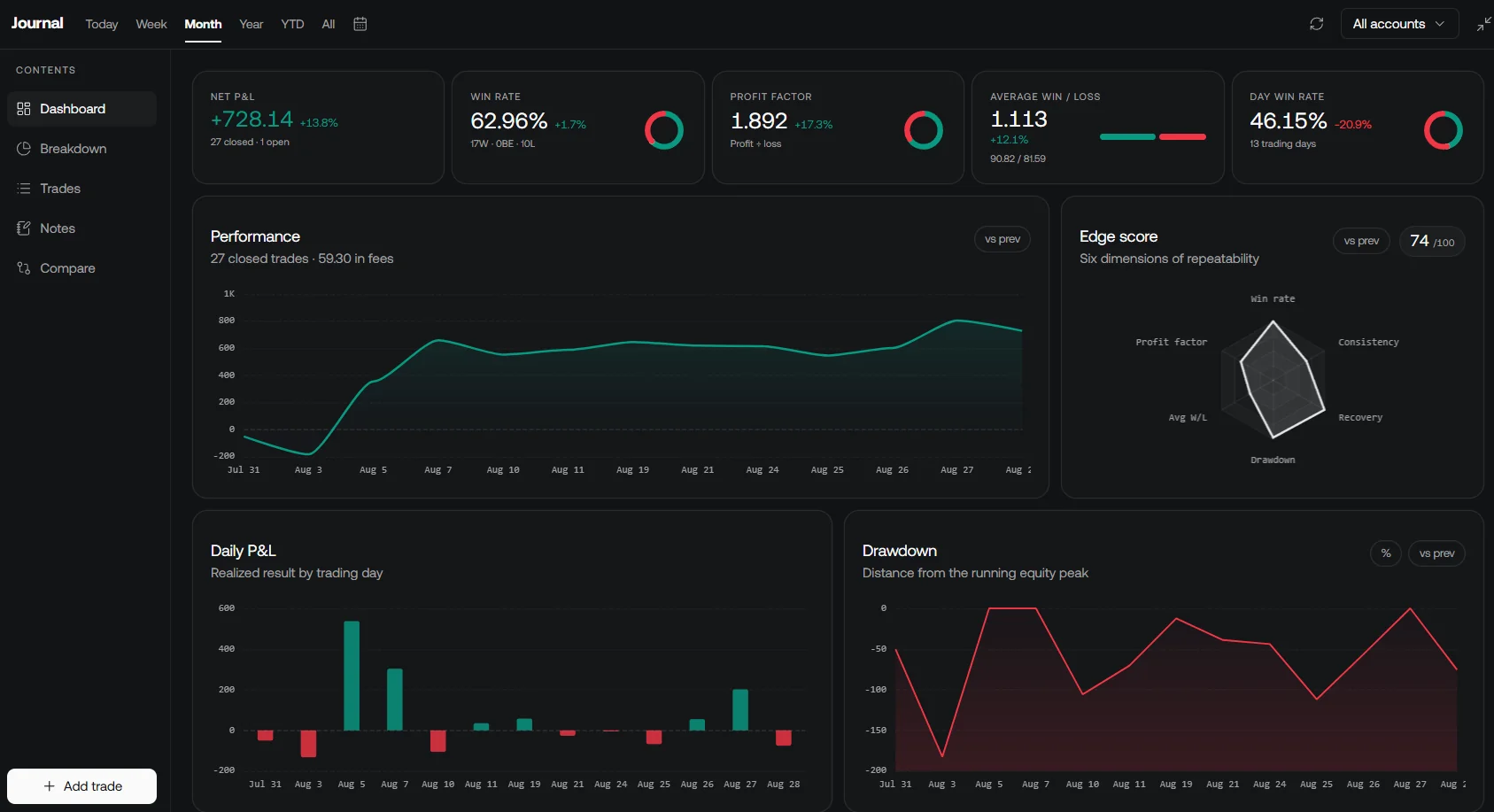
LuxAlgo’s native journal can help review recorded trading results. Record planned versus actual risk, fills, costs, remaining room above the floor, and any departure from the strategy. Keep the Topstep dashboard as the authority for account eligibility and limits; a journal does not certify compliance or establish an automatic connection to Topstep.
Separate Subscription Costs
Alerts and research outputs from LuxAlgo are not automatically approved Topstep order routes.
| LuxAlgo plan | Monthly billing | Annual total | Monthly equivalent billed annually |
|---|---|---|---|
| Free | $0 | $0 | $0 |
| Essential | $39.99 | $299.88 | $24.99 |
| Premium | $67.99 | $479.88 | $39.99 |
| Ultimate | $119.99 | $719.88 | $59.99 |
| AI Ultra | $229.99 | $1,439.88 | $119.99 |
These standard prices exclude temporary promotions. The annual equivalents are not month-to-month prices. Monthly credits are 500, 2,000, 5,000, 25,000, and 100,000 respectively. Budget for the research subscription separately from the Combine, data, and any execution software.
Choosing a Plan: Practical Advantages and Trade-offs
- Potential advantages: clearly specified evaluation tiers, micros for finer position sizing, a simulated stage before live trading, and platform risk controls.
- Costs and constraints: recurring fees, a trailing loss floor enforced on open P&L, consistency requirements, mandatory daily closes, and conditional payouts.
- Choose from evidence: compare the method’s tested position needs, losing-day distribution, session requirements, and total affordable spend with each tier.
- Recheck transitions: XFA payouts and live funding change account behavior. Review the next stage’s rules before relying on the previous stage’s setup.
The smallest tier is not automatically appropriate for every beginner, and the largest is not automatically appropriate for every experienced trader. A useful plan is one whose fee and loss allowance fit a method you understand and can execute within the rules. Educational resources and community feedback can support that process, but testimonials and historical payout totals cannot establish your own likely result.
LuxAlgo can make research and review more structured. The decision to enter or continue an evaluation should still rest on tested assumptions, current account rules, and a spending limit that does not depend on receiving a payout.
FAQs
Can I upgrade a Topstep Combine to a larger account after trading it?
No. Topstep says account size cannot be changed after purchase. An unused account bought within 28 days may be reviewed by support for a refund so a different size can be purchased; trading activity or exceeding that window removes that option under the stated policy.
Is the Maximum Loss Limit checked only at the end of the day?
No. The trailing floor rises with end-of-day balance highs, but a breach can occur at any point, including through unrealized losses. A liquidation fill ending above the floor does not reverse an earlier breach.
Does a profitable LuxAlgo backtest prove I can pass Topstep?
No. A backtest depends on its data and execution assumptions and may not reproduce Topstep’s intraday loss checks, consistency rules, daily close, or payout adjustments. Model those separately and validate the actual execution setup.
Read next