Cash Account Explained: Essential Fundamentals
A cash account is the simplest brokerage account: every purchase is paid for in full with money already in the account, and nothing is borrowed from the broker. That single rule shapes everything else about it, from what you can trade to how quickly you can reuse the proceeds of a sale. This guide covers how a cash account works under Federal Reserve Regulation T, what T+1 settlement means for reusing funds, the violations that can freeze an account for 90 days, what SIPC does and does not protect, and how to plan and review cash-account trades in Quant Charts.
What a Cash Account Is
The SEC describes a cash account as a brokerage account in which the investor must pay the full amount for securities purchased and is not allowed to borrow from the broker. FINRA adds the timing: you are expected to pay for securities by the settlement date, which for most securities, including options, is one business day after you place the order.
The name confuses some investors into thinking the account holds only cash. It does not. A cash account can hold stocks, bonds, mutual funds, exchange-traded funds and other securities alongside cash. FINRA's own example is an account with $5,000 in cash and $10,000 in stock. What the label describes is how purchases are paid for, not what the account contains.
Cash Account vs Margin Account
| Feature | Cash account | Margin account |
|---|---|---|
| Paying for purchases | In full, with funds in the account, by settlement | Part deposit, rest borrowed from the firm |
| Borrowing and interest | None | Loan secured by your securities; interest charged |
| Short selling | Not available | Available; the only account type that permits it |
| Options | Limited; many strategies require margin | Broader range of strategies |
| Largest possible loss | What you paid | Can exceed what you deposited |
| Maintenance requirement and margin calls | None | Equity minimums; forced sales possible |
| Main operating risk | Settlement violations under Regulation T | Margin calls and liquidation |
A margin account has its own rulebook, covered in our margin account guide. The rest of this article stays with the cash account, where the rules revolve around one thing: settled funds.
Settlement and the T+1 Cycle
Settlement is the point at which a trade is final: the buyer's cash and the seller's securities change hands. In February 2023 the SEC adopted rules shortening the standard settlement cycle for most broker-dealer securities transactions from two business days after the trade date (T+2) to one (T+1), with a compliance date of May 28, 2024. FINRA's current guidance reflects that cycle: a purchase in a cash account must be paid for generally one day after the order, and most equity trades settle the next business day.
For a cash-account trader the cycle governs when money can be reused. Sell a stock on Monday and the proceeds settle on Tuesday. Regulation T lets a broker execute a purchase either when there are sufficient settled funds in the account or when the firm accepts, in good faith, your agreement to make full cash payment promptly and not to sell the security before paying for it. Buying against unsettled proceeds therefore relies on that good-faith arrangement, and selling before the payment arrives is where violations begin.
| Day | Action | Settled cash available |
|---|---|---|
| Monday | Sell $5,000 of stock | Proceeds unsettled until Tuesday |
| Tuesday | Sale settles | $5,000 settled and reusable |
| Tuesday | Buy $5,000 of another stock | Purchase must be paid for by Wednesday |
Regulation T Violations and the 90-Day Freeze
Regulation T, the Federal Reserve Board rule that governs credit extended by brokers, includes specific provisions for cash accounts. Two violations come up repeatedly in FINRA's investor guidance:
| Violation | What happened | How to avoid it |
|---|---|---|
| Free-riding | Buying a security and selling it before paying for the purchase | Pay for every purchase with settled funds at the time you buy |
| Good-faith violation | Buying with the proceeds of an unsettled sale, then selling the new position before those proceeds settle | Wait for sale proceeds to settle before they fund a purchase you may sell quickly |
The consequence is written into the regulation. Under 12 CFR 220.8(c), if a security is sold or delivered out of a cash account without having been paid for in full, the privilege of delaying payment beyond the trade date is withdrawn for 90 calendar days from the date of the sale. The SEC glossary puts the practical effect plainly: during those 90 days you may still buy securities, but you must pay for any purchase in full on the trade date. The freeze does not apply if full payment is received within the payment period, or a check clears, and the sale proceeds were not withdrawn first. FINRA notes that firms must comply with Regulation T and can impose restrictions on trading when they determine a violation has occurred.
Avoiding the freeze is a bookkeeping discipline: know the settled cash balance before each order, and treat unsettled proceeds as spoken for until they settle.
What a Cash Account Can and Cannot Do
- Buy and hold securities. Stocks, ETFs, bonds and funds can all be bought and held with settled cash.
- Trade frequently, within limits. Frequent intraday trading is possible in a cash account, but every purchase must be fully paid with settled funds, and rapid round trips against unsettled money create the violations above. FINRA's intraday margin framework and its minimum equity rules apply to margin accounts, not to cash accounts.
- No short selling. FINRA states that a margin account is the only type in which investors can sell short.
- Limited options. Many options strategies require a margin account; what a cash account can hold is set by the broker's approval levels.
- No leverage, no interest, no margin calls. The loss on a position cannot exceed what was paid for it, and no lender can force a sale to protect a loan.
Fully Paid Securities and Custody
Once a purchase is paid for, the securities are "fully paid securities," and FINRA explains that the brokerage firm must promptly obtain and then maintain possession or control of them. The firm must hold them physically or in a good control location free of liens, may not use them to deliver on a short sale by the firm or another customer, and may not lend them to third parties. The exception is a fully paid lending agreement: if you sign one, the firm may borrow your shares, and the possession-or-control protection no longer applies to the borrowed securities. Investors who want the protection should terminate any such agreement.
Uninvested cash is a separate question. Many firms sweep excess cash into a bank deposit or money market fund; the interest paid and the insurance that applies depend on the arrangement, so FINRA suggests asking the firm what the choices are.
What SIPC Protects
The Securities Investor Protection Corporation protects cash and securities held at a financially troubled SIPC-member brokerage firm, up to a limit of $500,000 per customer, which includes a $250,000 limit for cash. The protection covers the custody function only: SIPC works to return the securities and cash that were in the account when the firm's liquidation began. It does not protect against a decline in the value of securities, against being sold worthless securities, or against losses from bad investment advice, and it is not the same as FDIC insurance on a bank deposit.
Where Quant Charts Fits
LuxAlgo does not hold cash, settle trades or place orders, and it does not know your broker's settled balance. What Quant Charts adds is a way to plan trades to the size a cash account can actually fund, test a rule with no leverage assumed, and review the results against your own cash constraints.
Size to settled cash, and to risk. In a cash account the hard ceiling on any position is the settled cash available, a notional cap in the terms of the Library's sizing bases entry. That cap says nothing about how much you lose if the stop is hit, so pair it with a risk rule: fixed fractional sizing works back from a chosen fraction of the account and the stop distance to a share count, and the position is the smaller of the two. With no margin to lean on, the difference between the two numbers is also the cash that stays settled for the next trade.
Backtest with no leverage. Describe a rule to Quant, our coding agent, in plain language, for example a long entry on a close above the 50-day average with an exit on a close below it. Quant writes the Pine Script; open Code to inspect it, then click Run. In the strategy's Properties, set the initial capital to the cash you would commit, keep order size within that capital, set commission and slippage to realistic values, and leave the margin setting at no leverage so the simulation cannot hold more than a cash account could. The Backtest Summary then reports net profit, trade count, win rate, max drawdown and profit factor for a strategy that a cash account could have run.
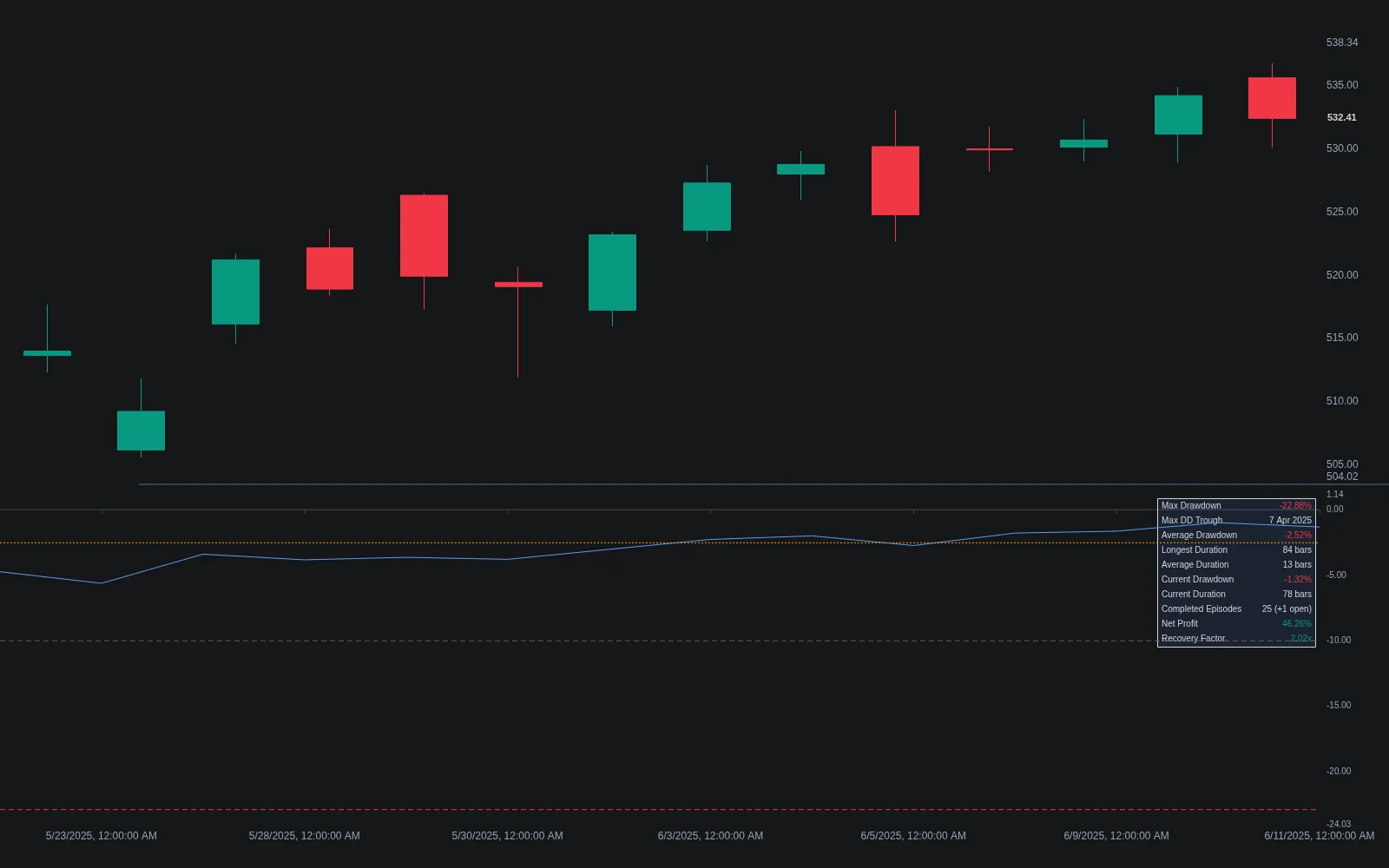
Read the drawdown in cash terms. A cash account cannot borrow through a losing streak, so the strategy's max drawdown is money that would have been unavailable for other trades. The drawdown statistics concept and the Drawdown Statistics indicator report depth, duration and recovery, and expectancy puts win rate and payoff ratio into a single per-trade figure. Together they answer whether the rule's edge survives the cash it ties up.
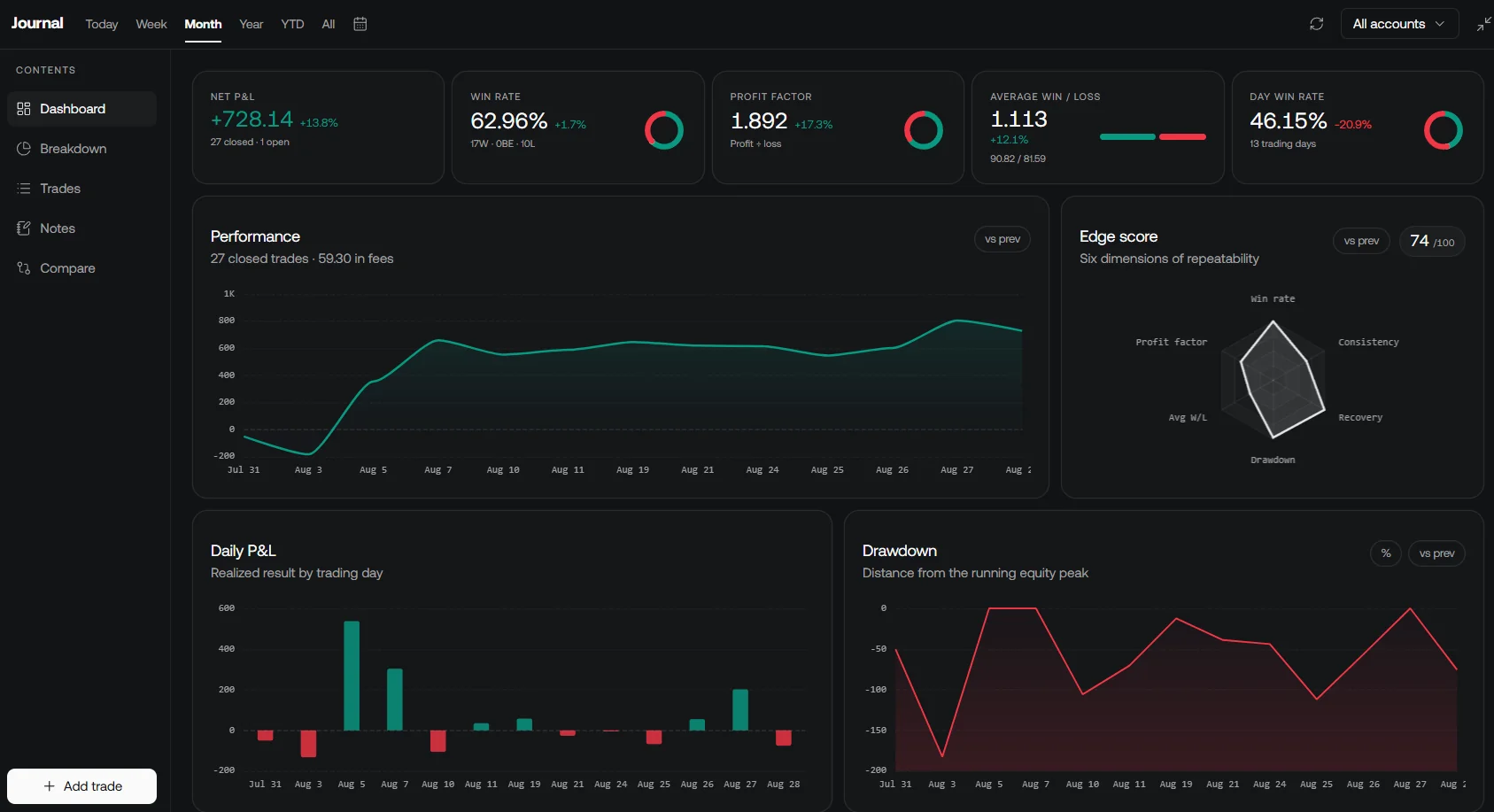
Journal against a starting balance. The Quant Charts Journal accepts a manual account with a starting balance, so the dashboard can show drawdown as a percentage of the cash you started with, alongside net P&L, win rate, profit factor and average win versus loss. Logging fills with the settled-cash balance in the note makes settlement-driven mistakes visible in review.
The video below shows how an indicator such as Drawdown Statistics is added to a chart in Quant Charts.
Where Each Tool Stops
- The broker holds the cash and securities, tracks settled versus unsettled funds, applies Regulation T and decides when a violation restricts the account.
- Quant Charts charts exchange-listed US equities, ETFs and crypto, runs Quant strategies with capital, order size, commission, slippage and leverage settings, and keeps a journal. It does not see your settled balance or place orders.
- The Library explains sizing bases, fixed fractional sizing, drawdown statistics and expectancy, and provides indicators that implement the measurable ones.
- SIPC protects custody of assets at a failed member firm, up to its limits, and nothing about investment outcomes.
Conclusion
A cash account trades what you have, when it has settled. Under Regulation T a purchase must be paid in full by the T+1 settlement date, free-riding and good-faith violations arise from spending proceeds before they settle, and a security sold before it was paid for can trigger a 90-day restriction to settled cash. In exchange there is no loan, no interest, no margin call, and the broker must keep fully paid securities in its possession or control. SIPC covers the custody of those assets up to $500,000, not their value. Quant Charts helps with the part you control: sizing positions to settled cash and to risk, backtesting rules with no leverage, and journaling results against the balance you started with.
Key Takeaways
- A cash account requires full payment by settlement, generally one business day after the order, and permits no borrowing.
- The SEC's standard settlement cycle has been T+1 since May 28, 2024, so sale proceeds settle the next business day.
- Free-riding and good-faith violations come from buying and selling against unsettled funds; Regulation T's 90-day freeze requires full payment on the trade date.
- No short selling, limited options, no leverage: the largest loss is the amount paid, and there are no margin calls.
- Fully paid securities must stay in the broker's possession or control unless you sign a lending agreement; SIPC covers custody up to $500,000 including $250,000 in cash.
- Quant Charts, the Library and the Journal support sizing, unleveraged backtesting and review; the broker's settled balance remains the binding constraint.
FAQs
What is a cash account?
A brokerage account in which you pay the full purchase price of securities with funds in the account, generally by the settlement date one business day after the order, and cannot borrow from the broker. It can hold stocks, bonds, funds and cash.
When can I reuse the money from a sale?
When the sale settles. Under the SEC's T+1 cycle, in force since May 28, 2024, most securities trades settle one business day after the trade date, so proceeds from a Monday sale are settled cash on Tuesday.
What is a good-faith violation?
Buying a security with the proceeds of a sale that has not yet settled and then selling that security before those proceeds settle. FINRA describes it, along with free-riding, as a Regulation T problem that can lead to account restrictions.
What is the 90-day freeze?
Under 12 CFR 220.8(c), if a security is sold from a cash account before it has been paid for in full, the privilege of delaying payment beyond the trade date is withdrawn for 90 calendar days, so during that period any purchase must be paid for in full on the trade date.
Does SIPC protect my cash account from losses?
SIPC protects the cash and securities held at a failed SIPC-member brokerage firm, up to $500,000 including $250,000 for cash. It does not protect against declines in the value of investments, worthless securities or bad advice.
How can Quant Charts help with a cash account?
It lets you size positions to settled cash and to risk using Library sizing concepts, backtest a rule through Quant with capital, commission, slippage and no leverage set in Properties, and journal results against a starting balance. It does not hold funds, track settlement or place orders.
References
LuxAlgo Resources
- Sizing Bases, Fixed Fractional and Expectancy (LuxAlgo Library)
- Drawdown Statistics concept and indicator (LuxAlgo Library)
- Making strategies with Quant and Reading a strategy backtest (LuxAlgo Docs)
- Quant Charts Journal and Journal dashboard (LuxAlgo Docs)
- Margin Account 101: Key Concepts (LuxAlgo Blog)
External Resources
- FINRA: Brokerage Accounts (Cash Accounts section)
- FINRA: Frequent Intraday Trading, Understanding the Basics
- SEC Investor.gov: Types of Brokerage Accounts
- SEC Investor.gov Glossary: Cash Account
- SEC Press Release 2023-29: Rules Shortening the Settlement Cycle to T+1
- 12 CFR 220.8: Regulation T, Cash Account (Cornell LII)
- SIPC: What SIPC Protects
Read next