Circuit Breakers: How Halts Protect Investors

Circuit breakers pause trading under defined market-stress conditions. They give market participants time to assess information and organize reopening orders, but they do not guarantee that prices will recover or that investors can exit at their intended price.
For U.S. equities, distinguish market-wide circuit breakers from the Limit Up–Limit Down (LULD) system for individual securities. News, regulatory, and operational halts are separate again. Knowing which mechanism applies helps you interpret the pause, check your orders, and avoid treating a frozen chart as a stable market.
- Market-wide thresholds use declines of 7%, 13%, and 20% in the S&P 500 from the previous close.
- LULD uses security-specific price bands and can address moves in either direction.
- The stated pause duration is not a promise that every security will reopen at that exact time.
- Stops, limit orders, and alerts have different functions; none removes halt and reopening risk.
Circuit Breaker Mechanics
Market-Wide Stop Points
Investor.gov describes three U.S. market-wide thresholds. Each compares the S&P 500 with its previous trading day’s closing value, not with the current day’s high or the level at the previous reopening.
| Level | Decline from previous close | Regular-session response |
|---|---|---|
| 1 | 7% | Halt of at least 15 minutes if triggered before 3:25 p.m. ET. |
| 2 | 13% | Halt of at least 15 minutes if triggered before 3:25 p.m. ET. |
| 3 | 20% | Trading stops for the rest of the day. |
At or after 3:25 p.m. ET, a Level 1 or Level 2 decline does not trigger that market-wide halt. Each of those levels can trigger only once in a trading day. Individual securities can still be halted for other reasons; “only Level 3 applies late in the day” is not a rule covering every type of halt.
The NYSE’s February 2026 circuit-breaker FAQ explains that reopening auctions may take longer than the minimum 15-minute interval. Follow the exchange’s actual resumption notice rather than a countdown alone. Check the applicable schedule on shortened trading days.
Correctly Calculate the Index Levels
Assume a hypothetical S&P 500 previous close of 6,000. The following values separate the point decline from the resulting index level:
| Level | Point decline | Resulting index value |
|---|---|---|
| 1: 7% | 6,000 × 0.07 = 420 | 6,000 − 420 = 5,580 |
| 2: 13% | 6,000 × 0.13 = 780 | 6,000 − 780 = 5,220 |
| 3: 20% | 6,000 × 0.20 = 1,200 | 6,000 − 1,200 = 4,800 |
A 7% decline from 6,000 is 420 points, leaving the index at 5,580. It is not a 5,580-point loss. These values illustrate the arithmetic; actual daily thresholds change with the official prior close.
Individual-Stock Controls: LULD
The official LULD overview describes bands around a reference based on eligible transactions over the preceding five minutes. Tier 1 includes S&P 500 and Russell 1000 securities and selected exchange-traded products; Tier 2 covers other eligible NMS securities. Rights and warrants are excluded.
| Category by previous closing price | Normal band | Final 25 minutes of regular session |
|---|---|---|
| Tier 1 above $3 | ±5% | ±10% |
| Tier 2 above $3 | ±10% | ±10% |
| Both tiers: $0.75 through $3 | ±20% | ±40% |
| Both tiers: below $0.75 | Smaller distance of $0.15 or 75% | Double the normal distance |
The regular-session framework covers 9:30 a.m.–4:00 p.m. ET. Bands prevent executions outside permitted prices. An unresolved limit state lasting 15 seconds generally leads to a five-minute trading pause, subject to extension and reopening rules. It is not simply “a trade outside the band for 15 seconds.”
For a hypothetical Tier 1 security above $3 with a $100 reference price, a 5% parameter gives $95 and $105 bands. A Tier 2 security above $3 uses $90 and $110 at the same reference. Its band does not automatically double late in the session. The reference can change; these are not permanent levels for the day.
Use the disseminated bands and official halt status for the actual security. A chart’s five-minute moving average need not reproduce the plan’s eligible-trade calculation, rounding, updates, and opening conditions. Consult the current plan and tier lists for instrument-specific details.
Do Not Confuse Different Halt Types
A market-wide decline halt, an individual-security LULD pause, a news-pending halt, and an operational interruption have different triggers and reopening procedures. Do not infer the reason from the absence of new candles alone; the feed might also be delayed or disconnected.
Use official exchange notices, such as the Nasdaq trading-halts page, and your broker’s status information. Read the halt reason and resumption fields. A pause in U.S. cash equities is not a universal rule for all futures, foreign exchanges, or cryptocurrency venues.
Effects of Circuit Breakers
What the Pause Is Designed to Accomplish
A coordinated pause gives participants time to process information and prepare orders for an orderly reopening. It can replace an uncoordinated rush to stop trading across venues with a known procedure. It does not establish fair value, remove uncertainty, or prevent every liquidity problem.
The U.S. framework developed after the 1987 crash, with market-wide rules introduced in 1988 and revised over time. The NYSE filing published by the SEC reviews the October 27, 1997 halts under earlier Dow-based rules and the four Level 1 halts on March 9, 12, 16, and 18, 2020. Those episodes did not all use today’s design.
In March 2020, a pause did not necessarily end the day’s selling. The filing records further declines after reopening. That is a reason to assess a halt as a market-process intervention rather than a price floor or a signal to buy.
Limitations and the “Magnet Effect”
A known threshold can influence behavior before it is reached. Investors worried about losing access to trading may accelerate their orders. Research by Hui Chen, Anton Petukhov, and Jiang Wang models how this “magnet effect” can increase pressure and volatility near a circuit breaker. It is a mechanism whose effects depend on market design, not proof that every halt makes markets worse.
The same paper discusses China’s short-lived January 2016 system, with 5% and 7% thresholds and activations on January 4 and 7. Its suspension illustrates why threshold design and surrounding market rules matter. It does not establish that one country’s thresholds are automatically best for another.
| Practical limitation | What it means for a position |
|---|---|
| Trading interruption | You may be unable to exit while the security is halted. |
| Reopening gap | The next executable price may differ sharply from the last trade. |
| Uncertain timing | An auction or pause extension can delay continuous trading. |
| Order-handling differences | Some orders may be retained, rejected, canceled, or accepted for an auction. |
| False reassurance | A circuit breaker does not cap an investor’s loss at the trigger percentage. |
Managing Trades During Halts
Before a Halt: Size for Execution Risk
Plan for the possibility that an intended exit cannot execute promptly. Review total exposure, leverage, correlated holdings, overnight risk, and the liquidity of the instrument. A “small percentage of capital” allocation is different from a loss budget and does not by itself establish a safe position size.
Consider a hypothetical purchase of 100 shares at $50 with an intended stop at $48. The planned price loss is $200. If trading halts and the eventual exit is $42, the price loss is $800 before costs. A system pause has not limited the trade to its original $200 plan.
Investor.gov’s order guide explains the difference: a stop-market trigger does not guarantee the stop price, while a stop-limit order may remain unfilled. A buy limit controls the maximum purchase price; a sell limit controls the minimum sale price, but neither guarantees a transaction.
Price and volatility alerts can help you notice conditions. They cannot guarantee advance warning of a halt, execute through a pause, or verify that a broker received an order. Decide how you will check official notices and contact your broker if access fails.
During a Halt: Verify Positions and Orders
- Confirm the security, venue, halt reason, and official status.
- Check the broker’s actual positions and order states.
- Read how the relevant order types will be handled during the pause and auction.
- Confirm cancellation or amendment acknowledgements before submitting replacements.
- Reassess the intended trade using the new information and plausible reopening prices.
The NYSE FAQ distinguishes primary-listed securities from those traded on an unlisted-trading-privileges basis, with different treatment for incoming and resting orders. Do not assume “all orders are canceled” or “all orders wait unchanged.” Repeated clicks while a response is delayed can also create duplicate instructions.
After a Halt: Reassess the Reopening
Wait for the actual resumption and distinguish an auction print from subsequent continuous trading. Recheck spreads, executable quotes, size, and whether your orders participated. A large reopening volume bar may include an auction and does not demonstrate that conditions are now stable.
A limit order can help express an acceptable price, but a missed fill is possible. Do not chase a reopening solely because the chart resumed. Compare the current price with the original entry rationale, invalidation, and risk budget.
Using LuxAlgo to Review Conditions
Inspect Price and Participation in Context
Use LuxAlgo charts to compare pre-halt levels with the reopening and subsequent price action. Mark reference levels and the time of the official event. Keep the symbol, session, and feed consistent when comparing periods.
Orderflow tools can help examine executed participation. A volume profile shows traded volume by price; market depth concerns resting quoted orders. Neither establishes who traded or proves institutional intent. Historical volume at a level is not a promise that liquidity will be available there after a halt.
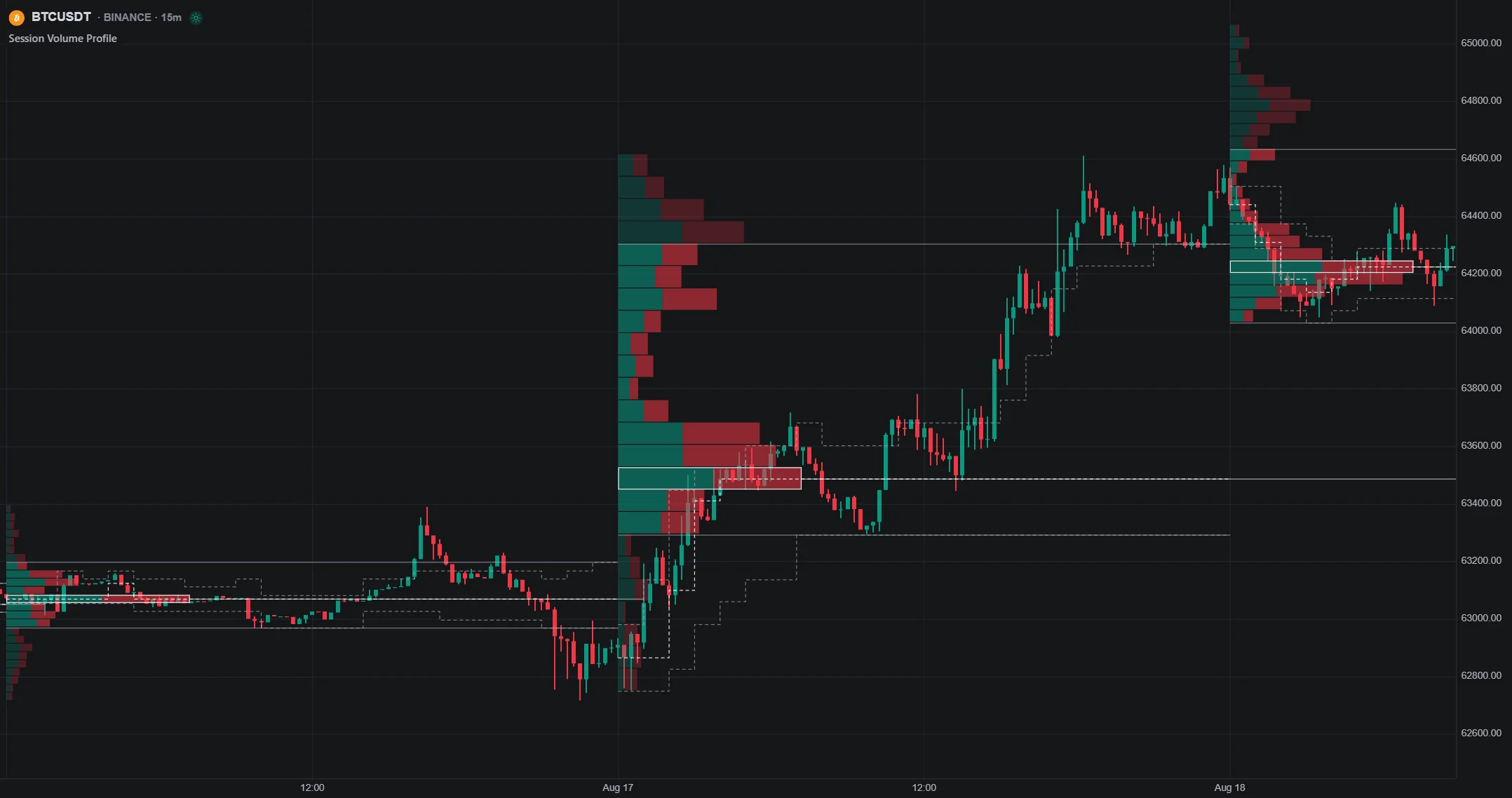
Check LuxAlgo’s data coverage before interpreting a chart. Venue-specific U.S. equities volume is not consolidated market volume, and the chart is not the authoritative source for a halt or LULD band. The Library can supply support, resistance, and volume concepts, but those references do not override exchange status.
Test Execution Assumptions with Quant
Quant, our coding agent, can help make a strategy’s behavior around gaps and interrupted trading explicit. Describe the rule, intended orders, and what should happen if no execution is possible. Follow the strategy review-and-run workflow and inspect simulated trades individually.
A useful research prompt is: “Review this strategy for impossible fills during a trading pause. Explain how missing bars, the next available price, stop orders, and the reopening auction are represented. Show which parts require data beyond ordinary OHLCV.”
Without reliable halt events and suitable execution data, a chart backtest cannot fully validate auction participation or the order queue. Label those limits. Compare an adverse reopening scenario with the original stop assumption instead of assuming the software enforces exchange rules automatically.
Record the official cause, intended orders, actual executions, and decisions in LuxAlgo’s Journal. Reviewing that sequence helps distinguish a strategy problem from an execution assumption or an operational mistake.
Why Do Stocks Halt?
This VANT TRADING explainer introduces individual-stock halts and LULD. Use the current official rules linked above for timing, price bands, and reopening procedures; the tutorial is background education rather than a live halt-status source.
Summary and Guidelines
Circuit breakers protect the trading process by imposing defined pauses. They do not protect every position from loss. Know the mechanism, calculate thresholds correctly, verify official status, and understand how your orders will be treated.
- Use the previous S&P 500 close for market-wide thresholds.
- Use actual LULD bands and the security’s tier for individual-stock pauses.
- Allow for extensions, reopening gaps, and unfilled orders.
- Use market-analysis tools for context and broker records for execution verification.
- Review the result without assuming that a halt guarantees either stability or a reversal.
References
- Investor.gov: market-wide circuit breakers
- NYSE: Market-Wide Circuit Breakers FAQ, February 2026
- LULD Operating Committee: plan overview and bands
- NYSE filing published by the SEC: historical design and March 2020 review
- Chen, Petukhov, and Wang: The Dark Side of Circuit Breakers
- Investor.gov: order types
Read next