Deploying Your Algo: Cloud vs. Local
Choose cloud, local or hybrid deployment by the workload, the connection to your broker and your ability to operate it reliably. Cloud infrastructure can make capacity easier to obtain; local hardware can give you direct control. Neither choice automatically provides lower trading latency, lower total cost or uninterrupted execution.
First separate research from live execution. A historical backtest can often be restarted after a failure. A process that submits orders must also know which orders were accepted, which positions remain open and whether another process is acting on the same account. Those are different operational requirements.
Cloud, Local and Hybrid at a Glance
| Factor | Cloud infrastructure | Local hardware | Hybrid arrangement |
|---|---|---|---|
| Capacity | Resources can be provisioned subject to availability, quotas and setup | Bounded by installed hardware until upgraded | Place each workload where its requirements fit |
| Latency | Depends on region, network path and service design | Depends on location, network path and hardware | Measure the connections between components |
| Cost | Usage, storage, network and operations charges | Purchase, power, connectivity, maintenance and operations | Includes both environments and their integration |
| Security | Responsibilities are shared with the provider | You manage the machine and its protections | Policies and access must remain consistent |
| Recovery | Requires a designed and tested recovery process | Requires backups, replacement and connectivity plans | Must avoid duplicate live order submission |
A cloud virtual machine, a managed trading platform and a browser-based research tool are not interchangeable services. A provider may operate the underlying computer while leaving you responsible for the operating system, trading application and broker connection. Read the responsibility boundary before assuming maintenance is included.
Desktop Algo Trading Platform vs Cloud
This retained AlgoCloud video, published April 16, 2024, presents a platform vendor’s comparison of desktop and cloud approaches. It covers subjects such as a virtual private server, monitoring and flexibility. Treat product claims as the vendor’s historical perspective, rather than an independent performance benchmark or a description of LuxAlgo.
Start with the Workload
Write down what the system must do before choosing hardware. A daily calculation on a few symbols differs from a large parameter search, a tick-data archive or a live order process. A workload does not require a GPU simply because it is called algorithmic trading. Measure CPU, memory, storage and network demands using representative data.
- Research: historical data processing, experiments and reproducible results.
- Live decisions: timely market data, strategy state and exposure checks.
- Order handling: broker requests, acknowledgments, rejections, cancellations and fills.
- Operations: monitoring, credentials, backups, recovery and human intervention.
Specify the market hours, acceptable delay and consequences of missing a calculation. Include peak load, not just an average quiet period. Also confirm the broker or platform’s supported operating systems, session behavior and connection limits before designing around a particular machine.
What Cloud Infrastructure Can Help With
Cloud resources can be useful when research demand varies, when a process needs to run independently of a personal laptop or when a chosen location improves the measured connection to a service. Provisioning additional research workers can reduce a batch job’s elapsed time if the work can be divided efficiently.
Scaling still takes planning. Instances may need to start, load data, initialize the application and establish authorized connections. Quotas and capacity availability can limit provisioning. A live strategy that holds state cannot safely be multiplied like independent research jobs without deciding how work and order authority are divided.
Two machines running the same strategy against the same account can submit duplicate orders. If using a standby, define which process is permitted to act, how that authority changes and how the replacement reconciles broker state. More machines do not automatically create a safer trading system.
Shared Security Responsibilities
AWS’s shared responsibility model distinguishes provider infrastructure from customer responsibilities. For a guest operating system, those responsibilities include updates, application software and security-group configuration. The exact division changes with the services selected.
Protect broker credentials, limit access to what each component needs and avoid placing secrets in logs or source files. Define who patches the application and who receives alerts. Cloud hosting does not establish that a strategy, account or data use meets every applicable requirement.
Interruptible Capacity Needs a Suitable Job
AWS documents that Spot Instances can be interrupted when capacity is reclaimed, among other reasons. Depending on configuration, the instance can stop, hibernate or terminate. A discount therefore needs to be evaluated alongside the interruption behavior.
A restartable research job with saved progress can be a better fit for interruptible capacity than an unprotected live order process. Decide what happens to unfinished work and external actions before choosing the lower price. The ability to relaunch a machine does not undo an order already accepted by a broker.
What Local Hardware Can Help With
A local computer can make development and inspection straightforward, especially when suitable hardware is already available. You control the installed environment and can keep selected research files on the machine. That control also leaves power, connectivity, updates and physical recovery in your hands.
Local does not mean co-located. A computer at home may be far from the broker or trading venue. Owning its processor removes neither the internet path nor the broker’s processing time. Specialized equipment near a venue is a different arrangement from a desktop on residential broadband.
Size the machine from the measured workload. Data growth depends on instruments, granularity, retention and format; it is not universally 50–100 GB a day. Check free disk space, backup capacity and restore time. A reproducible environment can make replacement easier, but packaging software does not itself provide failover or protect order state.
Consider whether research should share a live machine. A large data job, reboot or software change can interfere with the process that needs predictable resources. If separating them, document the boundary and how a tested strategy version moves into the execution environment.
Measure the Full Trading Path
A fast message-processing benchmark measures only the work included in that benchmark. It cannot be relabeled as a complete order-execution time. Likewise, low latency between two cloud machines says little about an unrelated broker connection.
| Measurement | What to record | What it does not prove |
|---|---|---|
| Market-data arrival | Arrival delay, missing updates and timestamps | That the feed covers every venue or arrives first |
| Strategy calculation | Processing time under representative peak load | That the broker accepts the resulting order quickly |
| Order acknowledgment | Elapsed time from request to broker response | That the order has filled |
| Fill and reconciliation | Actual fill information and account-state updates | That every order will fill at the same speed or price |
| Recovery | Detection, restart and reconciliation time | That a machine restart restores correct trading state |
Compare like with like: the same broker endpoint, market-data source, instrument set and application version. Record typical delays and the slow end of the distribution, along with errors and reconnects. Averages alone can hide the difficult periods that matter to a strategy.
Use synchronized clocks when comparing timestamps from different machines, and distinguish locally measured durations from timestamps supplied by an external system. Test during relevant busy periods. A general “cloud versus local” microsecond figure is not a substitute for these measurements.
Availability Is More Than a Running Server
A machine can be reachable while its data feed is stale, its credentials have expired or its order handler is stuck. Monitor the behavior needed for the strategy, including the age of the latest data, rejected requests, unexpected positions and whether the operator can intervene.
The Amazon Compute SLA illustrates why scope matters. It distinguishes a qualifying deployment across multiple Availability Zones from an individual instance and defines eligibility for service credits. Its infrastructure availability terms are not a guarantee that a trading application will keep working or that trading losses will be reimbursed.
For planning arithmetic, 99.95% of a 30-day month leaves 21.6 minutes outside that percentage: 30 × 24 × 60 × 0.0005. That calculation is not a prediction of one evenly distributed outage, a universal cloud commitment or proof that the system can tolerate an interruption. The timing and failure mode matter.
Test Recovery Before Depending on It
- Stop the application and confirm that monitoring notices the failure.
- Disconnect a dependency and check how the system handles stale or missing data.
- Restart with an outstanding order and reconcile its actual broker status.
- Verify that a standby cannot create a second active order writer.
- Restore a backup into a separate environment and confirm it is usable.
- Practice disabling new orders and reviewing existing exposure through the broker.
A timeout after submitting an order is ambiguous: the broker may have accepted it even though the response did not reach the application. Use the broker’s documented identifiers and status facilities to determine what happened before resubmitting. A generic retry loop can otherwise turn a communication problem into duplicate exposure.
Compare Total Cost with Consistent Assumptions
Build a budget for the same workload and recovery standard on both sides. Cloud bills can include compute, persistent storage, backups, data transfer, network services, monitoring and support. Local costs can include hardware, replacement, electricity, internet, backup storage and the time spent operating the system. Data and software licenses may apply to either choice.
Do not compare the rental price of one GPU configuration with the purchase price of a different machine and call the difference a saving. Include the useful capacity, hours required, location, software and service level. Obtain current quotes for the actual configuration once those requirements are clear.
| Illustrative item | Assumption | Calculated amount |
|---|---|---|
| Cloud compute only | $0.10 per hour for 720 hours | $72 for a 30-day month |
| Local purchase allocation | $1,800 spread over 36 months | $50 per month as a budgeting allocation |
| Local electricity only | Average 100 watts for 720 hours at $0.20 per kWh | $14.40 for the month |
| Other expenses | Storage, backups, connectivity, licenses and operations | Add measured usage or relevant quotes |
These numbers demonstrate arithmetic, not market prices or complete budgets. The local purchase still requires its upfront payment; spreading it over months does not change cash timing. The cloud figure excludes every charge except the assumed compute rate. Neither column establishes which option is cheaper for your workload.
Include peak usage and idle resources. Schedule restartable research when needed, track spending by project and review storage retention. Reserved or committed capacity should be considered against expected usage and its terms, rather than assumed to be a saving in every case.
Use a Hybrid Setup Only When the Boundary Helps
One possible arrangement is local research with a separate hosted execution process. Another uses cloud resources for large experiments while keeping selected development tasks local. The useful boundary depends on the workload; hybrid does not automatically combine only the advantages of both.
Keep strategy versions, dependencies, data assumptions and configuration aligned across environments. A change that passes on one machine can behave differently with another library version, timezone, dataset or broker setting. Record what was tested and what was deployed so a failure can be investigated.
Also plan for the connection between environments. A local control screen losing connectivity must not leave the operator assuming that the remote process stopped. Make the execution status visible and provide an independent way to inspect the account and stop new activity when required.
Research the Strategy in LuxAlgo Before Choosing Execution Infrastructure
Begin with a precise chart-strategy question in Vela, our next-generation charting platform. Define the market, timeframe, entry and exit conditions before spending effort on deployment. This research workflow is separate from building and operating a broker-connected order service.
Ask Quant, our coding agent to help express a supported strategy hypothesis. Inspect the generated code and run it manually. Review strategy settings, costs and individual trades, then compare a period that was not used to choose the rule. A favorable backtest does not demonstrate reliable live deployment.
Check native data coverage when comparing results with another environment. The documented US-equity source is Cboe EDGX rather than a consolidated all-venue feed. Different feeds, sessions and execution assumptions can produce different results even when the rule appears similar.
Review Research Outcomes and Actual Execution Separately
If a strategy is later implemented in a separately supported execution environment, compare actual fills and decisions with the research assumptions. Start with the relevant platform’s testing facilities and verify its limitations. Simulated trading can help find integration errors, but it does not reproduce every live fill or failure condition.
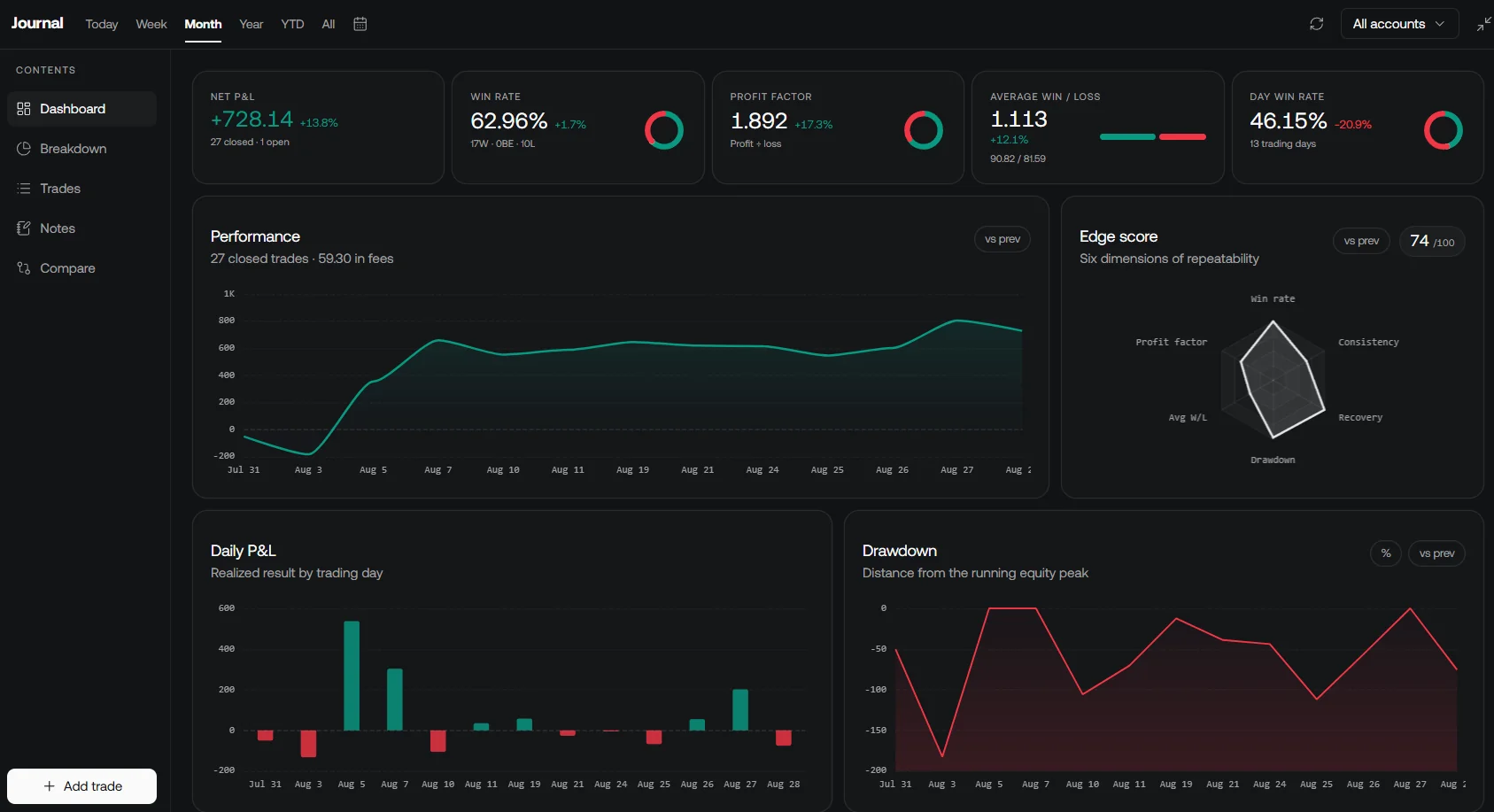
Use the native journal to review imported trade records alongside broker statements. Investigate differences between planned and actual execution. A journal is a review tool, not a substitute for the live system’s exposure controls or broker-state reconciliation.
The best deployment choice is the one you can justify with measurements and operate through failure. Choose the workload boundary first, compare complete costs, test recovery and keep research success separate from execution readiness.
Frequently Asked Questions
Is local deployment always faster than cloud deployment?
No. End-to-end delay depends on location, network path, application behavior and the broker or venue connection. A home computer is different from specialized equipment located near a venue.
Does cloud hosting handle all security and maintenance?
No. Responsibilities depend on the service. For a cloud virtual machine, the customer can remain responsible for guest operating-system patches, applications, access and configuration.
Are Spot Instances suitable for every trading workload?
No. They can be interrupted. Restartable research can be a suitable use case, while a live order process requires explicit handling of interruption, state and recovery.
How should cloud and local costs be compared?
Use the same workload and recovery requirements. Include compute or hardware, storage, power, connectivity, licenses, backups and operations. An hourly rate or purchase price alone is not total cost.
Does a strategy tested with LuxAlgo automatically become a live trading service?
No. Native charts and Quant support strategy research. Inspect generated code and run it manually. Broker-connected execution is a separate workflow with its own supported integrations, controls and recovery requirements.
Read next