How AI Agents Are Revolutionizing Trading: Advanced Backtesting & Strategy Optimization for Maximum Profit
AI can shorten the path from a trading question to a documented hypothesis and testable code. It cannot establish a profitable strategy merely by producing a persuasive explanation. Useful results still depend on accurate data, explicit trading rules, realistic costs and evaluation on observations that did not guide the strategy’s design.
“Maximum profit” is not a result an AI agent can promise. A better objective is to make research reproducible and judge returns alongside drawdown, exposure and execution assumptions. Faster experimentation helps only when each experiment answers a clear question.
Research Agents, Reasoning Models and Backtests Do Different Jobs
A research agent gathers and synthesizes information using tools. A reasoning model can help work through a problem or generate code. A backtesting engine applies specified rules to historical data under an execution model. These capabilities can work together, but a cited report is not a backtest, and a backtest is not a filled broker order.
The distinction matters when comparing OpenAI deep research with DeepSeek. Deep research describes a research capability and workflow, while DeepSeek develops model families. Comparing them as two research divisions with directly comparable budgets obscures what a trader would actually use.
OpenAI Deep Research: Sources and Synthesis
OpenAI’s deep research documentation describes models optimized for finding, analyzing and synthesizing sources into reports. The documented workflow can use web search, file search and connected data sources; code-based analysis is also available in supported configurations. Access to a private dataset requires an appropriate connection or supplied data, rather than being automatic.
For strategy research, this can help collect exchange specifications, compare published explanations of a method or identify assumptions worth testing. Check the underlying citations and their dates. A report’s references do not prove that its interpretation is correct, and browsing information for a report is different from training a new model on that information.

DeepSeek: Distinguish V3 from R1
The DeepSeek-V3 repository describes a mixture-of-experts language model and efficiency techniques used in its training. The DeepSeek-R1 repository separately documents reasoning models built on DeepSeek-V3-Base. Its R1-Zero experiment used reinforcement learning without preliminary supervised fine-tuning, while R1 added cold-start data and a broader training pipeline. Those are historical model-specific descriptions, not claims about every DeepSeek release.
Published math and coding benchmarks can inform model evaluation, but they do not measure a trading strategy’s future profitability. Downloadable weights also do not make a complete research or trading system free to operate: deployment, data, tools and human review still have costs. Check the license and capabilities of the exact model or service being considered.
What the $5.576 Million Figure Actually Covers
The DeepSeek-V3 technical report reports 2.788 million H800 GPU hours for its official training and calculates $5.576 million using an assumed rental rate of $2 per GPU hour. It explicitly excludes prior research and ablation experiments. This is a scoped estimate for V3 training, not DeepSeek’s total company budget or the total cost of developing R1.
That figure cannot support a direct “millions versus billions” comparison with an unspecified OpenAI investment figure. Training, research, hardware ownership and serving costs cover different activities. For a trader, the more useful comparison is whether a particular tool produces accurate, reproducible work at an acceptable operating cost.
| Capability | Useful output | What it does not establish |
|---|---|---|
| Research agent | A source-linked explanation and documented assumptions | That a trading rule earns positive net returns |
| Reasoning or coding model | A candidate specification, calculation or implementation | That the code is correct or uses only information available at the time |
| Backtesting engine | Historical trades and metrics under stated assumptions | That future prices or broker fills will match the simulation |
| Broker execution system | Order acknowledgements and actual fills | That a strategy has a durable advantage |
Turn a Trade Idea into an Explicit Specification
“Buy strong trends” leaves too much interpretation to the model. Specify the instrument, data source, interval, session, direction, entry event, exit rules and position size. Also define whether decisions occur during a candle or after its close, when orders become eligible, and how missing data or conflicting exit conditions are handled.
For example, a research specification might use a completed 15-minute candle crossing above a 20-bar moving average, with the previous close at or below its corresponding average. An entry is eligible only afterward under the chosen fill model. A rule based on that closing signal cannot assume an entry at an earlier price within the same candle. The settings are a test hypothesis, not a recommendation.
- State the question: test whether a particular filter changes the baseline’s net outcomes, rather than asking the model to find the most profitable settings without constraints.
- Fix the data convention: identify the symbol, provider, timezone, session and candle construction; check corporate actions or contract rolls where relevant.
- Define risk and execution: specify size, stops, targets, commissions, spread, slippage and any financing assumptions.
- Keep the experiment reproducible: retain the specification, code version, parameters, date range and results, including unsuccessful variants.
Build and Review the Strategy in LuxAlgo
In LuxAlgo’s native platform, ask Quant, our coding agent to express the supported strategy rules in code. Inspect the generated code and run it manually. Check that the implementation matches the intended signals, sizing and exits; request clarification when the rule cannot be represented accurately.
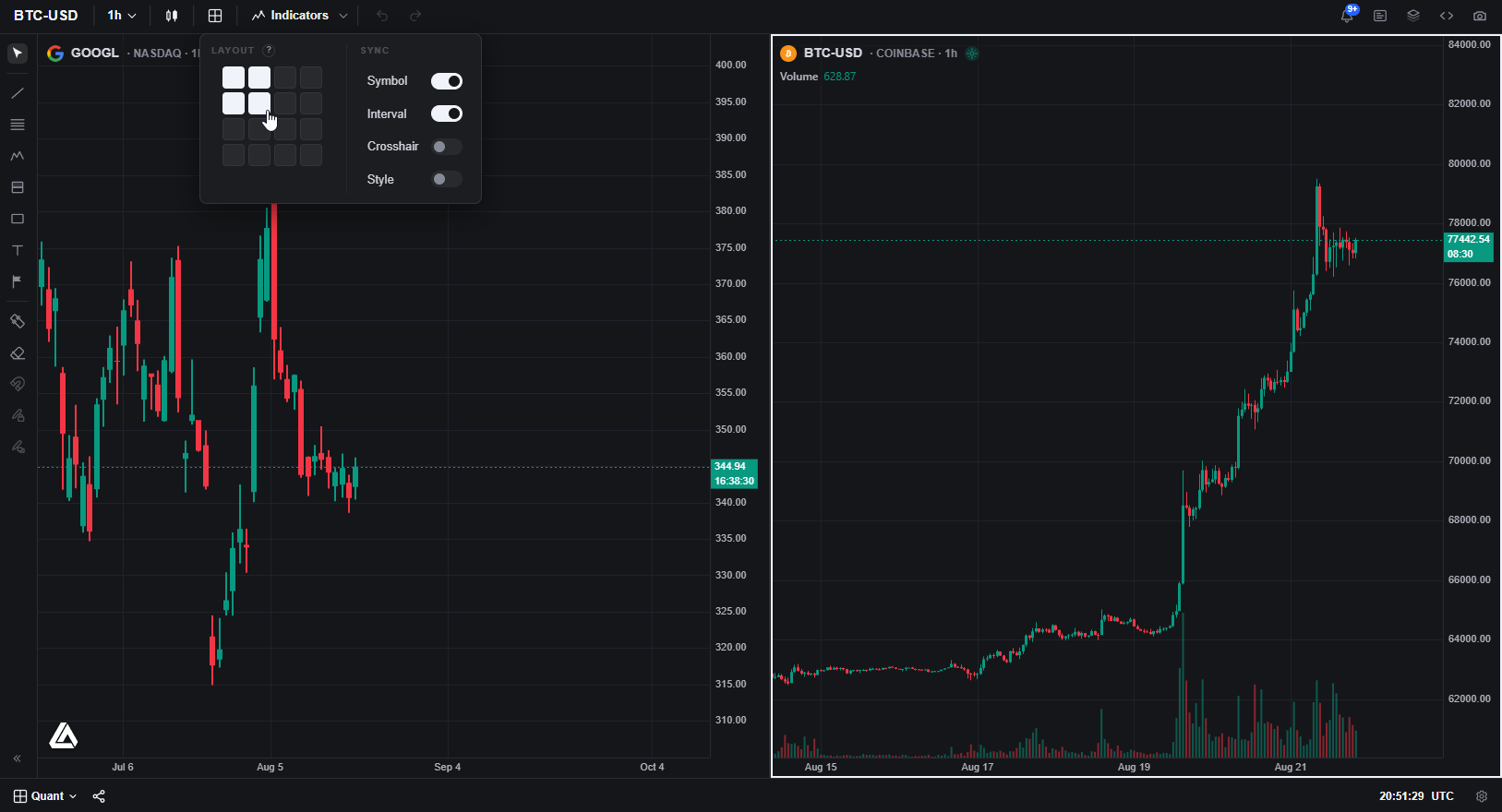
Use the strategy settings and individual trade results to inspect what actually happened in the simulation. Review sample trades against the chart, including entries near session boundaries and candles where both stop and target could be touched. If the available data cannot determine the order of intrabar events, the engine’s assumptions affect the result.
A compiled script is only the beginning of validation. Confirm that inputs are applied as intended, costs are included once and later information is not used to make earlier decisions. If a requested market, data field or execution behavior is unsupported, record that limitation instead of silently substituting a different test.
The TradingView toolkits and legacy Backtesting Assistant are separate workflows. Identify which tool a tutorial describes before applying its instructions. A generated strategy, indicator or alert is not itself an executed broker trade; actual execution requires a suitable system and confirmed order handling.
Optimize Without Mistaking Selection for Evidence
Optimization chooses parameters against a defined objective. Trying many combinations and reporting only the winner can make a weak idea look convincing. AI can accelerate this selection process, so keep a record of how many variants were examined and why the final candidate was chosen.
Separate chronological development data from later evaluation data. Use development data to form and adjust the rules, then evaluate the fixed candidate on the later segment. If you repeatedly inspect that segment and change the strategy in response, it has become part of development. A new untouched period is needed for a fresh test.
A walk-forward design repeats this sequence through time: fit or select using an earlier window, evaluate on the next window, then advance the windows under predetermined rules. Combine the evaluation segments rather than presenting the fitted segments as independent evidence. Respect warm-up needs and overlapping trades at boundaries; a split alone does not remove every source of leakage.
| Check | Question to answer | Reason |
|---|---|---|
| Costs | Does the result include realistic commissions, spread and slippage? | A small gross advantage may disappear after execution costs |
| Trade timing | Was every input available when the decision was made? | Future information can make a historical test misleading |
| Parameter stability | Do nearby settings and later periods behave similarly? | A narrow optimum can reflect selection noise |
| Risk and sample | How large are drawdowns, exposure and the trade sample? | High return or win rate alone can hide fragile outcomes |
| Operational fit | Can the intended orders be handled under actual account constraints? | Simulation rules and executable orders can differ |
For a simple cost illustration, suppose 100 completed trades produce $500 gross profit and each has $6 in total round-trip costs. Net profit is $500 − $600 = −$100, before any additional unmodeled costs. Do not subtract those charges again if the reported profit already includes them. This is an arithmetic example, not a LuxAlgo backtest result.
Review net returns together with maximum drawdown, average win and loss, trade count and exposure. A high win rate can coexist with losses if losing trades are large. Small samples and clustered outcomes can make estimates unstable; no single metric or minimum trade count proves that a strategy will remain profitable.
Use AI to Make the Process More Accountable
Ask for a concise record of assumptions, source citations and test settings rather than treating a fluent explanation as proof. Independently inspect key calculations and representative trades. Keep a baseline and change one meaningful element at a time so the effect can be traced.
The practical benefit is faster, clearer iteration: research a question, specify the rule, inspect the code, run the test and evaluate the evidence. Whether the starting point is a research agent, a reasoning model or an idea of your own, the standard for a trading claim remains the same: reproducible results under realistic assumptions, with uncertainty made explicit.
Frequently Asked Questions
Can an AI agent guarantee maximum trading profit?
No. An agent can assist research and implementation, but future returns depend on uncertain markets, costs and execution. Historical optimization does not guarantee future performance.
Is OpenAI deep research directly comparable to DeepSeek?
Not as a single like-for-like product comparison. Deep research is a research capability and workflow, while DeepSeek develops model families. Compare the exact task, model, tools and operating costs.
Did DeepSeek develop everything for about six million dollars?
The DeepSeek-V3 report estimates $5.576 million for its official training using an assumed GPU rental rate, excluding prior research and ablation experiments. It is not a total company or R1 development budget.
Does generated trading code count as a verified strategy?
No. Inspect the implementation, run it manually, check individual trades and costs, and evaluate fixed rules on later data that did not guide development.
How does LuxAlgo fit into AI-assisted strategy research?
Use Quant, our coding agent, to express supported rules, then inspect the generated code and run it manually in the native platform. Review strategy settings and trades; distinguish that workflow from TradingView tools and the legacy Backtesting Assistant.
Read next