Lessons from Algo Trading Failures

Algo-trading failures reveal three different risks: defective software, execution that overwhelms liquidity, and strategies with hidden shared exposures. Knight Capital’s 2012 incident, the May 2010 Flash Crash and the August 2007 quant meltdown illustrate why a profitable backtest is only one part of a reliable trading process.
The practical lessons are to verify deployed code, limit orders and aggregate exposure, test adverse conditions, and give a responsible person enough information to intervene. These controls can reduce avoidable failures; they do not guarantee that losses or market disruptions will never occur.
| Event | Failure mechanism to study | Practical lesson |
|---|---|---|
| Knight Capital, 2012 | Defective code, deployment errors and inadequate controls | Verify releases and prevent unintended order accumulation |
| Flash Crash, 2010 | Selling pressure, vanishing liquidity and feedback across markets | Test depth and execution behavior, not trading volume alone |
| Quant meltdown, 2007 | Portfolio deleveraging and shared liquidity needs | Stress overlapping exposures and simultaneous exits |
Knight Capital: A Deployment Failure Became an Exposure Crisis
The SEC’s October 2013 account of Knight Capital’s August 1, 2012 incident reports a loss of more than $460 million. That is the later regulatory finding used here, rather than the $440 million figure often repeated in earlier summaries.
The SEC described defective functionality left in an automated equity router and an incorrect deployment that triggered it. The router failed to recognize when affected orders had been filled. In the first 45 minutes after the market opened, it sent more than four million orders while attempting to fill 212 customer orders, traded more than 397 million shares and accumulated unwanted positions.
The SEC also reported 97 automated emails identifying an error before the market opened. They were not designed as system alerts, and the opportunity to identify the problem was missed. Recording an error is not equivalent to an effective alert with an owner and a response procedure.
Lesson: test the deployed system and its controls, not only the strategy formula. A release check should verify the intended version and configuration on every active instance. Order and exposure limits should remain effective when the strategy or router behaves incorrectly.
- Record the approved release, dependencies and configuration before deployment.
- Verify each active instance rather than assuming a deployment command reached every server.
- Test duplicate prevention, filled-order recognition and maximum exposure.
- Define a rollback or shutdown procedure that accounts for existing orders and positions.
- Assign actionable alerts to someone who can investigate and intervene.
The Flash Crash: Liquidity Can Disappear While Trading Remains Active
On May 6, 2010, U.S. markets experienced an abrupt decline and rebound. In an October 13, 2010 SEC staff speech Gregg Berman described the joint SEC–CFTC investigation and the liquidity crisis in E-mini futures and equities. His remarks were his own staff perspective, not a statement of the Commission’s views.
The account described a large trader selling 75,000 E-mini contracts and a severe deterioration in buy-side depth. It also explained that participants withdrew liquidity because of rapid price changes, position and risk limits, and uncertainty about the information they were seeing. This was a market-feedback problem, not simply evidence that every automated strategy was defective.
Lesson: traded volume is not the same as available liquidity for the next order. A volume-based execution rule can behave poorly when turnover is high but meaningful buying interest is disappearing. Test spread, depth, participation, price movement and unfilled exposure together.
A historical replay should use data appropriate to the question. Daily bars cannot reconstruct intraday order-book conditions or every fill. Label proxies and simplified fill assumptions, and avoid treating a later price recovery as proof that an affected trader could exit without loss.
The 2007 Quant Meltdown: Different Portfolios Can Share the Same Exit
The quant meltdown concerned losses among quantitative long/short equity funds during the week of August 6, 2007. It should not be explained by unrelated market-share statistics about high-frequency trading in later years.
In their 2011 study, “What Happened to the Quants in August 2007? Evidence from Factors and Transactions Data,” Amir Khandani and Andrew Lo found evidence consistent with portfolio deleveraging and a temporary withdrawal of market-making risk capital. Their simulated portfolios and transaction analysis support an interpretation of shared exposure and liquidity pressure; they do not identify a single universal cause for every fund’s loss.
Lesson: apparent diversification can weaken when many portfolios must unwind similar positions at the same time. Review factor exposures, financing, leverage and the liquidity required to reduce positions. Several strategies with different labels may depend on the same price relationships and funding conditions.
Stress the portfolio jointly. Combine a market move with wider spreads, reduced executable size and correlated exits. Testing each strategy independently can miss the capital and liquidity demands created when they all lose together.
Test Strategy Logic, Execution and Operations Separately
A historical backtest evaluates rules under a model. It does not establish that a release was deployed correctly, that an order was accepted or that a restart reconstructs positions. Use separate checks for calculations, the simulated ledger, broker integration and the deployed process.
FINRA Regulatory Notice 15-09 discusses supervision and control practices for algorithmic trading at member firms, including development, testing, validation and change management. Its regulatory scope is those firms; it is a useful reference for engineering controls rather than a retail compliance certificate.
| Test | Question it answers | Important limitation |
|---|---|---|
| Out-of-sample evaluation | Does the fixed strategy hold up on later untouched data? | Repeated revisions after viewing the period remove its independence |
| Walk-forward process | How does a predefined sequential selection process behave? | It does not automatically adapt safely to every regime |
| Monte Carlo or resampling | How do outcomes vary under the chosen random process? | A model cannot reveal risks its assumptions exclude |
| Parameter and cost sensitivity | Does behavior depend on a narrow setting or cheap execution? | Selecting the best result from many trials adds selection bias |
| Integration and fault testing | What happens after rejects, timeouts, partial fills or restarts? | Paper fills and test environments differ from live execution |
Keep the strategy version, data, costs, parameters and test results together. Use coherent adverse scenarios instead of arbitrary noise that creates invalid prices or destroys every relevant relationship. A passing test provides evidence about its covered behavior, not every possible failure.
Set Limits That Work When the Algorithm Does Not
Define maximum order size, aggregate exposure, concurrent orders and acceptable data age. Include overlapping strategies and pending orders when calculating exposure. A strategy that checks only its filled positions can still accumulate excessive working orders.
Consider a hypothetical timeout: the system submits a 100-share order, receives no response and immediately submits another. If both were accepted, the intended 100-share position can become 200 shares. Before retrying an uncertain submission, reconcile it using a stable client identifier and the broker’s order state.
A loss threshold needs a specific action. It may stop new orders, request cancellations or trigger a managed exit. Those actions have different risks. Stopping the process does not automatically cancel broker orders, and requesting a market exit does not guarantee a particular price.
The Investor.gov order-types guide explains that stop prices are not guaranteed execution prices. Stop-limit orders can remain unfilled. Volatility-based sizing or exit distances may alter the distribution of losses, but they do not turn a planned loss budget into a maximum possible loss.
Distinguish local stop-new-orders controls from exchange circuit breakers and trading halts. Verify the applicable broker and venue behavior for the actual instrument. A halt can leave exposure in place while preventing an immediate exit.
Make Human Oversight Actionable
Monitoring needs to answer what changed, how much exposure exists and who must respond. Alert on meaningful conditions such as an unknown position, a stale feed, repeated rejects or divergence between intended and confirmed fills. An inbox full of undifferentiated messages is not an incident-response plan.
- Name an owner and escalation path for each material alert.
- Display broker-confirmed positions and open orders alongside local state.
- Define when to stop new activity and how remaining exposure will be managed.
- Practice the response in a test environment, including a failed recovery attempt.
- Preserve logs and release details before investigating the root cause.
Separate operational intervention from impulsive strategy changes. A detected system fault can justify a predetermined shutdown response; an ordinary losing trade is not automatically evidence that the strategy should be retuned. Record why an intervention occurred and verify the resulting state.
Protect Data Quality Without Erasing Real Events
Validate schema, timestamps, symbols, adjustment conventions, missing observations and duplicate records. Keep the raw source alongside transformed data so a suspicious result can be investigated. Cross-source comparisons are useful only when the feeds represent comparable instruments, sessions and market coverage.
Do not remove every extreme observation because it looks unusual. A large move may be a real event that the strategy must handle, a corporate-action adjustment or a vendor error. Investigate its provenance and document the treatment instead of adopting a blanket rule either to “clean everything” or “never clean data.”
Use only information available at the decision time. The scikit-learn guidance on data leakage explains why preparation and feature selection must not learn from test observations. Revised data, future-filled gaps or later-known constituents can make a historical model appear stronger than it was.
Data supplied by a reputable platform still needs checks against the intended use. A vendor’s validation does not establish that its resolution, delay, adjustments or coverage match a particular execution or stress-testing requirement.
Use LuxAlgo for Inspectable Strategy Research
Begin with LuxAlgo’s native charts and documented data coverage. Keep the instrument, data source and timeframe consistent when investigating a hypothesis. Charts support research; they do not by themselves verify a broker connection or production deployment.
Ask Quant, our coding agent to implement a precise strategy specification. Inspect the generated code and run it yourself. Review signal timing, sizing, costs and warm-up before interpreting the result.
Example prompt: “Build an inspectable version of this strategy with explicit entry, exit, sizing and cost assumptions. Explain timing and warm-up, flag missing requirements, and keep the code available for me to review and run. Identify which deployment and broker-failure tests need a separate environment.”
Use native strategy testing on standard candles with realistic assumptions and later evaluation data. Preserve the baseline. An attractive equity curve does not show whether an order router handles retries, a release reached every instance or a broker position was reconciled.
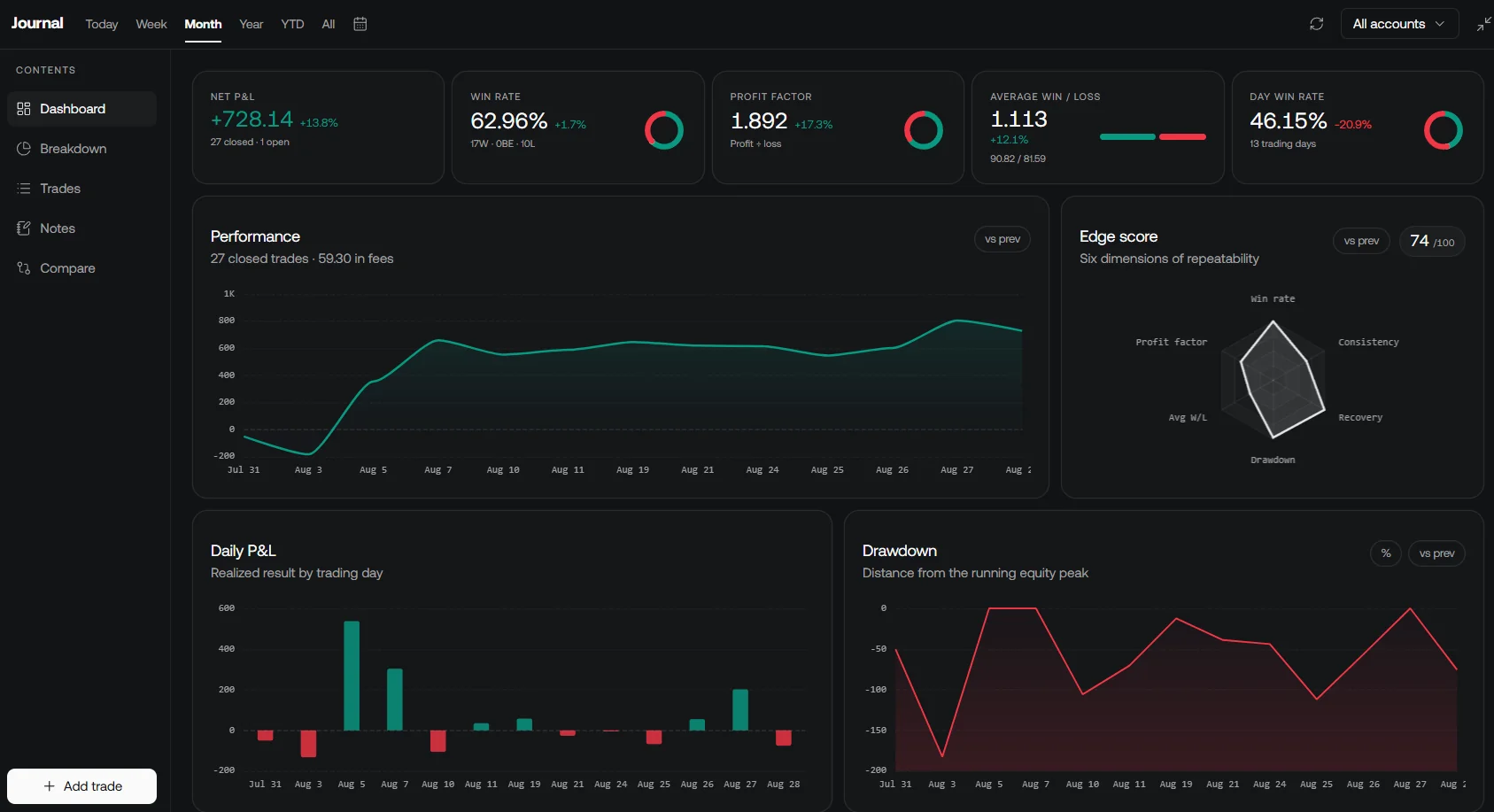
Review compatible recorded trades in the native journal and compare them with intended signals and execution logs. Keep simulated outcomes distinguishable from actual recorded fills and investigate discrepancies.
Quant backtests and strategy alerts are research and notification tools. They are not substitutes for independent execution controls and a verified incident-response process.
Historical Video: The May 2010 Flash Crash
The original video uploaded by Matias Araya on November 2, 2011 presents audio described by the uploader as coming from the S&P futures pit during the May 6, 2010 Flash Crash. It conveys the pace of the disruption. Treat it as historical context; use the regulatory and research sources above for causal claims.
A Repeatable Review Before the Next Release
Turn the lessons into evidence that can be checked: an approved version, reproducible test results, documented limits, a verified order-state model and a practiced recovery procedure. Assign responsibility for remaining weaknesses and repeat affected tests after code, data, sizing or broker changes.
New automation and machine-learning tools still require input validation, monitoring and human accountability. Avoid judging reliability from broad adoption statistics or unsupported claims about how often market crashes occur. Judge the system by the behavior its controls actually cover and the risks that remain.
Frequently Asked Questions
How much did Knight Capital lose in its 2012 incident?
The SEC’s October 2013 account reports more than $460 million. It describes defective router functionality, an incorrect deployment and inadequate controls.
Was the 2007 quant meltdown simply a software bug?
No. Research examined losses among quantitative long/short equity portfolios and found evidence consistent with deleveraging and withdrawal of liquidity. Shared exposures and funding pressures are central lessons.
Does a profitable backtest prove a system is ready for live trading?
No. It does not verify deployment, order handling, broker state or recovery. Those require separate testing and controls.
Should a timed-out order be submitted again immediately?
Not without reconciling its state. The broker may have accepted it even though the response was lost, so an immediate retry can create a duplicate.
Does stopping an algorithm close its positions?
Not necessarily. Broker orders and positions may remain active. Define and verify the cancellation and exposure-management procedure separately.
Read next