Position Sizing: How Much is Too Much?

A position is too large when its plausible loss, capital requirements, or combined portfolio exposure exceed the limits you chose before the trade. The number of shares alone cannot answer that question. Entry price, stop distance, contract value, liquidity, and other open positions all matter.
Position sizing determines how much to trade; it does not turn a weak strategy into a profitable one. Use a defined risk budget, calculate the quantity, and test how that rule behaves through losing periods. LuxAlgo’s native charts, Quant, and Journal support that planning-and-review workflow.
Position Size Calculation Methods
Account Size and Risk Limits
Start with current account equity and a chosen risk allowance. For example, 2% of a hypothetical $25,000 account is $500. This is an illustration, not a percentage that is suitable for every trader. A series of losses, correlated positions, or potential gaps may require a smaller allowance.
Distinguish money committed from planned loss at a stop. Buying $500 worth of an asset is not the same as planning to lose $500 if a stop is reached. Margin posted is another separate amount; it does not define the position’s possible loss.
Basic Position Size Math
For a simple long stock trade with a stop below entry, the starting calculation is:
- Risk budget: equity × chosen risk fraction.
- Price risk per share: entry price − stop price.
- Quantity: risk budget ÷ price risk per share, rounded down to a permitted increment.
Consider a hypothetical $160 entry, $140 stop, and $500 budget. The distance is $20 per share, so $500 ÷ $20 = 25 shares before costs. Those shares cost $4,000, while the planned loss at $140 is $500. The distinction is central to position sizing.
Include fees and an allowance for execution differences before finalizing size. If fixed costs are $4 and the modeled loss plus variable costs is $20.20 per share, floor(($500 − $4) ÷ $20.20) gives 24 whole shares. Also check available capital and instrument-specific quantity limits. CME’s position-sizing guide connects the risk allowance with stop distance.
Stop-Loss Placement
Choose a stop that expresses the trade’s invalidation rule, then calculate size. With the same budget, a wider stop requires fewer shares and a tighter stop permits more. Choosing an artificially tight stop merely to buy more can expose the position to ordinary price fluctuations.
The same basic idea applies to a simple spot-crypto example: a $50 entry and $45 stop create $5 of price risk per unit; $500 ÷ $5 = 100 units before costs. Derivatives, leverage, currency conversion, and contract specifications require additional calculations.
A stop price is not a guaranteed fill. Gaps or liquidity problems can make losses larger, while a stop-limit can remain unfilled. Review the SEC’s stop-order guidance and the rules of the venue handling the trade.
Risk Management Limits
Risks of Large Positions
Larger positions magnify both gains and losses. A 50% account loss requires a 100% gain on the remaining balance to recover, before any withdrawals or additional costs. Sizing should therefore consider survival through a difficult sequence, not just the next trade.
Comfort matters too, but anxiety is not a precise risk calculator. Use it as a reason to review exposure and the ability to follow the plan. A position can exceed a sound budget even if you feel confident about it.
Position Sizing Red Flags
- Increasing size to recover a loss: a desire to get back to even is not evidence of a better opportunity.
- Raising size after a short winning streak: several wins do not establish that the underlying probability improved.
- Ignoring the full position: additions and pending orders may use more risk than the first entry suggests.
- Using leverage as the budget: the amount a platform permits can be much larger than the exposure your plan supports.
- Ignoring costs and gaps: stop-based arithmetic is a planning estimate, not a ceiling on possible loss.
Consistent Position Rules
Document the equity basis, risk fraction, stop method, rounding, and maximum exposure. Keep a record of intended and actual quantities. Change the rule through a review process rather than in response to the pressure of an open trade.
For scale-ins, recalculate combined risk across all entries and remaining exits. The scaling-in/out guide shows why a percentage of shares is not automatically the same percentage of risk.
How to Calculate Position Sizing & Risk Per Trade
UKspreadbetting explains the basic sizing process. Apply the contract, cost, and execution assumptions appropriate to the instrument you trade.
Risk-Reward and Position Sizing
Risk-Reward Calculations
Reward potential helps evaluate an idea, but a larger target does not by itself permit a larger position under an unchanged risk budget and stop distance.
For an illustrative EUR/USD long entry at 1.09414, stop at 1.08760, and target at 1.11396, the price distances are 0.00654 and 0.01982. Using the conventional 0.0001 pip, these are 65.4 pips of risk and 198.2 pips of reward, or approximately 1:3.03 risk-to-reward, before costs.
Quantity still depends on the money lost per pip for the chosen size and account currency. Moving the target farther away leaves the loss per pip unchanged. It may also lower the chance of reaching that target. Compare realized expectancy and win rate instead of sizing from the attractiveness of a target alone.
Adjusting for Market Conditions
ATR measures variability in price units. If a stop is defined as a multiple of ATR, calculate its monetary distance before deciding size. ATR as a percentage of price does not prescribe an appropriate leverage ratio.
For example, a $500 budget and a stop two ATR away allow 125 shares when ATR is $2: $500 ÷ $4. At ATR $4, the same two-ATR stop is $8 away and allows 62 whole shares before costs. This is a conditional sizing calculation, not a claim that two ATR is the best stop.
Portfolio Distribution
Several individually small positions can create a large shared exposure. Three stock trades each budgeted for a $500 stop loss represent $1,500 of combined planned loss, and a common sector shock can affect them together.
Review concentration by instrument, sector, currency, direction, and the market factors behind the trades. Counting more positions is not enough to establish diversification. Include the effect of gaps and changing correlations when judging whether the portfolio can withstand the scenario.
Position Sizing Methods
Fixed Percentage of Equity at Risk
This method recalculates the risk budget from current equity. The following hypothetical examples use a 2% allowance and a $2 stop distance, with no costs or capital constraints included:
| Equity | Illustrative risk fraction | Planned-loss budget | Stop distance | Calculated shares |
|---|---|---|---|---|
| $100,000 | 2% | $2,000 | $2 | 1,000 |
| $150,000 | 2% | $3,000 | $2 | 1,500 |
| $75,000 | 2% | $1,500 | $2 | 750 |
The percentage stays the same while the monetary budget changes. Entry price is still needed to assess capital requirements, and actual losses can exceed the estimate. Fixed percentage risk should not be confused with investing a fixed percentage of equity in every position.
Kelly Formula Sizing
In a simplified two-outcome wager, f = (b × p − q) ÷ b, where p is win probability, q = 1 − p, and b is the net gain per unit wagered when it wins. A loss forfeits that unit. Edward Thorp describes the model in his Kelly criterion chapter.
At p = 0.60 and b = 3, f = (3 × 0.60 − 0.40) ÷ 3 = 0.4667, or 46.67%. This is the mathematical result under those assumptions, not a recommended trading risk or a 20% position allocation.
The fraction refers to the capital wagered in that model, not automatically a security’s notional value. Real trades have uncertain probabilities, variable outcomes, costs, gaps, and overlapping exposures. Full Kelly can produce severe drawdowns; fractional Kelly reduces the model’s wager but does not repair inaccurate inputs or establish a safe practical size.
Volatility-Based Sizing and Scaling
Volatility-based sizing changes quantity as the chosen measure changes. Scaling instead adds or removes exposure through a sequence of orders; the two can be combined, but they are different rules.
State whether volatility is measured once at entry or updated while a position is open. If it updates, specify whether the strategy changes the stop, quantity, or both. Recompute total risk before an addition, and keep an independent cap on capital and leverage.
Test and Review Sizing with LuxAlgo
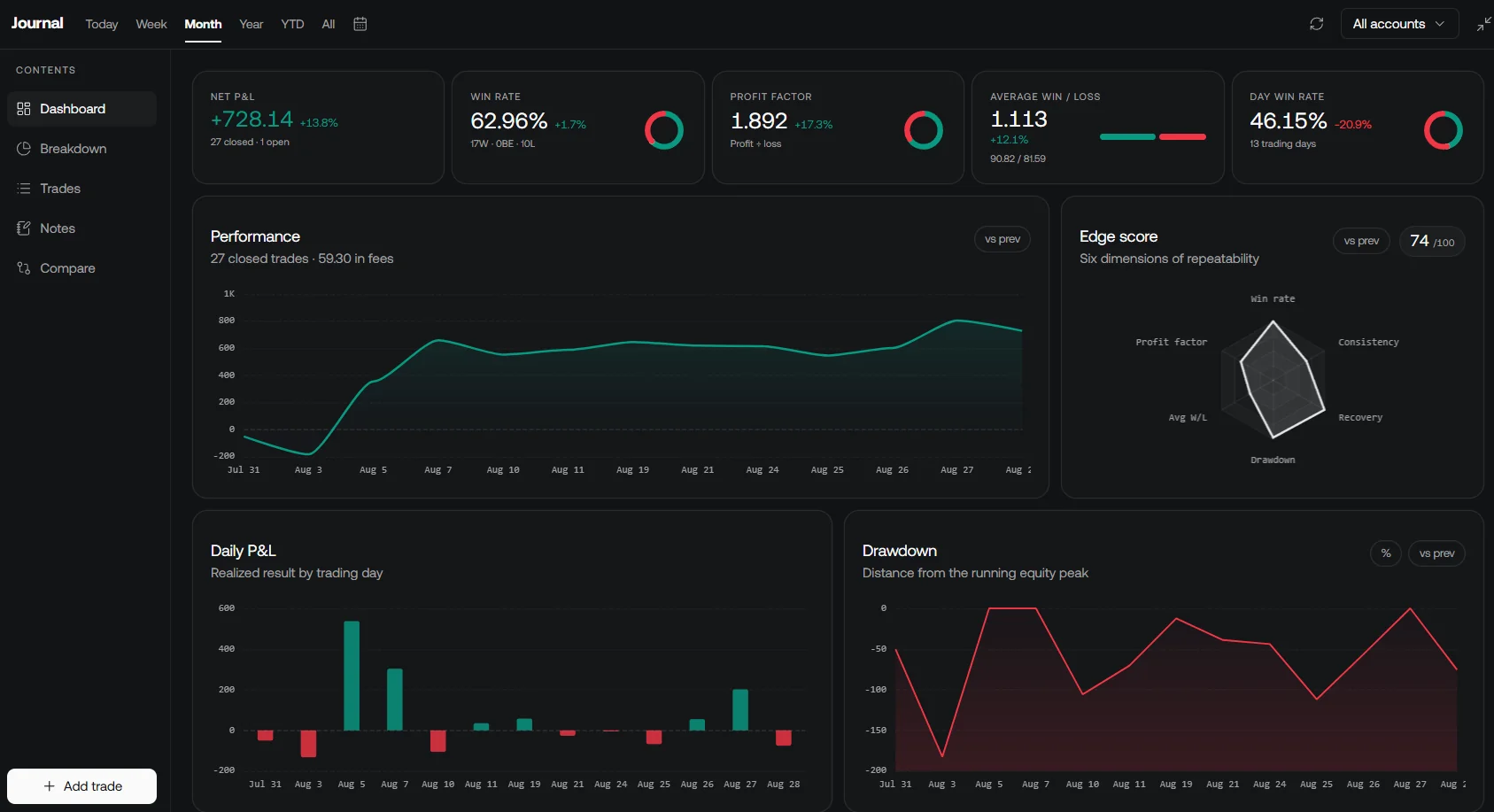
Use LuxAlgo’s native charts to define the setup, then ask Quant to implement explicit quantity and stop rules. Review the code and run it on the intended symbol and timeframe. A percentage order-size setting alone does not calculate the percentage of equity at risk.
In the native strategy results, compare sizing alternatives with consistent entry logic, data, and costs. Inspect drawdown, capital use, and sample trades rather than judging only net profit. Check rounding, maximum additions, and what happens after equity falls.
Use the Journal to review available actual trade records and notes. Compare intended risk with fills, fees, and outcomes, and investigate differences between the plan and execution. Testing and review help evaluate a sizing rule; they do not guarantee growth.
How to Decide Whether the Position Is Too Large
Check the planned monetary loss, a worse execution scenario, required capital, and the combined portfolio exposure. Then consider whether the rule remains workable after several losses. Universal targets for win rate, leverage, or drawdown cannot substitute for those calculations.
A practical sizing process is repeatable: define the budget, choose the stop logic, calculate and constrain quantity, test the rule, and review actual results. Reduce or skip the position when it cannot fit the limits without changing the trade merely to justify more exposure.
Read next