Why Focusing on Process, Not Profits, Leads to Better Trading
A good trading process helps you make decisions that can be reviewed and improved. It does not guarantee profits. The aim is to separate what you could reasonably decide at the time from what the market happened to do afterward, while still measuring whether the strategy earns an acceptable return after costs.
Profit-chasing can turn a missed move into an impulsive entry or a small loss into an oversized attempt to recover. A process gives you a different set of questions: Does this setup meet the rules? What would invalidate it? How much exposure fits the plan? What evidence should change the strategy?
- Prepare: Define the setup, context, and risk before the decision.
- Execute: Use only information available at the time and verify actual orders and positions.
- Review: Score rule adherence separately from profit and loss.
- Improve: Test changes instead of rewarding an accidental winner or abandoning a rule after one loss.
Process Over Profit: A Trading Discussion
Vincent Desiano discusses the importance of process in the video below. Use it as a prompt to examine your own decisions alongside the concrete review methods in this guide.
Why Profit-Chasing Can Distort Trading Decisions
A Winning Trade Can Still Be a Process Mistake
Suppose your plan permits a $100 risk budget. You double the intended position because you want to recover a previous loss, and the trade earns $400. The gain is real, but it does not validate breaking the size rule. Repeating the behavior can create an exposure the account was never intended to carry.
The reverse also matters. A trade can meet every documented condition and lose within the expected scenario. That does not automatically make the entry a mistake. Review the evidence and execution before deciding whether the strategy or the behavior needs to change.
| Execution | Financial outcome | Useful review question |
|---|---|---|
| Followed the rules | Profit | Was the result consistent with the assumptions, and does it hold across more trades? |
| Followed the rules | Loss | Was this a modeled risk, an execution problem, or evidence that the assumptions need review? |
| Broke the rules | Profit | Which exception created extra risk, even though this trade worked? |
| Broke the rules | Loss | What specific behavior or operational failure needs correction? |
Following the rules is not the same as proving that the rules are sound. A consistently executed strategy can still lose money. Process review and performance review should inform each other rather than compete.
What Outcome-Bias Research Actually Shows
In Baron and Hershey’s 1988 study, Outcome Bias in Decision Evaluation, participants evaluated decisions involving medical situations or monetary gambles. Favorable outcomes led to more favorable judgments of decision quality, despite participants receiving the information available to the original decision-maker.
This supports a reason to examine a decision without relying solely on its outcome. It was not a trial demonstrating that a particular trading routine produces profits. The practical application here is to record the setup and reasoning before the result is known, then review that record alongside the eventual gain or loss.
Recognize the Pressure to “Make Something Happen”
FOMO can appear when a market rises quickly or other traders post gains. Frustration can appear after a stop-out; overconfidence can follow a winning streak. These experiences can encourage chasing, holding a losing trade beyond its invalidation, or increasing size without a change in the plan.
Use observable behavior as the trigger for action. “I am moving the stop because I cannot accept this loss” is more useful than a vague instruction to be disciplined. A process should tell you what to do when that behavior appears.
Core Elements of an Effective Trading Process

1. Prepare Before the Trading Session
Review scheduled events, relevant news, overnight price changes, and the market conditions your strategy was designed to address. Use primary release sources where possible, and confirm announcement times against your own clock. More information is useful only when it changes a defined decision.
Write a short session plan: the markets you will watch, qualifying setups, entry triggers, invalidation levels, permitted size, and reasons to stay out. If no trade meets the criteria, a session with no new position can still be a correctly executed plan.
Replace a daily demand such as “make $300” with actions you can assess: check every entry against the rules, respect the exposure limit, and reconcile the account before finishing. A daily profit target should not become a reason to force trades or continue until the market pays you.
2. Define Entry and Exit Rules Precisely
An educational daily-chart rule might require all three conditions:
- Today’s completed close crosses above its 20-period simple moving average: the previous close was at or below its own average, and the current close is above its current average.
- The chosen RSI, with a documented lookback, is above 50 at that close.
- Today’s volume is at least 1.25 times the average volume of the preceding 10 completed daily bars.
This is an example of specificity, not a recommended strategy. It distinguishes a new cross from merely remaining above an average and makes the volume comparison explicit. A rule based on the completed daily bar cannot assume that you entered earlier using that bar’s final information.
Define the order timing, stop, target, maximum holding period, and response to an opposite signal as well. For live orders, verify the broker’s acceptance and fill rather than assuming that a plotted signal equals an executed trade.
3. Tie Position Size to Planned Risk
Set a cash risk budget appropriate to the account and instrument, then calculate exposure from the intended entry-to-stop distance and unit value. Include costs and an allowance for adverse execution where relevant.
For example, a $250 planned risk budget and a $2.50 per-share stop distance imply 100 shares before costs. If the valid stop is $5 away, the equivalent size is 50 shares. Widening the stop while retaining the larger size would double the planned price risk.
Two percent of a $50,000 account is $1,000, but calling that a guaranteed maximum loss is incorrect. A gap, slippage, leverage, or several correlated positions can produce a larger loss. Investor.gov explains that stop orders and limit orders have different execution constraints; neither should be treated as a universal promise of an exit at the intended price.
Also distinguish position value from planned loss. A $5,000 stock holding is not automatically $5,000 of stop-based risk, and a small margin deposit does not describe the full exposure of a leveraged position. Define portfolio limits in units you understand and account for positions that could move together.
Diversification can reduce concentration, but it does not guarantee protection in a broad decline. An index position and several stocks from the same sector may share more risk than their different symbols suggest.
Use Journals and Checklists to Make Review Concrete
Record What You Knew Before the Outcome
For every trade, record the strategy version, market context, entry decision time, planned size and stop, actual fills, costs, exit, and result. Add the reason for the trade and any deviation from the plan. A screenshot taken at the decision point is more useful for reviewing information availability than a chart marked up after the move.
Track emotions as observations: urgency after a missed entry, hesitation after a loss, or temptation to increase size after a win. Avoid using a personality label when a specific action can be documented and changed.
Score Process and Performance Separately
Choose a small set of observable process checks, such as setup eligibility, correct sizing, order verification, and adherence to the exit rule. If 17 of 20 reviewed trades meet every check, full adherence is 85%. The other three deserve review even if they were profitable.
Do not let a high checklist score cancel out a critical risk violation. Increasing a position beyond the authorized limit matters more than completing several routine preparation steps. Record both the overall score and the nature of each failure.
| Measure | Definition | What it does not prove |
|---|---|---|
| Rule adherence | Share of reviewed decisions meeting the defined process checks. | That the strategy itself has a profitable edge. |
| Win rate | Winning trades divided by the defined set of closed trades; state how breakeven trades are treated. | Profitability without considering win/loss size and costs. |
| Average win/loss ratio | Average realized winning amount divided by the absolute average realized losing amount. | That a planned target ratio was achieved on every trade. |
| Profit factor | Gross profit divided by the absolute value of gross loss, using a consistent cost convention. | Robustness when the sample is small or dominated by one winner. |
| Maximum drawdown | Largest peak-to-trough decline in the chosen equity series. | The maximum loss that could occur in the future. |
Suppose 30 trades win an average of $40 and 20 lose an average of $80. The win rate is 60%, but gross profit is $1,200 against $1,600 of gross losses: a $400 loss and a profit factor of 0.75 before additional costs. Execution discipline and financial performance need separate explanations.
For drawdown, a fall from a $10,000 equity peak to $9,200 is 8%. State whether the equity series includes open positions or only closed trades. A closed-trade curve can conceal adverse movement while a position was still open.
Turn a Review Finding into One Testable Change
Review regularly, with the frequency suited to how often you trade. A weekly operational check can identify order mistakes, while a broader periodic review can compare strategy behavior across conditions. A calendar interval alone does not supply enough evidence.
If your records suggest that late entries perform poorly, define “late” before testing a filter. Compare the original rule with a specific alternative using consistent dates and costs, then examine an untouched period. Do not change several variables after every losing session or discard losses because they do not fit the story.
Using LuxAlgo to Support the Process
Prepare and Inspect the Market on Charts
Use LuxAlgo charts to organize the symbols, intervals, and levels relevant to your plan. Choose indicators from the Library for specific questions, and record their settings so the setup can be reviewed consistently.
Orderflow tools can add information about measured participation, but they do not identify every participant or predict a reversal. Check data coverage for the selected instrument. An exchange-specific volume feed should not be interpreted as the entire market’s activity.
Express the Rules with Quant, Then Verify Them
Quant, our coding agent, can help turn a written rule into strategy code. Describe the entry, exit, sizing, and timing precisely. Ask it to explain when the information becomes available and how the simulated order is handled.
Follow the Quant strategy workflow: inspect the code, run it on the chart, and review Inputs and Properties such as capital, order size, commission, and slippage. Generated code still needs checking against the intended rule.
Use the strategy results and Trades Log to inspect individual entries and exits alongside drawdown, trade count, and performance. Test whether the rule is using a confirmed candle and whether it assumes an earlier fill than the decision permits.
A saved backtest is a record of a simulation under particular assumptions. It does not automatically create live broker orders or enable alerts. Compare versions under the same conditions and retain a later period for evaluation before relying on a proposed improvement.
Review Execution in Journal
Use LuxAlgo’s Journal to organize trades through manual entry, file import, or a supported broker connection. Confirm the account, date range, and completeness of the data before interpreting performance.
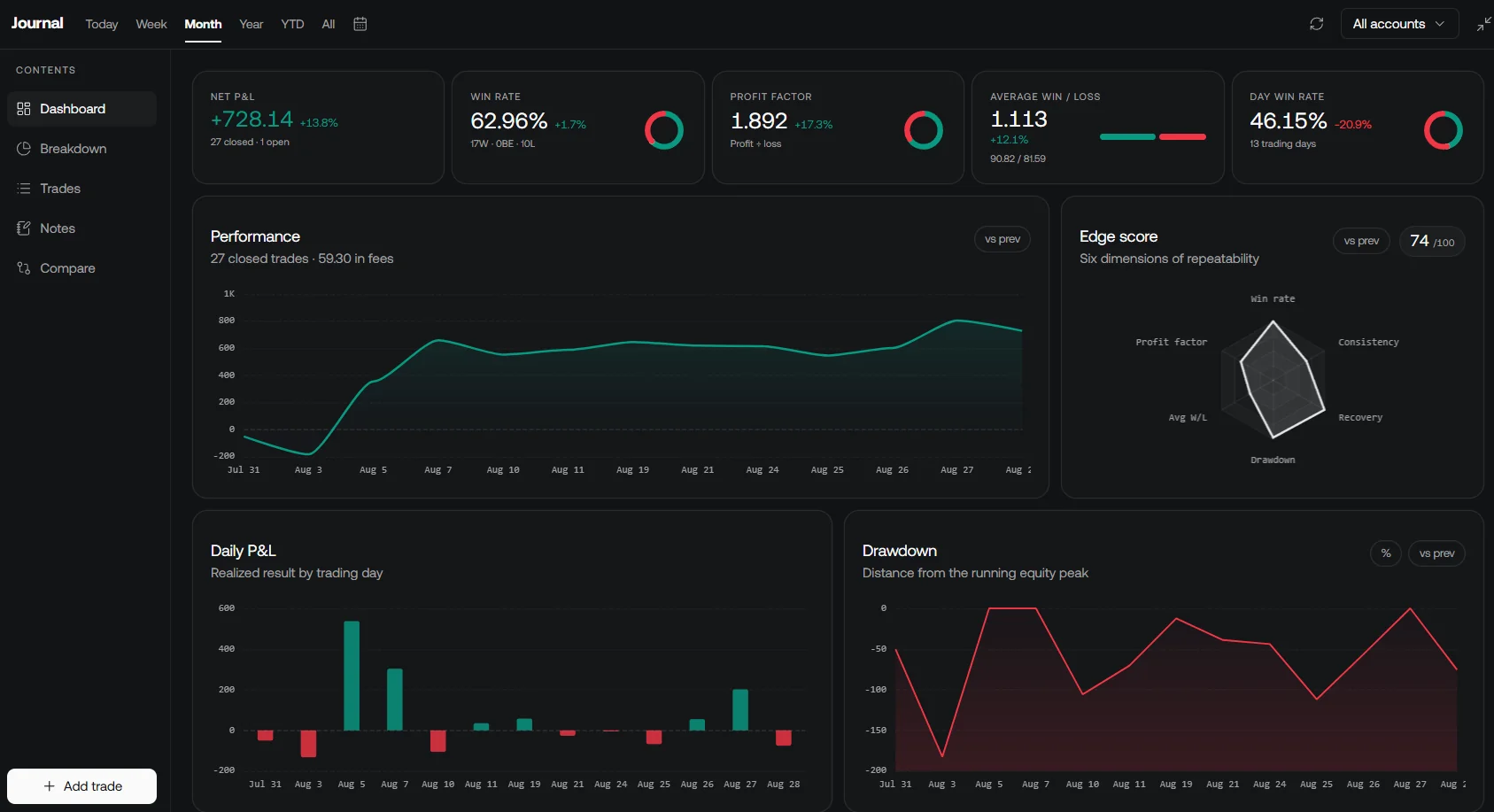
Use Journal notes for the session plan and individual trade reasoning. A short review might say: “Setup met the entry rule; size was correct; exit occurred as planned; trade lost $100.” Another might say: “Trade gained $150, but entry came before confirmation.” Those records lead to different lessons.
Keep live, paper, and backtested results clearly identified. Verify fees, quantities, currencies, and missing records before comparing periods. A smoother dashboard curve is not evidence of better decision-making if the underlying records are incomplete.
Managing Emotions Through a Practical Routine
A routine can reduce the number of decisions you need to improvise, but it cannot eliminate uncertainty or every emotional response. The aim is to notice a trigger and follow a predetermined response.
| Trigger | Observable behavior | Process response |
|---|---|---|
| FOMO | Entering after the permitted price or timing has passed. | Record the missed setup and wait for another valid opportunity. |
| Overconfidence | Increasing size because of recent wins. | Recalculate from the existing risk rule; review scaling separately. |
| Anger after a loss | Taking a trade mainly to recover money. | Pause new entries and check current exposure and orders. |
| Anxiety | Repeatedly changing an exit without new qualifying evidence. | Review the written invalidation and whether the position was appropriate. |
Set daily or weekly pause conditions before the session and define what must be checked before resuming. Reaching a profit figure is not proof that the next setup is good or bad; if you use a profit-based stopping rule, evaluate it as part of the strategy.
For a brief reset, the NHS breathing guide describes gentle, comfortable breathing without forcing the breath. Such a practice may help with stress; it is not evidence that a trade is valid or that risk should be increased.
Seek constructive feedback on the decision record, not reassurance about a position you want to keep. Persistent distress or difficulty controlling trading behavior deserves attention beyond another indicator or checklist.
Build a Process That Can Change When the Evidence Changes
Preparation, execution, and review work together. A written plan makes choices visible, consistent execution makes results easier to interpret, and an honest review can reveal either behavioral mistakes or weaknesses in the strategy.
Keep profit and loss in the evaluation. The goal is not to ignore financial outcomes, but to avoid confusing one outcome with proof of decision quality. LuxAlgo charts, Quant, and Journal can support that work by making the rules and records easier to inspect.
FAQs
How can I shift my focus from profits to building a process-driven trading strategy?
Define entry, exit, sizing, and pause rules before trading. Record the information available at each decision, score adherence separately from profit and loss, and test changes before adopting them. A disciplined process still needs evidence that the strategy works after costs.
What are the most common emotional challenges in trading, and how can focusing on the process help overcome them?
FOMO, frustration, anxiety, and overconfidence can lead to chasing, oversizing, or unplanned exits. A process links those observable behaviors to a response such as checking exposure or pausing new entries. It can support consistency without eliminating emotions or guaranteeing results.
How do tools like trading journals and checklists improve trading performance?
They make rules, decisions, and deviations easier to inspect. Compare complete trade records, costs, and outcomes alongside adherence measures to identify what needs correction. Journaling and checklists support evaluation; they do not by themselves create a profitable strategy.
Read next