Climactic Moves
 By LuxAlgoApr 9, 2026
Climactic Moves is an indicator on Vela, our next-generation charting platform, written in Pine Script®.
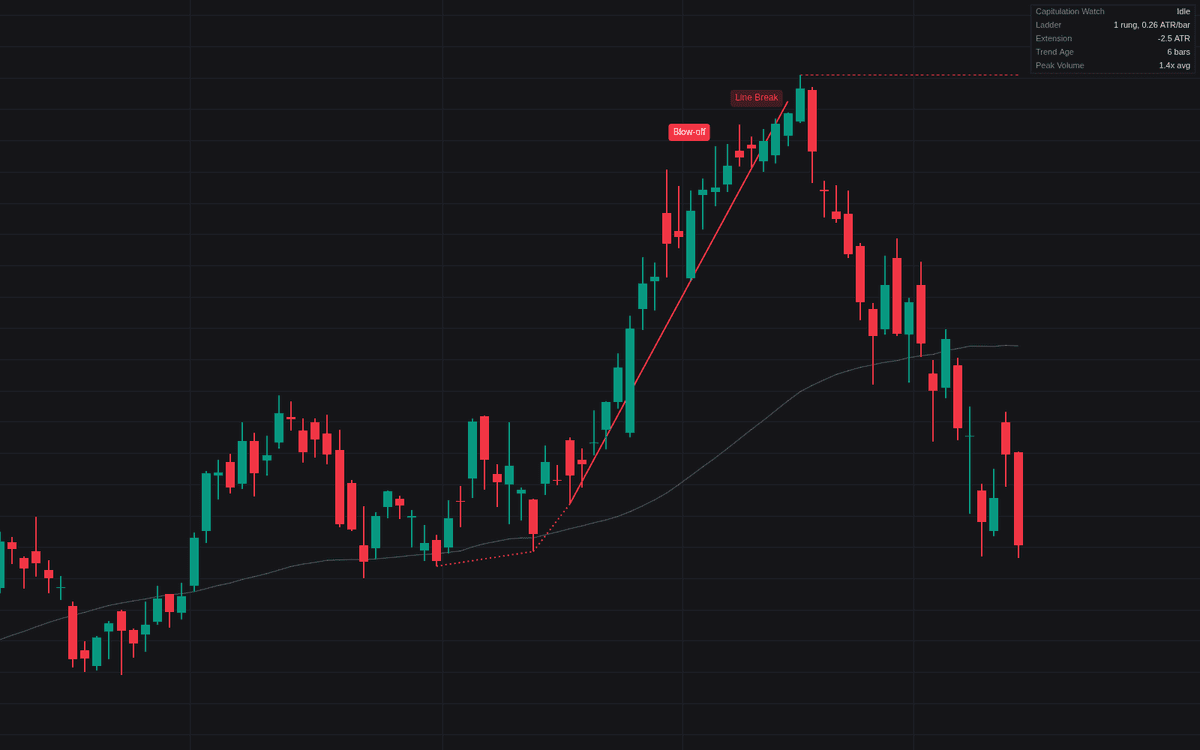

The Climactic Moves indicator identifies the terminal phase of mature price trends by detecting parabolic, exhaustion-prone market behavior. By analyzing trend maturity, acceleration ladders, and volume effort, it highlights potential blow-off tops and capitulation bottoms as they unfold. This provides actionable insights into when a vertical move is losing steam, helping traders recognize the transition from impulsive momentum to exhaustion or imminent reversal.
How to Trade the Climactic Moves?
The indicator categorizes price action into distinct stages: detection, exhaustion, and retest. A "Blow-off" signals a potential bearish reversal after a vertical uptrend, while "Capitulation" signals a potential bullish reversal after a vertical decline.
Once a climax is flagged, the indicator monitors for an "Exhaustion Tell." This event signals that the trend's vertical acceleration has ended, either through a break of the trendline ladder, a stall in price progress, or a wide-range reversal. Traders often use this tell to scale out of existing trend-following positions or tighten stops significantly.
The final phase is the "Weak Retest." If price returns toward the extreme point of the climax on notably lower volume and fails to break through, the exhaustion is considered confirmed. This setup is often viewed as a high-probability zone for looking at contra-trend opportunities or anticipating a corrective move. It is critical to distinguish these events from "Continuation" signals, which occur when price pushes past the extreme on heavy volume, indicating that the initial momentum is still aggressive and the climax was merely a pause in the primary trend.
Climactic Moves Settings
Mature Trend
- Baseline SMA: Defines the moving-average baseline against which trend maturity and climactic extension are measured.
- Trend Maturity (bars): The minimum number of consecutive closes on the trend side of the baseline required before a move can be labeled as a climax.
- Extension from Baseline (ATR): The threshold distance between the price and the baseline, in ATR multiples, needed to trigger a climax.
- ATR Length: The lookback period used for the Average True Range calculations.
Acceleration Ladder
- Swing Length: Controls the sensitivity of the pivot detection used to build the trendline ladder.
- Minimum Steepening Rungs: The number of consecutive, increasingly steep trendlines required to confirm that a move is accelerating.
- Fresh Extreme Lookback: The window used to identify if the current price represents a new peak or trough.
Effort
- Volume Surge: A toggle to require the peak volume of the effort window to exceed a specified multiple of the average volume.
- Effort Window: The number of bars analyzed to determine if the volume surge and range expansion are significant.
Exhaustion & Retest
- Failure to Extend (bars): The number of bars without a fresh extreme that triggers an exhaustion signal.
- Reversal Bar Range (ATR): The range threshold for a wide-range reversal bar to trigger an exhaustion tell.
- Minimum Reaction (ATR): The distance price must move away from the climactic extreme to validate a future retest.
- Retest Proximity (ATR): The distance from the extreme at which a return is monitored for a potential exhaustion confirmation.
- Retest Volume, % of Peak: The relative volume threshold below which a retest is considered weak and therefore confirmed.
Frequently Asked Questions
Free to use
Run it on Vela. Go further with a paid plan.
- Up to 500 Custom Alerts, with webhook automation
- Up to 10× the chart history of Free
- Orderflow lookback up to full history
- More Quant usage to customize it, plus extra usage when you need it
- Futures data alongside crypto, stocks, forex and commodities

Related indicators
Run it on Vela. Make it yours with Quant.
Open this indicator free on Vela, our next-generation charting platform. Then ask Quant, our coding agent built into Vela, to retune it or turn it into a backtested strategy of your own.