Quarterly Theory
 By LuxAlgoMar 31, 2026
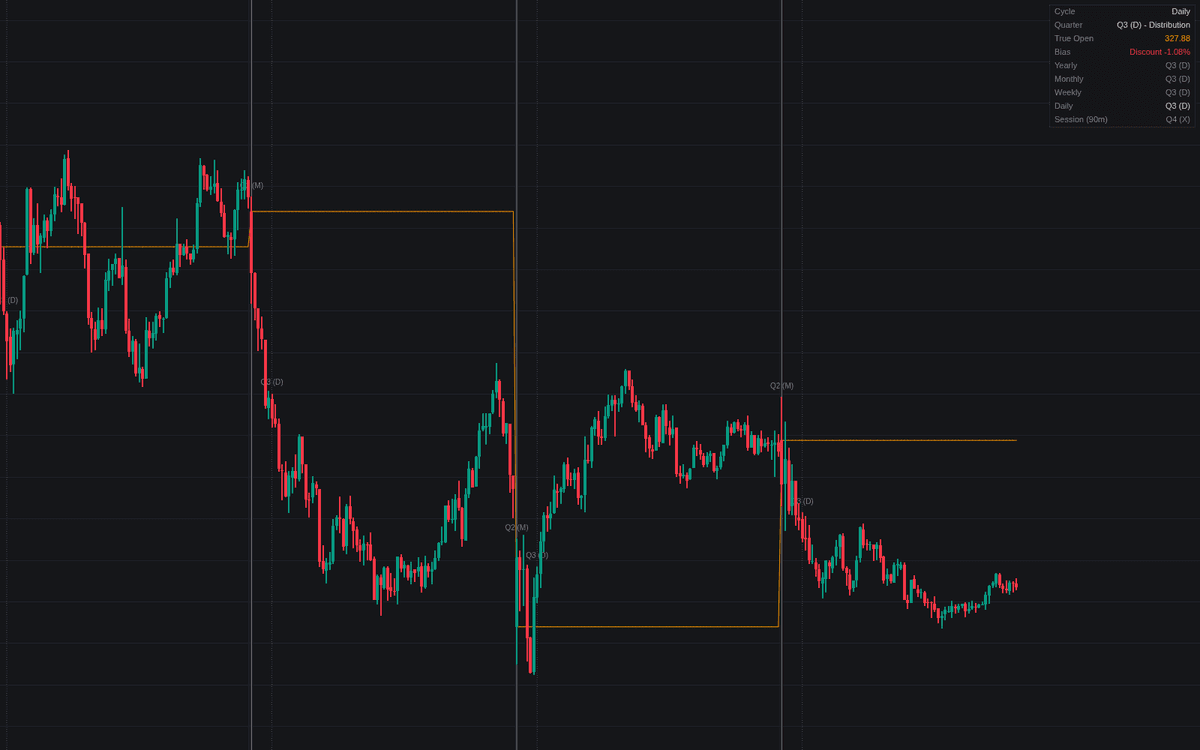

Quarterly Theory lays the four-quarter cycle grid over the chart: solid lines where each cycle begins, dotted lines at quarter starts, Q1-Q4 labels carrying the expected phase, and the two working references of Quarterly Theory (the true open, taken from the open of the cycle's second quarter, and the Q1 range), both extended through the cycle. Boundaries are clocked on New York time with trading days running 18:00 to 18:00, so the daily cycle divides into the four six-hour sessions and its true open lands at midnight New York.
How to Trade the Quarterly Theory?
- Price above the true open: premium; below it: discount. The dashboard quantifies the distance and alerts fire on closes across the level.
- Q2 begins: the true open is set; manipulation is anticipated to run one side of the Q1 range near it before delivery.
- Sweep-and-fail at a Q1 extreme: a Q2 or Q3 bar raiding the Q1 high or low but closing back inside prints the manipulation signature. Marks optional, alerts always live.
- Quarter transitions: alerts announce each new cycle and the Q2, Q3, and Q4 starts.
The dashboard names the current quarter and the phase it should carry, and can stack one row per degree.
Quarterly Theory Settings
- Cycle Degree (default Daily): from Yearly down to Session (90m).
- Sub-Quarters (default None): a finer degree as faint dotted boundaries, the recursion.
- Phase Sequence (default AMDX (accumulation first)): the XAMD alternative reorders the phases for delivery-first cycles.
- Time Zone (default America/New_York): other anchors misplace the quarters.
- True Open, Q1 Range (both default enabled), Mark Manipulation Signatures (default disabled).
- Dashboard and style inputs cover the cross-degree stack, quarter labels, and colors.
Frequently Asked Questions

The Library is free. Quant makes it yours.
Pull any concept or indicator into Quant: rebuild it, retune it, or turn it into a backtested strategy of your own.