Short-Term Order Block Rejections
 By LuxAlgoOct 5, 2026
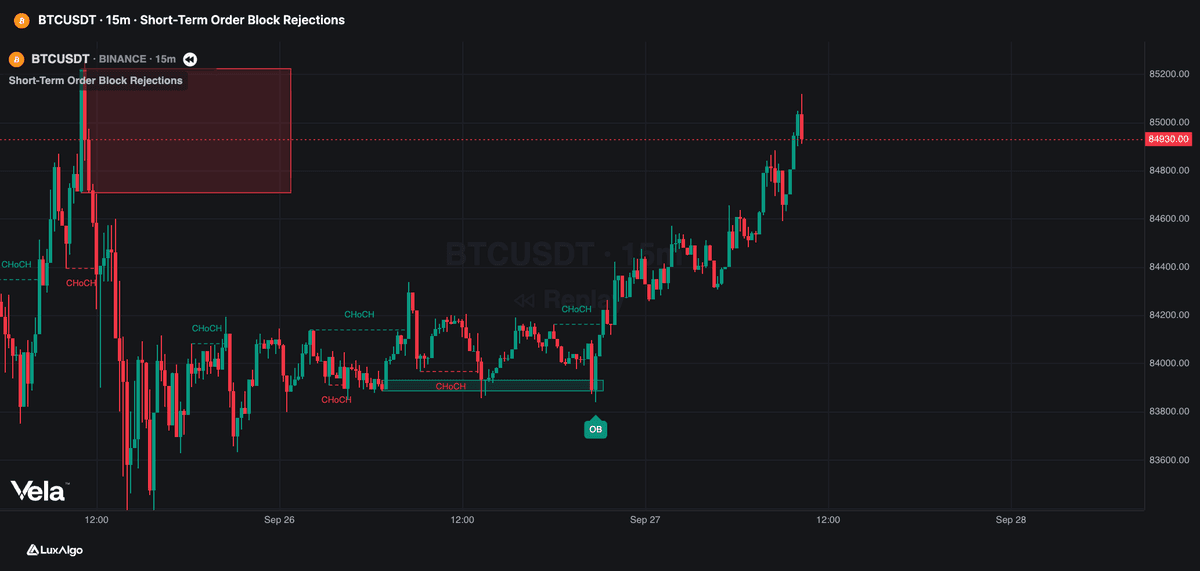

Short-Term Order Block Rejections is an automated technical analysis tool designed to identify and highlight potential reversal zones based on price action following a Change of Character (CHoCH). By locating specific source candles that initiate structural breaks, this indicator provides traders with actionable order block zones. It systematically filters these zones for high-quality rejection signals, helping users identify entry opportunities where price revisits a significant structural level and displays evidence of immediate institutional interest or follow-through.
How to Trade the Short-Term Order Block Rejections?
To effectively utilize this indicator, first observe the CHoCH labels on your chart to determine the current market structure direction. The indicator automatically draws boxes representing order blocks that form during these structural shifts. Focus your attention on these zones when price returns to them.
A valid entry signal is generated when price enters an existing order block and produces a rejection, marked by an "OB" label. These signals are filtered by specific criteria, such as the candle's body percentage and its reaction to the zone's boundaries. To improve your win rate, prioritize signals that align with the primary market structure trend. If the indicator displays a signal in a highly volatile or "choppy" market, utilize the range filter settings to suppress signals occurring too close to the recent swing pivots. Always consider these zones as areas of interest rather than guarantees, and ensure your risk management strategy accounts for potential zone failure or unexpected market momentum.
Short-Term Order Block Rejections Settings
Market Structure
- Structure pivot bars: Sets the number of candles on each side required to confirm a swing high or low for identifying market structure.
- Search back for order block: The maximum number of candles to search backward before a CHoCH to anchor the order block at the structural extreme.
- Maximum reaction window: Limits how many bars after a CHoCH signal-based blocks remain active for potential rejections.
- Minimum signal body: The percentage of the full high to low range that the signal candle body must occupy to be considered a valid rejection.
- Historical blocks per direction: The maximum number of bullish and bearish blocks retained on the chart.
- Show CHoCH levels: Toggles the visibility of lines and labels marking each change of character.
- Only signal with current structure: Restricts signals to those that align with the established trend direction.
- Require swing range: Ensures bullish source candles are not above the broken swing high and bearish source candles are not below the broken swing low.
- Avoid fresh extreme signals: Suppresses short signals at new local lows or long signals at new local highs to avoid late entries.
Range Filter
- Require significant pivot to block range: Enables filtering of signals based on the distance between the latest confirmed pivot and the order block.
- Range ATR length: The lookback period for the Average True Range calculation used to normalize distance.
- Minimum pivot to block distance: The minimum required distance in ATR units between the pivot and the block to qualify as a valid signal.
Cleanup
- Suppress overlapping blocks: Removes or ignores blocks that substantially overlap with existing zones to prevent clutter.
- Overlap threshold: The percentage of overlap required to flag a zone as a duplicate.
Frequently Asked Questions
Free on Vela
Run it on Vela. Go further with a paid plan.
- Up to 500 strategy alerts, with webhook automation
- Up to 10× the chart history of Free
- Orderflow lookback up to full history
- Up to 100,000 monthly credits for Quant to customize it
- Futures data alongside crypto, stocks, forex and commodities

The Library is free. Quant makes it yours.
Pull any concept or indicator into Quant: rebuild it, retune it, or turn it into a backtested strategy of your own.