Rare Candlestick Formations
 By LuxAlgoJun 2, 2026
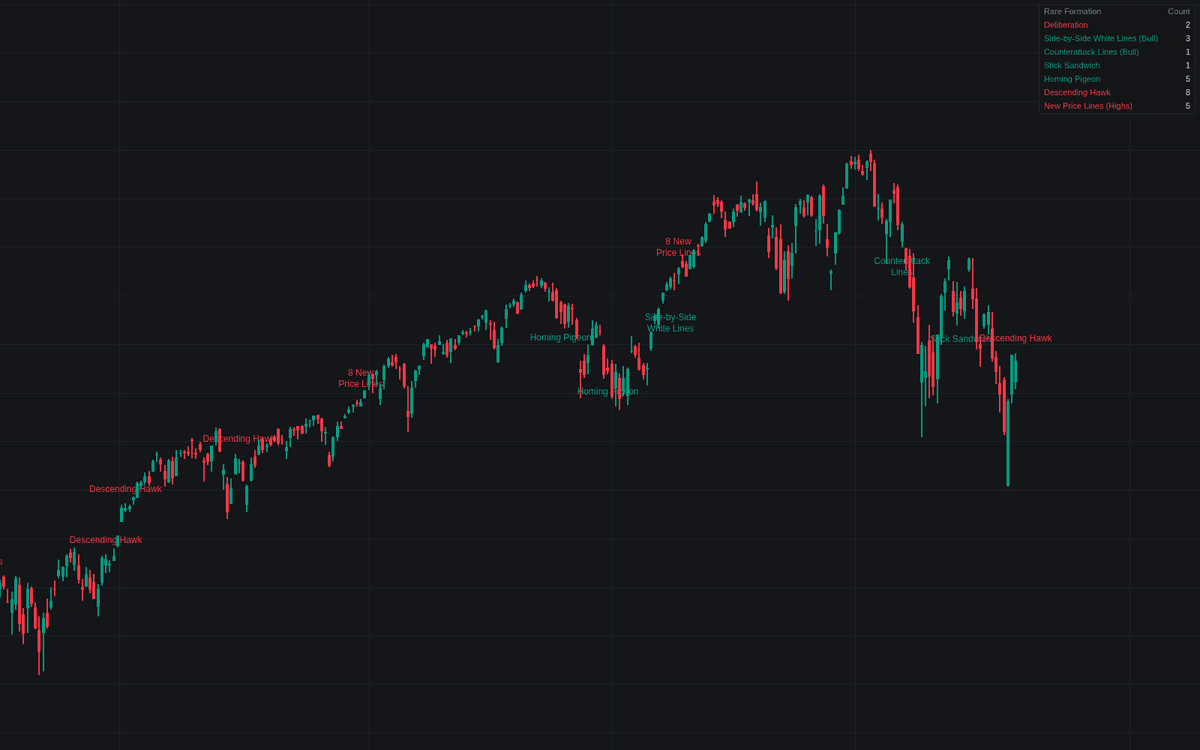

Rare Candlestick Formations watches the long tail of the candlestick catalog in one screener: fifteen rare candlestick formations, advance block to concealing baby swallow to the new-price-lines exhaustion count. Each detection enforces the strict classical sequence of body sizes, colors, gaps, and shadows, with thresholds scaled to the recent average body and ATR; a prior-trend rule gates every print: no qualifying advance or decline, no signal.
How to Trade the Rare Candlestick Formations?
- Bullish reversals in a decline: three stars in the south, unique three-river bottom, concealing baby swallow, stick sandwich, homing pigeon, ladder bottom.
- Bearish warnings in an advance: advance block, deliberation, descending hawk, ladder top, upside gap two crows.
- Continuations: side-by-side white lines, separating lines, three-line strike, filed with the prior trend.
- New price lines: eight consecutive record sessions by default warn a run is overextended.
Every formation has its own alert, two catch-alls cover any bullish or bearish print, and the dashboard counts occurrences.
Rare Candlestick Formations Settings
- Prior Trend Rule (default EMA) and Trend Length (default 10): the context filter; None disables it.
- Body Average Length (default 14) with Long Body × (default 1.0) and Small Body × (default 0.5): adaptive body classification.
- Long Shadow × (default 0.5) and Marubozu Shadow Tolerance % (default 5): the shadow conditions.
- Price Match Tolerance % ATR (default 10): the equal-price conditions. Keep it tight.
- Require Confirmation Close (default disabled): signals wait for a close beyond the formation's extreme.
- New Price Lines Count (default 8), fifteen catalog toggles (all enabled), plus dashboard and style inputs.
Frequently Asked Questions

Original indicatorBuilt in-house by LuxAlgo
The Library is free. Quant makes it yours.
Pull any concept or indicator into Quant: rebuild it, retune it, or turn it into a backtested strategy of your own.