Evening Star
 By LuxAlgoJun 16, 2026
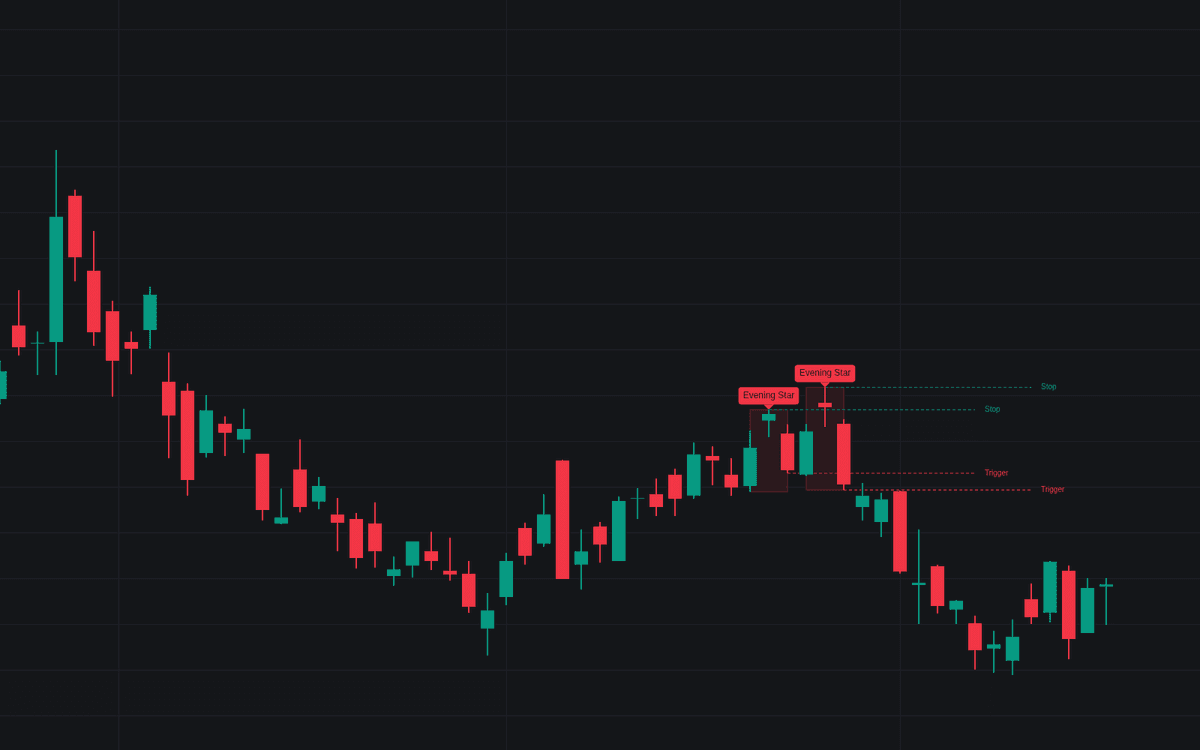

Evening Star is the definitive clean build of the evening star, the three-candle top that marks an advance rolling over. Each candle is sized against the average real body of the preceding bars, so “long” and “small” adapt to the chart. Completed patterns are shaded and labeled (Evening Doji Star when the star prints as a doji), with dashed trigger and stop levels.
How to Trade the Evening Star?
- Pattern label: long bullish candle, small star at or above its close, long bearish candle closing at least 50% into the first body. A warning, not an automatic short.
- Trigger break: price trading below the trigger level (the third candle's low by default) confirms the setup and fires its own alert.
- Stop at the star's high: a move above the star invalidates the pattern and is alerted separately.
Context filters do the heavy lifting: by default the first candle must close above a 50-bar SMA, keeping detections out of mid-range chop.
Evening Star Settings
- Body Average Length (default 14): bars in the average real body.
- Long Body Multiplier (default 1.0) and Small Body Multiplier (default 0.5): minimum outer bodies and maximum star body versus that average.
- Minimum Penetration % (default 50): required depth of the third close into the first body.
- Require Star Body Gap (default off): enforces the classic gap placement.
- Doji Body % of Range (default 5): at or below this share of the star's range, the label upgrades.
- Merged Shooting Star Check (default off): the merged three-candle bar must show a dominant upper rejection.
- Uptrend Filter (default on, SMA Length 50), Overbought Filter (default off, RSI Length 14, Level 70), Volume Filter (default off, SMA Length 20).
- Trigger & Stop Levels (default on), Trigger Level (default Third Candle Low), Levels Extension (default 10); Pattern Labels and Pattern Highlight (both on) cover the drawings.
Frequently Asked Questions

Original indicatorBuilt in-house by LuxAlgo
The Library is free. Quant makes it yours.
Pull any concept or indicator into Quant: rebuild it, retune it, or turn it into a backtested strategy of your own.