Rising/falling Three Methods
 By LuxAlgoJul 28, 2026
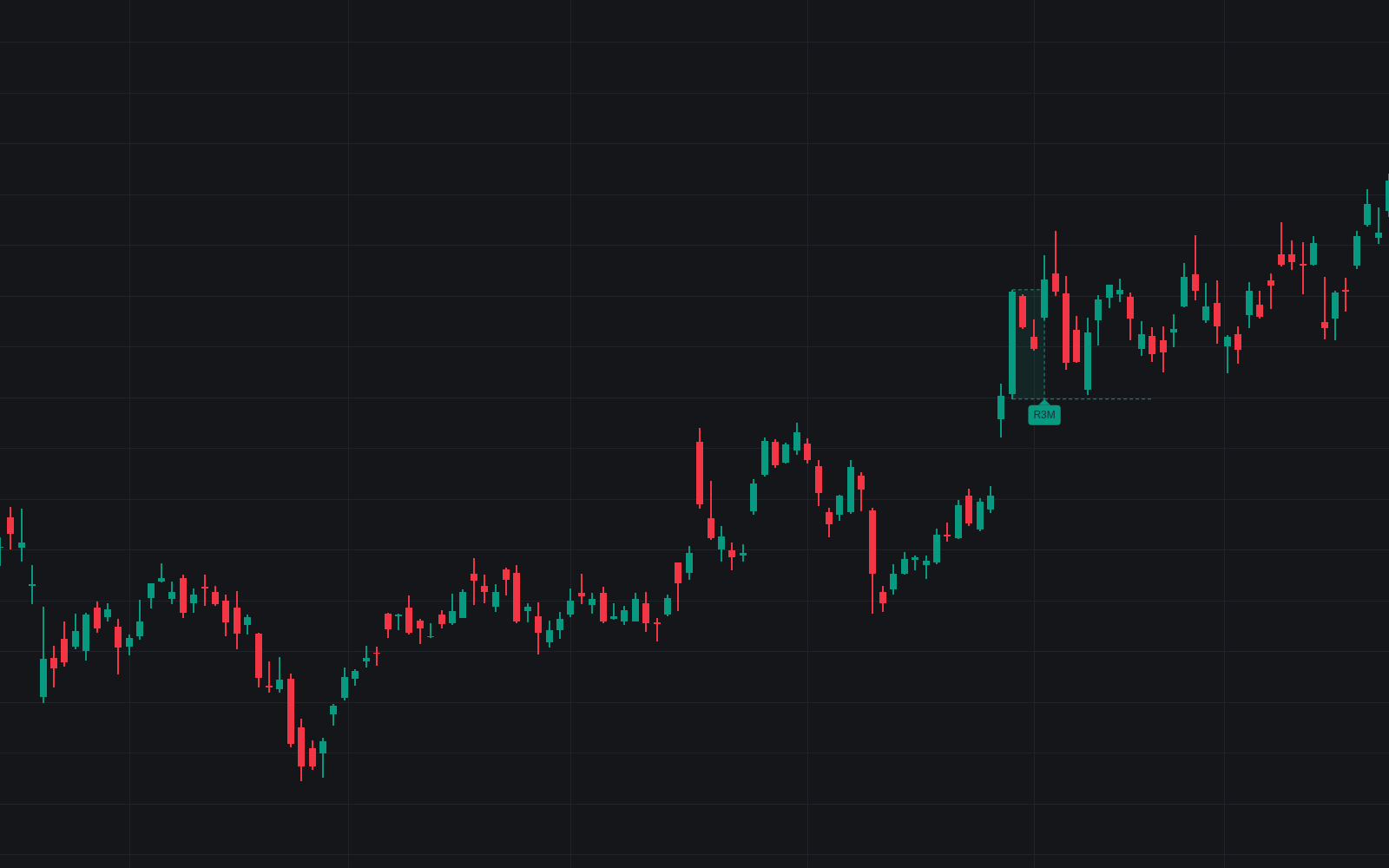

Rising/falling Three Methods scans every confirmed bar for the classic five-candle continuation template and its practical variants. A long body with the trend, a pause of small contained candles, then another long body finishing past where the first candle closed completes the rising or falling three methods; the build shades the containment zone, labels the completion R3M or F3M, and extends the invalidation level (the first candle's opposite extreme) past the resolution bar.
How to Trade the Rising/falling Three Methods?
- R3M / F3M label: the continuation confirms at the close of the resolution candle; the tooltip records middle-candle count and invalidation price.
- Invalidation level: a return through the far end of the containment range negates the pattern, its natural stop reference, drawn dashed.
- Volume convention: with the optional check on, the pause must contract in volume and the resolution expand, the flag convention applied to the candlestick form.
Rising/falling Three Methods Settings
- Minimum Middle Candles (default 2) and Maximum Middle Candles (default 5): the accepted pause lengths; the classical form uses exactly three.
- Containment Basis (default High-Low Range): Real Body adds the strict body-within-body reading, rarer and cleaner.
- Containment Tolerance % (default 0): allowance for minor violations; a middle-candle close through the far end always voids.
- Body Average Length (default 14), Long Body Factor (default 1.2), Small Body Factor (default 0.5): what counts as long impulse and small resting bodies.
- Trend Filter (default SMA) with Trend Length (default 50): context at the first candle.
- Volume Confirmation (default off): ignored without volume data.
- Containment Zone and Pattern Labels (on), Invalidation Level (on) with Extension (default 10).
Frequently Asked Questions

Original indicatorBuilt in-house by LuxAlgo
The Library is free. Quant makes it yours.
Pull any concept or indicator into Quant: rebuild it, retune it, or turn it into a backtested strategy of your own.