Concept
Rising/falling Three Methods
Rising/falling Three Methods are Chart & Candlestick Patterns concepts. The Library holds 1 implementation, a working definition you can pull into Quant.
Top Rising/falling Three Methods indicator
The top custom implementation, built on the original standard Rising/falling Three Methods formula.
1 total
Want to trade Rising/falling Three Methods? The implementation below is one prompt away from a backtested strategy in Quant.
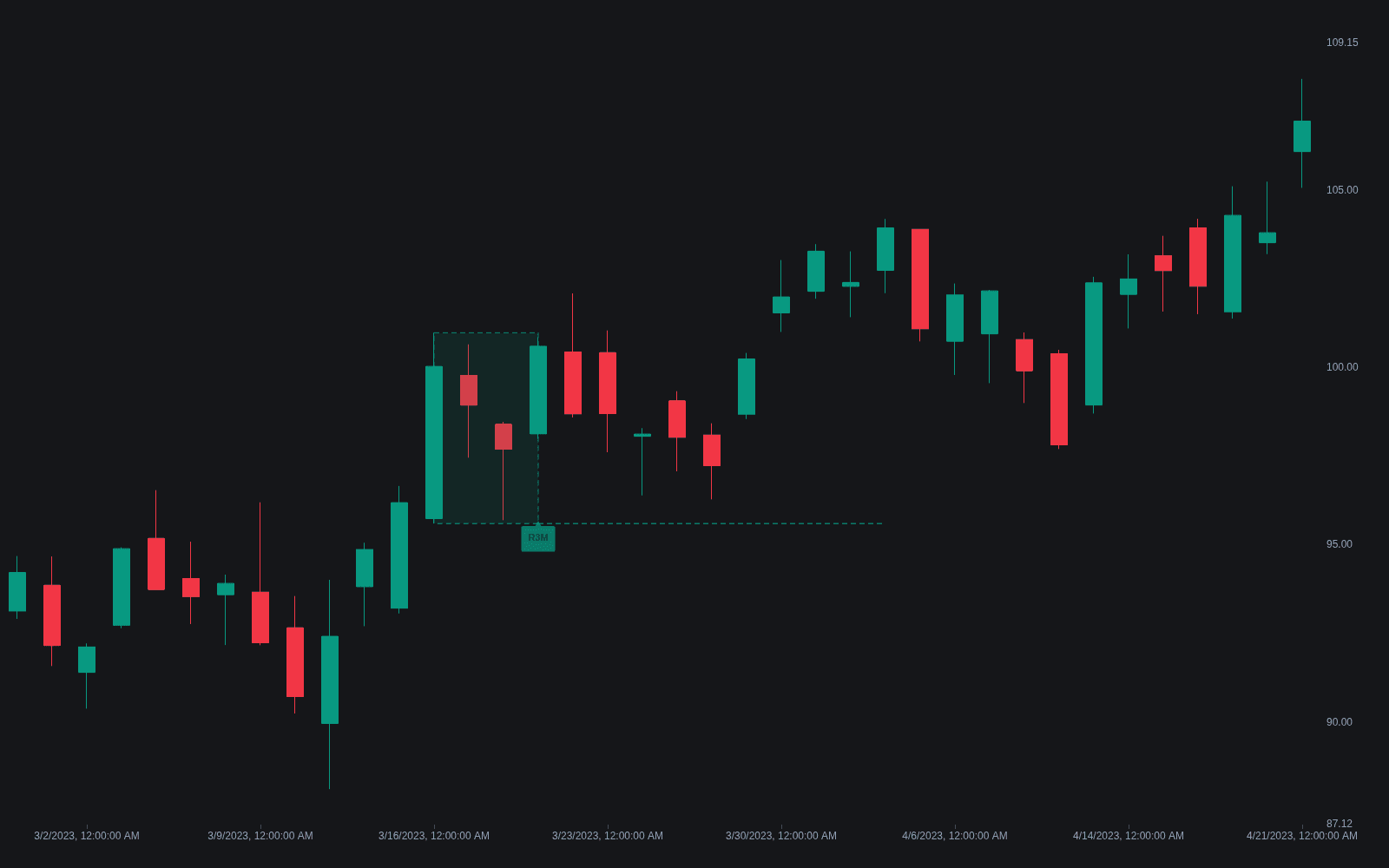
What are the Rising and Falling Three Methods?
The rising three methods is a five-candle continuation pattern from the Japanese candlestick catalog. A long white candle in an uptrend is followed by three small-bodied candles that drift lower while staying inside the first candle's high-low range, and the fifth candle is another long white body closing above the first candle's close. The falling three methods is the exact mirror in a downtrend: long dark candle, three small rising candles contained within its range, then a long dark candle closing at a new low. The name comes from the traditional Japanese description of markets needing rest within a campaign.
The mechanism is containment. The three middle candles represent a counter-trend attempt that never escapes the range set by the initial impulse: profit-taking and countertrend positioning show up, but they cannot even revisit the far end of the big candle. When the fifth candle resumes the trend and closes beyond the first candle's close, the pause reads as consolidation rather than reversal. It is candlestick language for the same behavior Western charting calls a flag, compressed into a fixed five-bar template.
Traders care because the pattern packages a with-trend entry, a nearby invalidation (the far extreme of the containment range), and an explicit confirmation bar into one structure. The caveats are the usual ones: the strict form, with exactly three contained candles, is uncommon, so most practical implementations allow two to five middle candles and minor range violations; and like every continuation pattern it fails often enough that trend context and position sizing matter more than the pattern itself.
How to identify the three methods on a chart
The essence is a big trend candle whose range contains the entire pause.
- 1Confirm the trend and the impulse: the first candle should be a long body in the trend direction, ideally one of the larger recent candles.
- 2Check containment: the small middle candles (classically three, practically two to five) hold within the first candle's high-low range, drifting against the trend.
- 3Prefer small bodies in the pause: spinning tops and modest bodies fit the resting logic; large opposing bodies argue for a real fight instead.
- 4Require the resolution candle: a long body in the trend direction closing beyond the first candle's close (above it for rising, below for falling).
- 5Set invalidation at the far end of the first candle's range; a close through it means containment failed and the pattern is void.
How traders use it
- As a with-trend entry: traders enter on the fifth candle's close or on a break of its extreme, with the stop beyond the containment range, treating the pattern as a completed rest within an ongoing move.
- As a trend-health read: clean containment says countertrend pressure is weak; a pause that repeatedly pokes out of the range warns that the trend candle's authority is being challenged even if the pattern eventually completes.
- As a volume check, by convention: many practitioners want volume to contract during the three middle candles and expand on the resolution candle, mirroring the flag-trading convention, though the classical definition is price-only.
- As a scanner family with relaxed rules: strict five-bar instances are rare, so implementations typically parameterize the number of middle candles and the containment tolerance, and hit rates change materially with those settings.
Three methods vs related patterns
Mat hold: The mat hold opens its pause with a gap up and tolerates a slightly deeper dip; the three methods keeps the pause fully inside the first candle's range with no gap. The mat hold is traditionally graded a touch stronger.
Inside bar: A stack of inside bars after an impulse is the bar-by-bar version of the same containment logic; the three methods adds the requirement of a confirmed resolution candle before the pattern is complete.
Bull/bear flag: The flag is the Western equivalent: impulse, shallow counter-drift, breakout. Flags have no fixed bar count and are drawn with trendlines, while the three methods is defined by candle ranges and counts.
Concept family
Chart & Candlestick Patterns
84 concepts mapped · 84 in the Library
Rising/falling Three Methods FAQ
Turn Rising/falling Three Methods into a trading strategy.
Take the implementation from this page into Quant, then build on it, backtest it on real data, and keep refining it in conversation.