Aroon
 By LuxAlgoApr 13, 2020
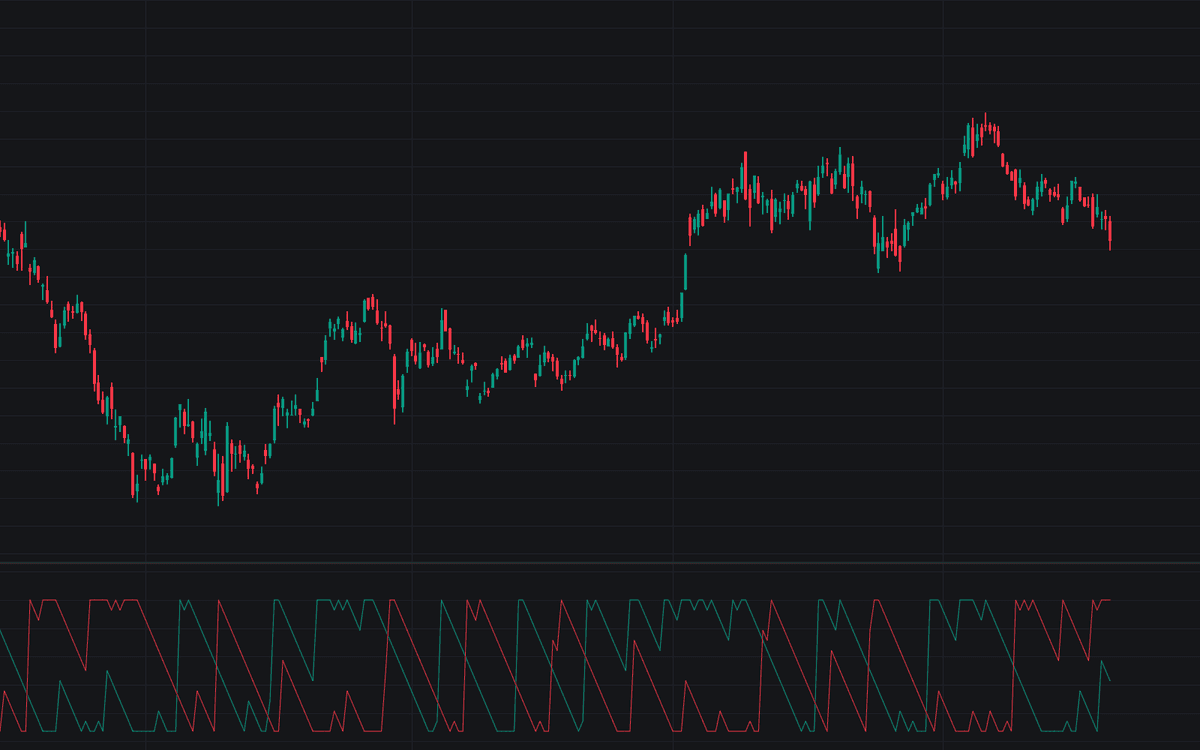

Aroon measures the freshness of extremes: how many bars have passed since the highest high and the lowest low of a lookback window, each rescaled to a 0-100 percentage. Aroon Up reads 100 when the window's highest high printed on the current bar and decays toward 0 as that high ages; Aroon Down does the same for the lowest low. Tushar Chande's design cares about how long ago the latest record printed, not how far price traveled, and this build is a plain, unmodified implementation of the original indicator with its classic default length of 14.
How to Trade the Aroon?
- Aroon Up holding near 100: new highs keep arriving within the window. The uptrend is active and persistent.
- Aroon Down holding near 100: fresh lows keep printing, the same persistence on the sell side.
- Aroon Up crossing above Aroon Down: highs are now more recent than lows, an early trend-shift cue best treated as a prompt for further checks rather than an order trigger.
- Both lines sagging mid-range: neither extreme is fresh. The market is drifting sideways and crossover signals will whipsaw.
- One line pinned while the other decays to 0: the strongest configuration, a one-sided market whose opposing extreme is a full window old.
Because only recency enters the formula, a slow creep to marginal new highs pins Aroon Up as hard as an explosive run: the reading is persistence, not force. Bullish Cross and Bearish Cross alert conditions fire when the two lines cross.
Aroon Settings
- Length (default 14): the lookback scanned for the highest high and lowest low. Shortening it makes the lines snap to every minor extreme, giving earlier but noisier crosses; lengthening it (25 is a popular slower choice) demands more durable extremes before the lines pin.
Frequently Asked Questions

The Library is free. Quant makes it yours.
Pull any concept or indicator into Quant: rebuild it, retune it, or turn it into a backtested strategy of your own.