Damiani Volatmeter
 By LuxAlgoMay 2, 2026
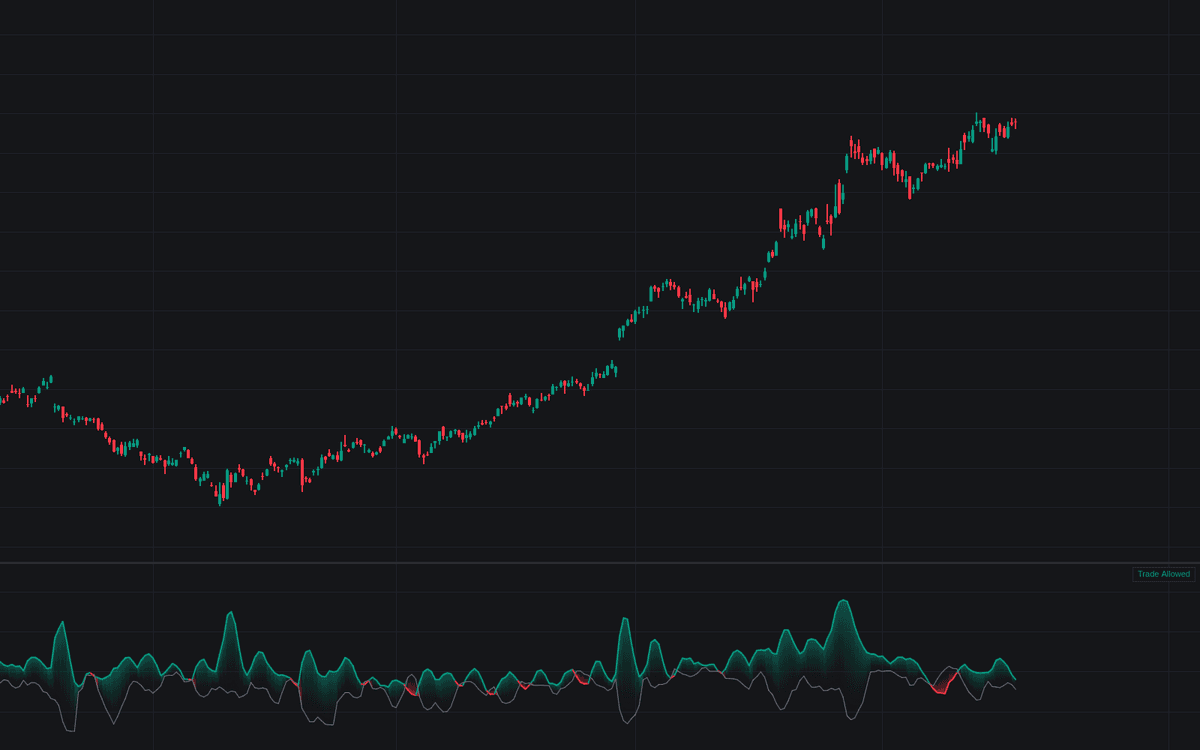

Damiani Volatmeter is the first faithful build of the Damiani Volatmeter in the Library, reproducing the widely shared formulation input for input. The pane plots two lines: Volatility, the fast/slow ATR ratio with the recursive lag-suppression term k × (V[1] − V[3]) added, and Threshold, the constant c minus the fast/slow standard-deviation ratio. A gradient fill turns green while trading is allowed and red while it is not, and a compact dashboard states the current regime in plain text.
How to Trade the Damiani Volatmeter?
- Volatility above Threshold: directional activity is sufficient. Breakout and trend entries from your actual system may be taken.
- Volatility below Threshold: conditions too quiet and erratic to trust a directional signal; stand aside.
- Regime flips: optional circle markers highlight each switch, and the Trade Allowed / No-Trade Zone alerts fire whether or not markers are shown.
The Volatmeter carries no directional opinion. Its double-ratio design exists to reject the churn that pure ATR filters mistake for opportunity: the standard-deviation term adapts the bar expanding range has to clear.
Damiani Volatmeter Settings
- Fast Length (Viscosity) (default 7): fast window shared by the ATR and standard-deviation ratios.
- Slow Length (Sedimentation) (default 50): slow baseline window for both ratios.
- Lag Suppressor (k) (default 0.5): coefficient of the recursive term; 0 disables it, as some circulating versions do.
- Threshold Constant (c) (default 1.1): the constant the standard-deviation ratio is subtracted from.
- StdDev Source (default close): source series for the threshold's deviation ratio.
- Style: Show State Dashboard (default on), Show Regime Change Markers (default off), Highlight No-Trade Zones (default off), plus line and state colors.
Frequently Asked Questions

The Library is free. Quant makes it yours.
Pull any concept or indicator into Quant: rebuild it, retune it, or turn it into a backtested strategy of your own.