Concept
Damiani Volatmeter
Damiani Volatmeter is a Volatility concept. The Library holds 1 implementation, a working definition you can pull into Quant.
Top Damiani Volatmeter indicator
The top custom implementation, built on the original standard Damiani Volatmeter formula.
1 total
This Damiani Volatmeter implementation is strategy-ready: open it in Quant, set your rules, and it backtests automatically.
What is the Damiani Volatmeter?
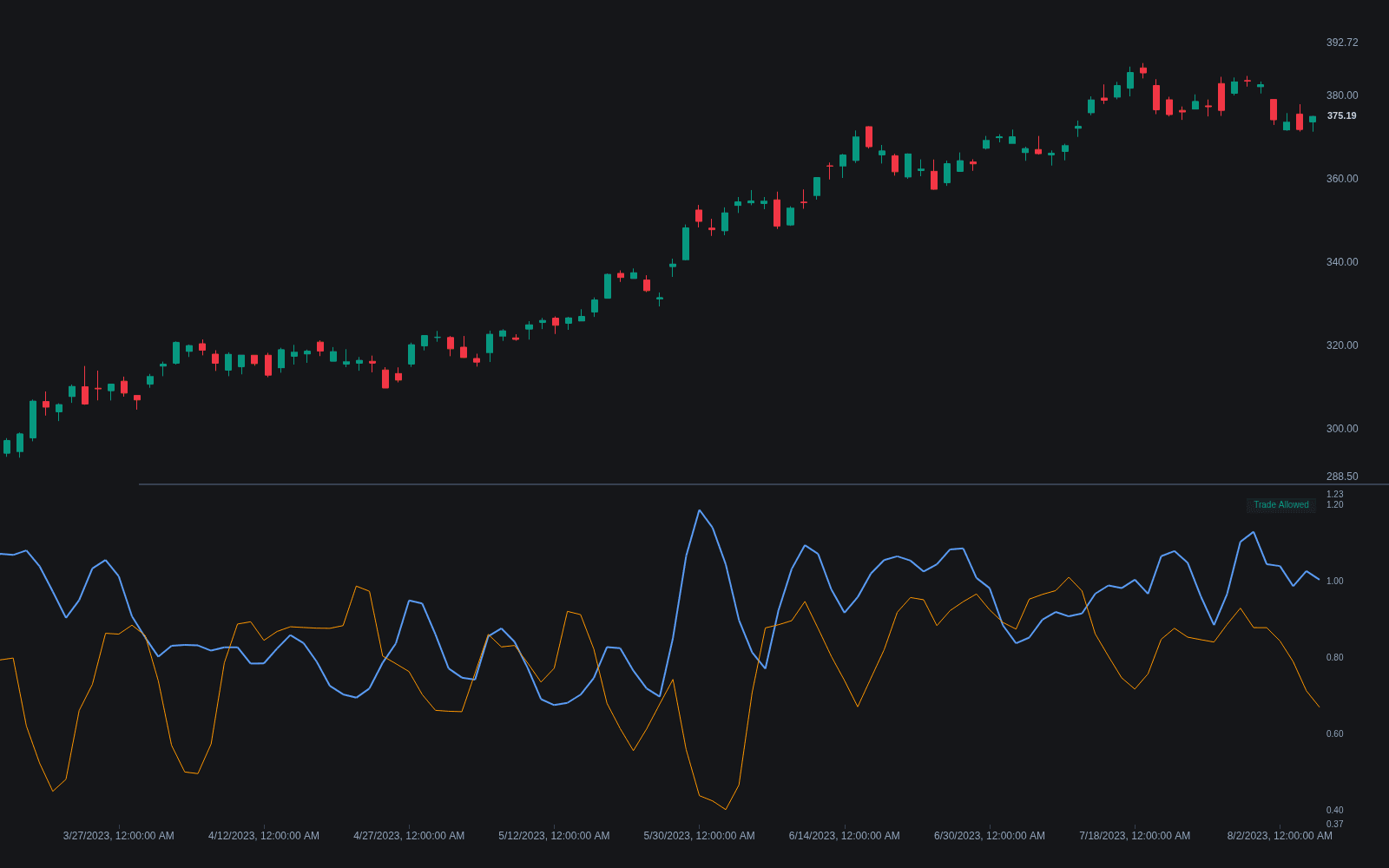
The Damiani Volatmeter is a trade/no-trade filter, attributed to Luis Damiani and circulated widely in the MetaTrader forex community in the mid-2000s, that tries to answer one question: is the market currently volatile enough, in a directional sense, for breakout and trend entries to be worth taking? It plots two lines in a subwindow, a volatility line built from the ratio of a fast ATR to a slow ATR, and a threshold line built from a constant minus the ratio of fast to slow standard deviation. When the volatility line is above the threshold line, trading is considered allowed; when it dips below, the market is judged to be in dead, choppy conditions where signals are more likely to be noise.
The double-ratio design is the interesting part. The ATR ratio rises when recent true range expands relative to its longer baseline, which flags emerging activity. The standard-deviation ratio term works in the opposite direction on the threshold, tightening or loosening the bar that activity has to clear. The intent is to reject the specific failure mode of pure ATR filters: bursts of range that are just churn rather than the start of a move.
Traders care because filtering is often worth more than signal generation. Applied on top of a breakout or trend system, the Volatmeter's only job is to keep the system flat during compression, competing in role with tools like the Choppiness Index and ADX-based filters.
How it's calculated
There is no single canonical publication; the standard form, taken from the widely shared implementation, is:
Ports differ in the lag suppressor, the constant c, and whether the standard deviation uses closes or another source, so readings are not directly comparable across platforms.
How traders use it
- As a system gate: breakout or momentum entries are only taken while the volatility line is above the threshold; signals during no-trade zones are skipped entirely.
- For session selection in forex: the filter tends to switch on around active session overlaps and off during quiet hours, effectively automating a time-of-day filter.
- As a squeeze-exit companion: some traders pair it with compression tools so that a squeeze plus a Volatmeter turn-on marks the transition from coiling to expansion, a role similar to Waddah Attar Explosion.
- With honest limits: it is reactive, so it usually switches on after the first expansion bars, and in strongly mean-reverting conditions it can enable trading right into whipsaw. It says nothing about direction.
Damiani Volatmeter vs other regime filters
Choppiness Index: The Choppiness Index scores trendiness from how much path was needed to cover the net range, on a bounded scale. The Volatmeter compares fast and slow volatility and outputs a binary trade/no-trade condition.
ADX / DMI System: ADX measures directional movement strength and comes with its own entry logic. The Volatmeter measures only activity relative to baseline; it is a gate for other systems, not a signal source.
Volatility Switch: The volatility switch ranks current volatility against its own history to label the regime. The Volatmeter's two-line crossing structure adds an adaptive threshold rather than a percentile rank.
Concept family
Volatility
57 concepts mapped · 57 in the Library
Damiani Volatmeter FAQ
Turn Damiani Volatmeter into a trading strategy.
Take the implementation from this page into Quant, then build on it, backtest it on real data, and keep refining it in conversation.