Diamond Top/bottom
 By LuxAlgoMay 28, 2026
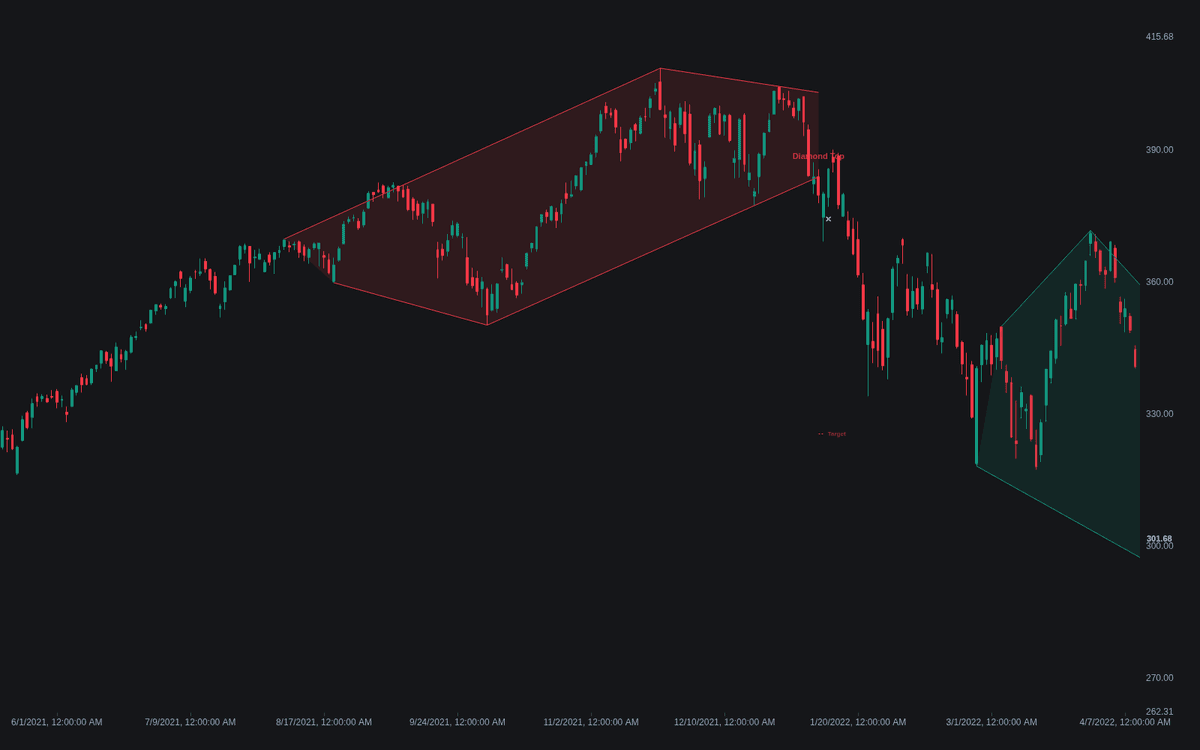

Diamond Top/bottom detects the four-sided reversal shape of a diamond top and bottom: alternating swings that broaden into a widest point, then contract, with verified touches on every edge. Its first Library build classifies each find by the prior move (advance means top, decline means bottom) and completes it when a close pushes decisively beyond a contracting edge, drawing edges, fill and a label.
How to Trade the Diamond Top/bottom?
- Forming preview: dotted boundaries appear once expansion-then-contraction confirms on all four edges, the earliest honest look.
- Decisive break: a close through a converging edge completes the pattern; trade the actual break direction.
- Measure-rule target: the widest-point height projected from the break, tracked as a dotted line until reached.
- Failure watch: acceptance back inside the broken boundary negates the pattern, marked with a cross.
Diamonds are among the rarer members of the chart pattern family, so the touch requirements are strict by design.
Diamond Top/bottom Settings
- Swing Length (default 6) and Maximum Swings (default 12): swing confirmation span, and the scan cap for one pattern.
- Touches per Edge (default 2): swing touches per edge.
- Decisive Break Buffer (ATR) (default 0): extra ATR a close must clear.
- Require Sharp Prior Move (default enabled), Prior Move Window (bars) (default 20), Minimum Prior Move (x ATR) (default 2) and Volatility Baseline Length (default 50): the ATR-normalized steep move that classical diamonds follow.
- Volume Fade Filter (default disabled): require volume to fade from the broadening half into the contracting half.
- Measure-Rule Target (default enabled) and Failure Watch (bars) (default 12): objective tracking and the post-break negation window.
- Style toggles: forming preview, pattern fill and the bullish/bearish colors.
Frequently Asked Questions

Original indicatorBuilt in-house by LuxAlgo
The Library is free. Quant makes it yours.
Pull any concept or indicator into Quant: rebuild it, retune it, or turn it into a backtested strategy of your own.