Concept
Diamond Top/bottom
Diamond Top/bottom is a Chart & Candlestick Patterns concept. The Library holds 1 implementation, a working definition you can pull into Quant.
Top Diamond Top/bottom indicator
The top custom implementation, built on the original standard Diamond Top/bottom formula.
1 total
The Diamond Top/bottom implementation below can become a backtested trading strategy — describe your rules and Quant writes the code.
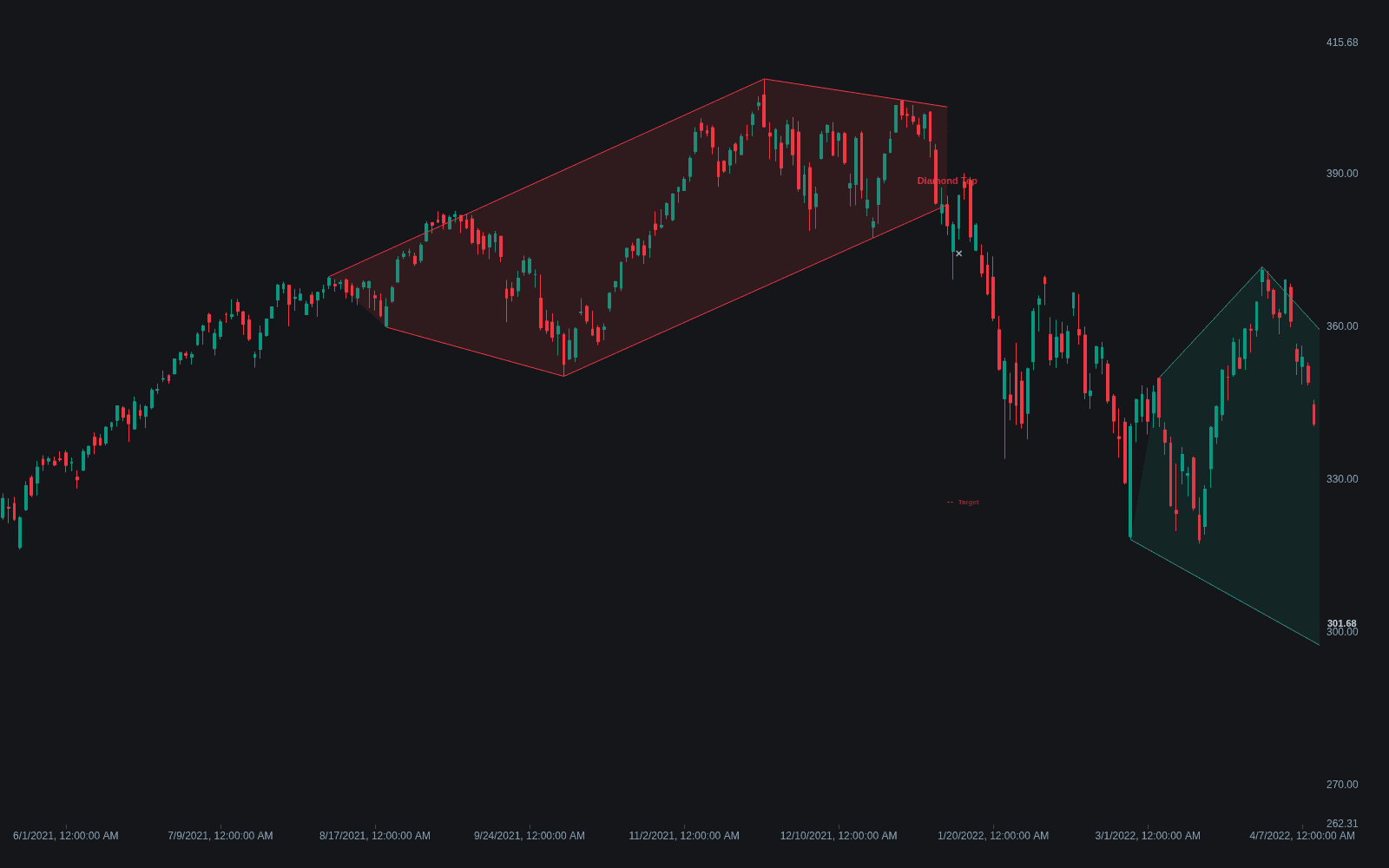
What are Diamond Tops and Bottoms?
A diamond is a reversal pattern in which price first broadens, making higher highs and lower lows, and then contracts, making lower highs and higher lows, so that the boundary lines trace a four-sided diamond shape. A diamond top forms after an advance and resolves downward through the lower right edge; a diamond bottom mirrors it after a decline. The pattern is effectively a broadening formation that morphs into a symmetrical triangle.
The sequence tells a story about participation. The broadening half records a volatile, emotional market where each swing overshoots the last, common after a fast run-up or a news-driven spike. The contracting half records the exhaustion of that emotion: rotations shrink, volume tends to fade, and the market coils around a consensus price before breaking. Because the widest point sits in the middle rather than at the start, diamonds are notoriously hard to see while forming and are usually recognized only in their second half.
Diamonds are among the rarer classical patterns, and the literature has treated them mainly as top formations after steep advances, where they often precede fast declines. Their rarity cuts both ways: they are distinctive when genuine, but the temptation to force diamond boundaries onto ordinary chop produces many false identifications.
How to identify a diamond top or bottom
The defining feature is the sequence: expansion first, contraction second, with real touches on all four boundary segments.
- 1Start with a sharp prior move; diamonds after steep advances or declines are the classical setting.
- 2Confirm the broadening half: at least two higher highs and two lower lows that let you draw diverging upper and lower lines.
- 3Confirm the contracting half: subsequent swings make lower highs and higher lows, letting you draw converging lines that meet the diverging pair at the widest point.
- 4Check volume: it often expands through the broadening half and contracts through the narrowing half, though this signature is not universal.
- 5Measure the pattern height at the widest point for the measure rule objective.
- 6Trade only the resolution: a decisive close through a converging boundary completes the pattern, and acceptance back inside negates it.
How traders use it
- Reversal entry on the boundary break: for a diamond top, short a decisive close below the lower right edge, stop above the most recent lower high, and project the pattern height downward from the break.
- Fast-move anticipation: because diamond tops often follow near-vertical rallies, some traders treat a completed diamond as a signal that the preceding spike may be retraced quickly, and manage targets accordingly rather than holding for a slow trend.
- Filtering out impostors: requiring genuine alternating touches on all four edges, rather than two lines forced over noise, removes most false diamonds; if the widest point is at the start, the structure is a triangle, not a diamond.
- Managing failure: diamonds resolve against the expected direction often enough that a false breakout plan, exiting on acceptance back inside the boundary, is part of the trade rather than an afterthought.
Diamonds vs. adjacent consolidations
Broadening Formation: A broadening formation keeps expanding until it resolves; a diamond is a broadening phase that folds into a contraction, moving its widest point to the middle.
Symmetrical triangle: A symmetrical triangle contracts from the start, with its widest point at the left edge; a diamond reaches its widest point mid-pattern after first expanding.
Head and Shoulders: Sloppy head and shoulders tops are sometimes redrawable as diamonds, since both center a dominant middle peak; the diamond read uses four boundary lines instead of a neckline.
Concept family
Chart & Candlestick Patterns
84 concepts mapped · 84 in the Library
Diamond Top/bottom FAQ
Turn Diamond Top/bottom into a trading strategy.
Take the implementation from this page into Quant, then build on it, backtest it on real data, and keep refining it in conversation.