Concept
Evening Star
Evening Star, also known as evening doji star, is a Chart & Candlestick Patterns concept. The Library holds 1 implementation, a working definition you can pull into Quant.
Top Evening Star indicator
The top custom implementation, built on the original standard Evening Star formula.
1 total
From studying Evening Star to trading it: take the implementation below into Quant and backtest it instantly.
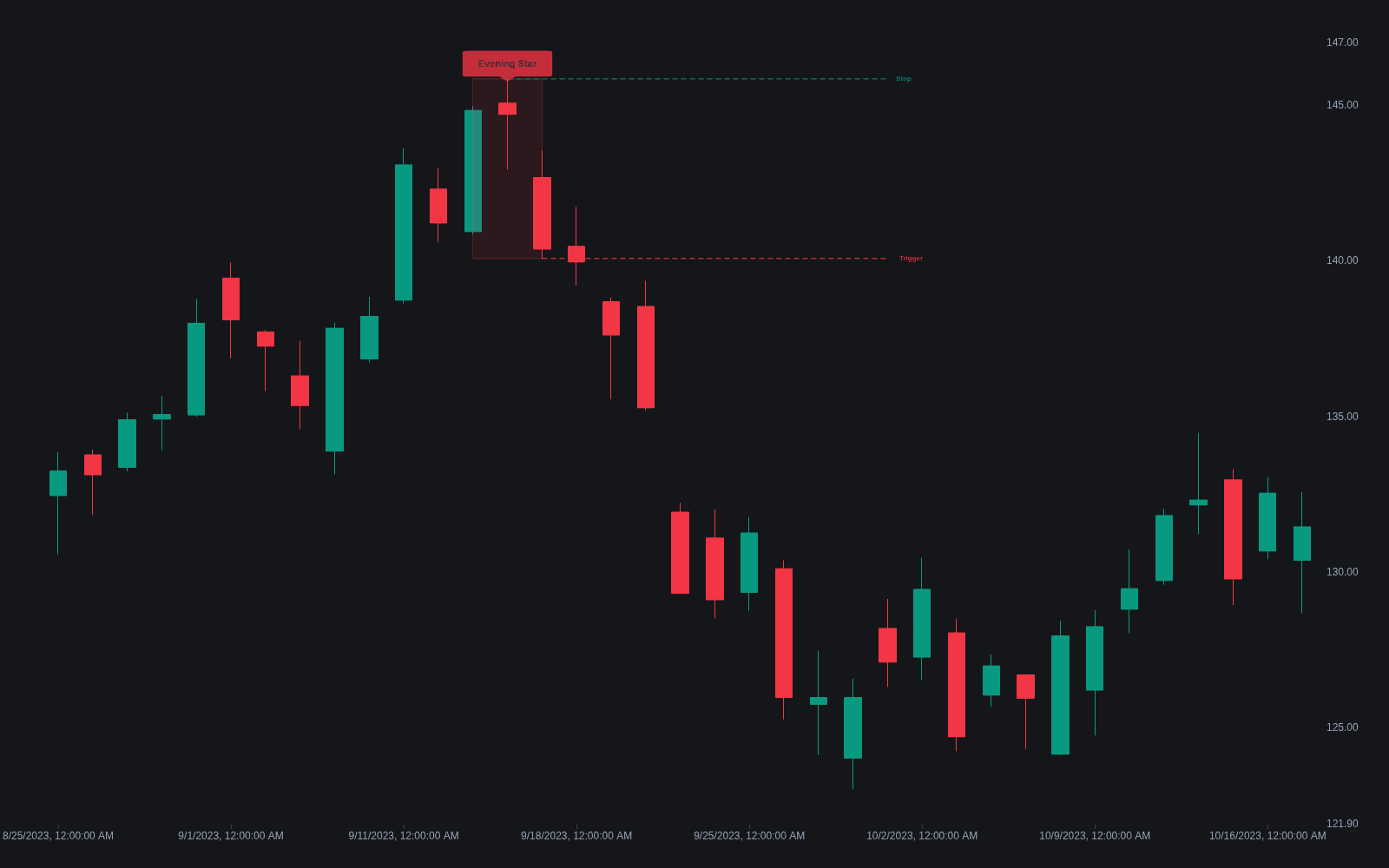
What is an Evening Star?
An evening star is a three-candle bearish reversal pattern from Japanese candlestick analysis. It forms at the top of an advance: a strong bullish candle, then a small-bodied candle (the star) whose body sits above the first, ideally gapping away, then a bearish candle that closes deep into the first candle's body. The sequence reads as momentum, hesitation, rejection. When the middle candle is a doji, the pattern is an evening doji star, conventionally treated as the stronger warning.
The pattern comes from the Japanese rice-trading tradition and reached Western readers largely through Steve Nison, whose 1991 book Japanese Candlestick Charting Techniques catalogued it among the classic candlestick patterns. The name refers to the evening star, Venus shining just before nightfall: the star candle is the last light of the uptrend before dark. Its bullish mirror at lows is the morning star, named for the planet that appears just before sunrise.
Each candle marks a stage in the handover of control. The first is one-sided buying, often a wide-range bar extending the trend. The second shows initiative stalling: price holds high but the body shrinks to a spinning top or doji. The third is the verdict, sellers driving price back through territory buyers had just paid for. Classical descriptions ask it to close well into the first candle's body, often below its midpoint, and a very large third candle can simultaneously qualify as a bearish engulfing of the star.
Like most candlestick reversals, the evening star carries more weight in context: after an extended run, at a resistance level or prior swing high, or with the third candle closing on expanding volume. On 24-hour markets the middle candle rarely gaps, so most traders accept a small body that merely holds above the first candle's close. A textbook example is still a statement about one swing, not a full trend forecast, so location and confirmation do most of the heavy lifting.
How to Identify an Evening Star on a Chart
The pattern only means something after a rise: confirm there is a trend to reverse, then grade the three candles in order.
- 1Confirm the setting: a clear advance, ideally several consecutive up closes or a push into prior highs where a double top could be forming.
- 2Grade candle one: a strong bullish candle with a full body, the uptrend still in force.
- 3Grade candle two: a small body of either color holding above candle one's body, gapping higher where markets gap; a doji makes it an evening doji star.
- 4Grade candle three: a bearish candle closing well into candle one's body, ideally below its midpoint, on steady or expanding volume.
- 5Set the invalidation: a close back above the star's high cancels the bearish reading, so mark that level before acting.
How traders use it
- As a reversal trigger: aggressive entries sell the third candle's close, conservative ones wait for a break of the pattern's low, with the stop above the star's high.
- As a location tool: the pattern is usually filtered by where it appears (at resistance, at prior highs, or after a stretch of consecutive up closes) rather than traded everywhere it prints.
- As confirmation alongside other evidence, such as bearish momentum divergence or overbought oscillator readings, rather than as a standalone signal.
- As an exit prompt: swing traders holding longs treat an evening star at a target zone as reason to take profit or tighten stops, even with no interest in shorting.
- As a target framework: common objectives are the origin of the advance, the nearest support shelf, or an open gap below, letting the follow-through double as a gap fill trade.
Evening Star vs Similar Reversal Patterns
Morning Star: The exact mirror image: a downtrend, a star below the first candle's body, then a bullish close deep into it. Same three-stage psychology, opposite direction.
Bullish/bearish Engulfing: The engulfing pattern compresses the reversal into two candles, skipping the hesitation stage. An oversized third candle can satisfy both definitions at once.
Two-bar Reversal: A two-bar reversal pairs a strong directional bar with an immediate strong bar the other way; the evening star inserts a pause between them, read by many as a more complete shift.
Concept family
Chart & Candlestick Patterns
84 concepts mapped · 84 in the Library
Evening Star FAQ
Turn Evening Star into a trading strategy.
Take the implementation from this page into Quant, then build on it, backtest it on real data, and keep refining it in conversation.