Concept

HTF-level Proximity Filters

HTF-level Proximity Filters, also known as LTF confirmation at HTF levels, are Meta & Composition concepts. A reference entry: the Library explains it rather than implements it.

What are HTF-level Proximity Filters?

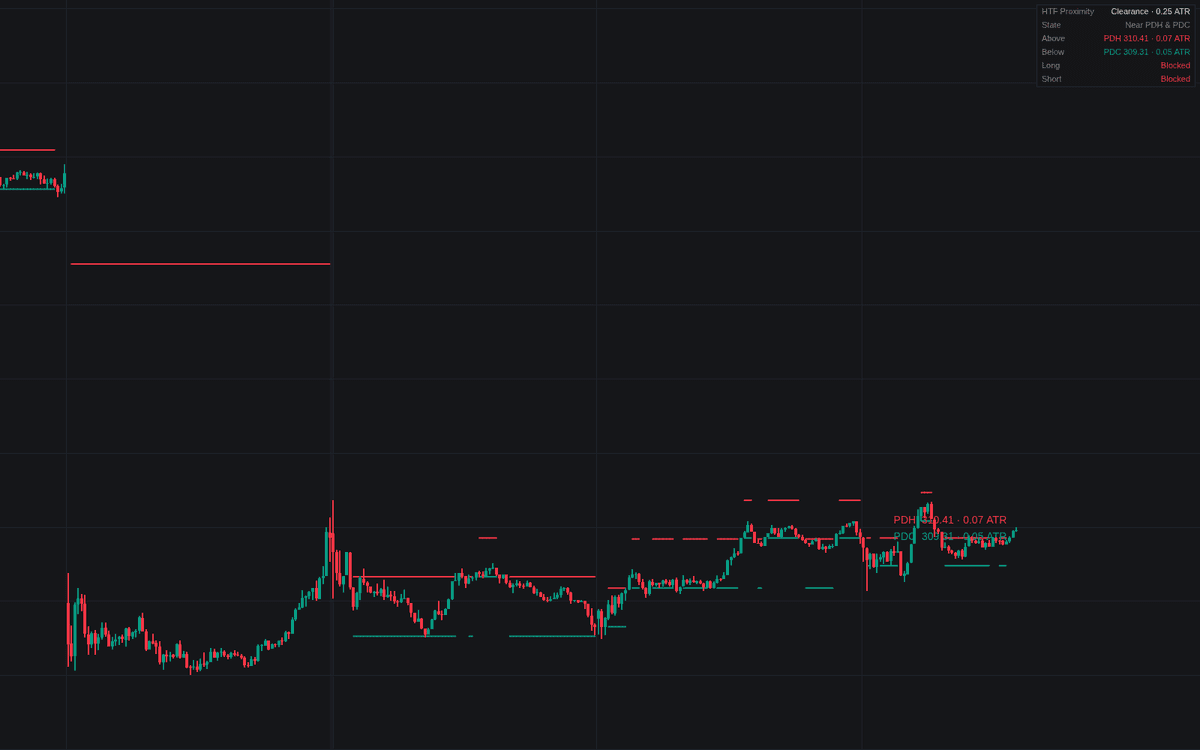
An HTF-level proximity filter gates lower-timeframe signals by their distance to higher-timeframe levels. The mechanics are simple: maintain a set of levels computed on a higher timeframe, such as prior period levels, pivots, or untested zones; measure current price's distance to the nearest one, usually normalized in ATR multiples or percent; and allow or suppress the signal based on that distance. It runs in two modes: require proximity, so entries only count when they fire at a level, or require clearance, so a long triggered directly beneath higher-timeframe resistance is discarded because its room to run may be capped before it starts.

The filter turns the top-down habit, trade the lower timeframe only where the higher timeframe agrees, into checkable arithmetic. Its output is only as good as its level set: feed it too many levels and everything is near one, feed it too few and valid locations are missed. Implementations therefore tend to cap the number of active levels per side and prefer fresh, untested ones.

The implementation choices are where filters diverge. Level sources range from mechanical period highs and lows through higher-timeframe pivots to specialized zones like rejection blocks, each with its own freshness bookkeeping; distances are normalized so one threshold travels across instruments; and the level budget, how many actives per side, is the quiet parameter that decides whether being near a level means anything. Architecturally it belongs to the filter stage of a filter-setup-trigger-exit pipeline: it never generates signals, it adjudicates locations for signals generated elsewhere.

The discipline that keeps it honest is measurement. A proximity filter makes a testable claim, that signals at higher-timeframe levels outperform signals in open space, and the claim is checked by running the filtered and unfiltered signal streams over the same history and comparing. The known failure modes are level inflation (so many levels that the filter passes everything), staleness (levels from a regime the market has left), and threshold overfit (a distance tuned to one backtest). Graded versions fold the distance into confluence scoring instead of a binary gate, and the same machinery drives alert routing, so notifications only fire where location adds odds.

How to identify and build a proximity filter

Five decisions define the filter, and each one is auditable.

  1. 1Choose the level set: which higher-timeframe levels count, with a hard cap per side and a preference for fresh, untested ones.
  2. 2Normalize the distance: ATR multiples or percent of price, so the threshold means the same thing across instruments and regimes.
  3. 3Pick the mode: require proximity for entry qualification, or require clearance to veto trades whose first obstacle is immediate.
  4. 4Set the threshold deliberately and sparingly; it is a tunable parameter with all the overfit risk that implies.
  5. 5Verify the contribution: compare filtered against unfiltered signal streams on the same data, and keep the filter only if its rejections demonstrably earn their keep.

How traders use it

  • As a veto: suppress longs within a set distance below higher-timeframe resistance and shorts just above higher-timeframe support, removing trades whose first obstacle arrives almost immediately.
  • As entry qualification: the inverse mode accepts lower-timeframe reversal triggers only when they print at a higher-timeframe level, the familiar pattern of dropping down a timeframe to confirm a location before committing.
  • As target logic: the same distance calculation ranks which level sits first in the trade's path, informing where targets or partial exits belong rather than whether to enter.
  • As a score component: graded systems feed the normalized distance into a confluence score alongside trend and momentum terms, so location weights conviction instead of switching it on and off.
  • As alert hygiene: routing only near-level signals to notifications cuts alert fatigue, reserving attention for the interactions the top-down thesis says matter.

Proximity filters vs related composition tools

Top-down Analysis: Top-down is the habit: read the higher timeframe first, execute lower only where it agrees. The proximity filter is that habit compiled into arithmetic, reproducible, backtestable, and immune to the discretionary drift that lets a trader call anything 'at a level' after the fact.

MTF Alignment & Confluence Scoring: Confluence scoring grades many conditions into a number; the proximity filter is one natural component, contributing location. As a standalone it is binary and blunt; inside a score it becomes graded evidence, which is usually the better use of distance information.

Signal Hygiene: Hygiene cleans the signal stream mechanically: dedupe, debounce, conflict resolution. The proximity filter edits the stream editorially, rejecting signals by thesis rather than by bookkeeping. Both reduce the stream; only one claims the survivors are better.

Concept family

Meta & Composition

28 concepts mapped · 28 in the Library

HTF-level Proximity Filters FAQ

How close does price need to be to a higher-timeframe level to count?

There is no universal number. Common practice normalizes distance by volatility, for example within a fraction of the daily ATR, or by a percentage of price, because a fixed tick distance means completely different things on different instruments and timeframes. The threshold is a tunable parameter: tighter thresholds select fewer, cleaner interactions, while looser ones catch more but dilute the meaning of being at the level.

Are signals taken at higher-timeframe levels more reliable?

They are differently located, not guaranteed. Higher-timeframe levels attract attention and order flow, which is why traders filter for them, but levels break regularly and a filter cannot know in advance which will hold. Treat proximity filtering as trade selection whose value should be measured: compare the filtered and unfiltered signal streams over the same data and confirm the filter is actually earning its rejections.

Which levels should feed a proximity filter?

Few, fresh, and independently meaningful. Prior period highs, lows and closes, untested higher-timeframe pivots, and well-defined zones beat exhaustive level dumps, because a filter fed fifty levels finds everything near something and rejects nothing. Most implementations cap actives per side, retire tested levels, and prefer sources whose relevance does not depend on the filter itself agreeing.

Should distance be measured in ATR or percent?

ATR-scaled distances travel best: half a daily ATR means comparably near on a quiet blue chip and a wild crypto pair, and the threshold adapts as regimes change. Percent-of-price is simpler and stable on one instrument but silently retunes itself across volatility shifts. Tick distances are the worst of both. Whichever unit you choose, the answer changes with it, so the unit is part of the filter's definition.

Can the same machinery pick targets?

Yes, and it is the filter's second job: the distance calculation that vetoes an entry under resistance is the same one that ranks which level sits first in an accepted trade's path. Clearance mode effectively computes room to run, and the first obstacle it finds is the natural first target or partial-exit point. Entry selection and exit mapping fall out of one level set kept honest.

How do you verify a proximity filter helps?

A/B it: run the identical signal stream with and without the filter over the same history and compare expectancy, drawdown and trade count. Then audit the rejections specifically, since a good filter's discarded trades should underperform its accepted ones by a margin that survives costs. Filters that only reduce trade count without separating quality are expressing a belief, not adding an edge.

Build HTF-level Proximity Filters your way.

Quant writes, tests, and refines it with you — then it runs on LuxAlgo charting or ports to TradingView.