Concept
HTF-level Proximity Filters
HTF-level Proximity Filters, also known as LTF confirmation at HTF levels, are Meta & Composition concepts. The Library holds 1 implementation, a working definition you can pull into Quant.
Top HTF-level Proximity Filters indicator
The top custom implementation, built on the original standard HTF-level Proximity Filters formula.
1 total
This HTF-level Proximity Filters implementation is strategy-ready: open it in Quant, set your rules, and it backtests automatically.
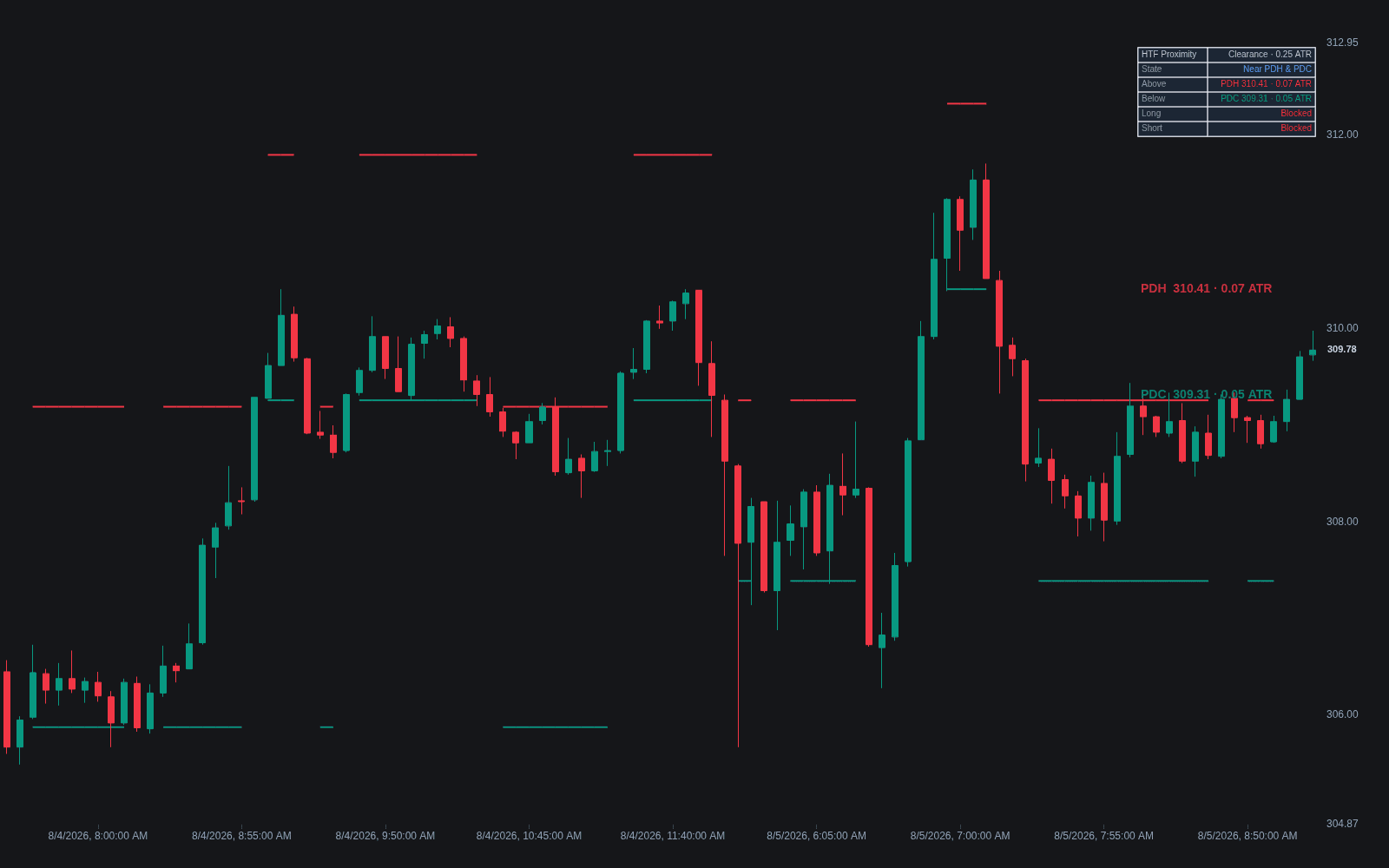
What are HTF-level Proximity Filters?
An HTF-level proximity filter gates lower-timeframe signals by their distance to higher-timeframe levels. The mechanics are simple: maintain a set of levels computed on a higher timeframe, such as prior period levels, pivots, or untested zones; measure current price's distance to the nearest one, usually normalized in ATR multiples or percent; and allow or suppress the signal based on that distance. It runs in two modes: require proximity, so entries only count when they fire at a level, or require clearance, so a long triggered directly beneath higher-timeframe resistance is discarded because its room to run may be capped before it starts.
The filter turns the top-down habit, trade the lower timeframe only where the higher timeframe agrees, into checkable arithmetic. Its output is only as good as its level set: feed it too many levels and everything is near one, feed it too few and valid locations are missed. Implementations therefore tend to cap the number of active levels per side and prefer fresh, untested ones.
The implementation choices are where filters diverge. Level sources range from mechanical period highs and lows through higher-timeframe pivots to specialized zones like rejection blocks, each with its own freshness bookkeeping; distances are normalized so one threshold travels across instruments; and the level budget, how many actives per side, is the quiet parameter that decides whether being near a level means anything. Architecturally it belongs to the filter stage of a filter-setup-trigger-exit pipeline: it never generates signals, it adjudicates locations for signals generated elsewhere.
The discipline that keeps it honest is measurement. A proximity filter makes a testable claim, that signals at higher-timeframe levels outperform signals in open space, and the claim is checked by running the filtered and unfiltered signal streams over the same history and comparing. The known failure modes are level inflation (so many levels that the filter passes everything), staleness (levels from a regime the market has left), and threshold overfit (a distance tuned to one backtest). Graded versions fold the distance into confluence scoring instead of a binary gate, and the same machinery drives alert routing, so notifications only fire where location adds odds.
How to identify and build a proximity filter
Five decisions define the filter, and each one is auditable.
- 1Choose the level set: which higher-timeframe levels count, with a hard cap per side and a preference for fresh, untested ones.
- 2Normalize the distance: ATR multiples or percent of price, so the threshold means the same thing across instruments and regimes.
- 3Pick the mode: require proximity for entry qualification, or require clearance to veto trades whose first obstacle is immediate.
- 4Set the threshold deliberately and sparingly; it is a tunable parameter with all the overfit risk that implies.
- 5Verify the contribution: compare filtered against unfiltered signal streams on the same data, and keep the filter only if its rejections demonstrably earn their keep.
How traders use it
- As a veto: suppress longs within a set distance below higher-timeframe resistance and shorts just above higher-timeframe support, removing trades whose first obstacle arrives almost immediately.
- As entry qualification: the inverse mode accepts lower-timeframe reversal triggers only when they print at a higher-timeframe level, the familiar pattern of dropping down a timeframe to confirm a location before committing.
- As target logic: the same distance calculation ranks which level sits first in the trade's path, informing where targets or partial exits belong rather than whether to enter.
- As a score component: graded systems feed the normalized distance into a confluence score alongside trend and momentum terms, so location weights conviction instead of switching it on and off.
- As alert hygiene: routing only near-level signals to notifications cuts alert fatigue, reserving attention for the interactions the top-down thesis says matter.
Proximity filters vs related composition tools
Top-down Analysis: Top-down is the habit: read the higher timeframe first, execute lower only where it agrees. The proximity filter is that habit compiled into arithmetic, reproducible, backtestable, and immune to the discretionary drift that lets a trader call anything 'at a level' after the fact.
MTF Alignment & Confluence Scoring: Confluence scoring grades many conditions into a number; the proximity filter is one natural component, contributing location. As a standalone it is binary and blunt; inside a score it becomes graded evidence, which is usually the better use of distance information.
Signal Hygiene: Hygiene cleans the signal stream mechanically: dedupe, debounce, conflict resolution. The proximity filter edits the stream editorially, rejecting signals by thesis rather than by bookkeeping. Both reduce the stream; only one claims the survivors are better.
Concept family
Meta & Composition
28 concepts mapped · 28 in the Library
HTF-level Proximity Filters FAQ
Turn HTF-level Proximity Filters into a trading strategy.
Take the implementation from this page into Quant, then build on it, backtest it on real data, and keep refining it in conversation.