Buy to Close: Effective Exit Strategies
A Buy to Close (BTC) order repurchases an option you previously sold short, reducing or eliminating that position when it fills. An effective exit plan specifies the contract, quantity, price instructions, and conditions for leaving. It also accounts for assignment, partial fills, and any exposure left elsewhere in the strategy.
Use LuxAlgo’s native charts to study the underlying market and Quant to help define reviewable exit rules. Then check the option’s current premium and the actual closing order in your broker’s platform. Underlying-price analysis can inform an exit without determining the option’s executable price.
Using Buy to Close Orders
BTC normally describes closing a short option. Buying back short stock is commonly called buying to cover. The distinction matters: a short call and a short put respond differently to an underlying-price move, and neither should be managed by blindly copying a short-stock stop.
Match the account and exact series: underlying, call or put, strike, expiration, and any adjusted contract terms. Buying another expiration or strike does not close the original position. To exit an option you own, the action is Sell to Close. Our option-order comparison explains all four actions.
A Complete Closing Example
Suppose you sold three hypothetical standard 100-share calls at $4.00 per share. The opening premium credit was $1,200 before costs. You later buy two of the same calls to close at $1.50:
- Closing debit: 2 × 100 × $1.50 = $300.
- Opening credit attributable to those two contracts: $800.
- Realized gross profit on the closed portion: $800 − $300 = $500, before costs.
- Remaining position: one short call, which still carries risk.
If only one of the two requested contracts fills, two calls remain short. If the buyback costs more than the original credit, the closed portion realizes a loss. Verify fills, remaining orders, and the account position together; submission alone does not reduce exposure.
Technical Signals for Exit Points
Choose signals that relate to the actual position. Rising underlying prices may challenge a bearish short-call thesis, while falling prices may challenge a bullish short-put thesis. Implied volatility and remaining time can change the option premium even when the stock moves as expected.
| Context tool | Possible research use | What to specify |
|---|---|---|
| 20-, 50-, or 200-period EMA | Compare price with different trend horizons | Chart timeframe, periods, and exact crossing rule |
| RSI or MACD | Review momentum changes | Inputs, threshold or crossover, and confirmed-bar timing |
| Volume and OBV | Check whether observed activity supports the move | Data source and comparison window |
| Failed breakdown or breakout | Reassess a price-level thesis | Level, penetration, reclaim, and decision timing |
A 20-period EMA is a 20-day EMA only on a daily chart. An RSI cross above 50 is a candidate rule to test, not an automatic BTC instruction for every short option. A volume spike does not prove a reversal or reveal who traded, and a failed breakdown does not establish algorithmic buying.
Market Events and News
Review earnings, dividends, economic announcements, and other events relevant to the underlying. Decide in advance whether the strategy should remain open through them. There is no universal percentage of time that all markets spend trending, nor a fixed volume multiple that makes an exit reliable.
Translate an event concern into a specific action: reassess before a scheduled announcement, reduce a stated quantity, or attempt a full close by a defined time. Allow for the possibility of an unfilled order rather than assuming the deadline itself removes risk.
Buy to Close Methods
Premium Targets and Loss Triggers
A closing limit order sets the maximum premium you will pay. It may fill at that price or lower, but it may also remain unfilled. A market order has different execution tradeoffs. Where your broker supports option stops, inspect whether the trigger uses trades, quotes, or another condition.
For example, selling an option at $4.00 and buying it back at $2.00 retains $200 gross per standard contract before costs. That is 50% of the opening premium, not a 50% return on account capital or a universal optimal target. Compare the remaining potential credit with the remaining risk and time.
Trailing Stops
A broker-supported buy trailing stop can follow a declining option premium and trigger after it rises by the chosen distance. As a hypothetical illustration, a 10% trail above an observed low of $3.00 would be $3.30; after a new low of $2.00, it would be $2.20. Actual reference prices and adjustment rules depend on the broker.
These levels are triggers, not guaranteed fills. A stop-market can execute above them, and a stop-limit can remain unfilled. A trailing-stop indicator plotted on the underlying chart is a separate analytical tool; it does not place or maintain the broker’s option order. Neither 10% nor a fixed ATR multiple is universally suitable.
Partial Position Exits
Closing part of a position reduces the number of short contracts while leaving the remainder exposed. Account for fees and the resulting strategy: closing a short call from a covered call leaves the stock, and changing one spread leg can alter or remove its protection. Buying-power changes depend on the remaining position and broker rules.
Time and Event Exits
A planned review date can prevent a position from drifting into expiration without attention. Define the desired exit window, contract quantity, and fallback if execution is unavailable. A halt or illiquid market can prevent a close, so a calendar rule is not a guarantee.
Risk Control for Buy to Close
Use the Correct Instrument and Direction
For an adverse rise in a short option’s premium, a buy-stop trigger would normally be above its current premium. An underlying-price condition must instead fit the position’s directional thesis. Placing a generic stop below stock support is not appropriate for every short call, short put, or spread.
Keep units consistent. An ATR value on a stock chart is measured in underlying-price units, not option-premium units. An exit based on that chart requires a separately defined condition and supported execution workflow. See our slippage guide for the difference between planned and actual prices.
Evaluate the Whole Position
An uncovered short call can have theoretically unlimited loss. A short put on a nonnegative-priced stock has substantial but finite downside, while covered positions and spreads have different combined exposures. Premium received is not the maximum amount at risk. Size the strategy using its obligations, stress outcomes, liquidity, and other account positions rather than a universal 1–2% rule or a stock-share formula.
Assignment Is Separate from an Exit Signal
American-style short options can be assigned before expiration. The Options Industry Council explains that a closing purchase completed during trading hours removes assignment exposure for the closed position that day, but you should first confirm that assignment has not already happened.
A working BTC order does not close the position, and a later purchase cannot undo an earlier assignment. Check current obligations with the broker. Halts can prevent trading while exercise and assignment obligations remain.
Video: Closing Options Positions
Build Reviewable Exit Rules with LuxAlgo
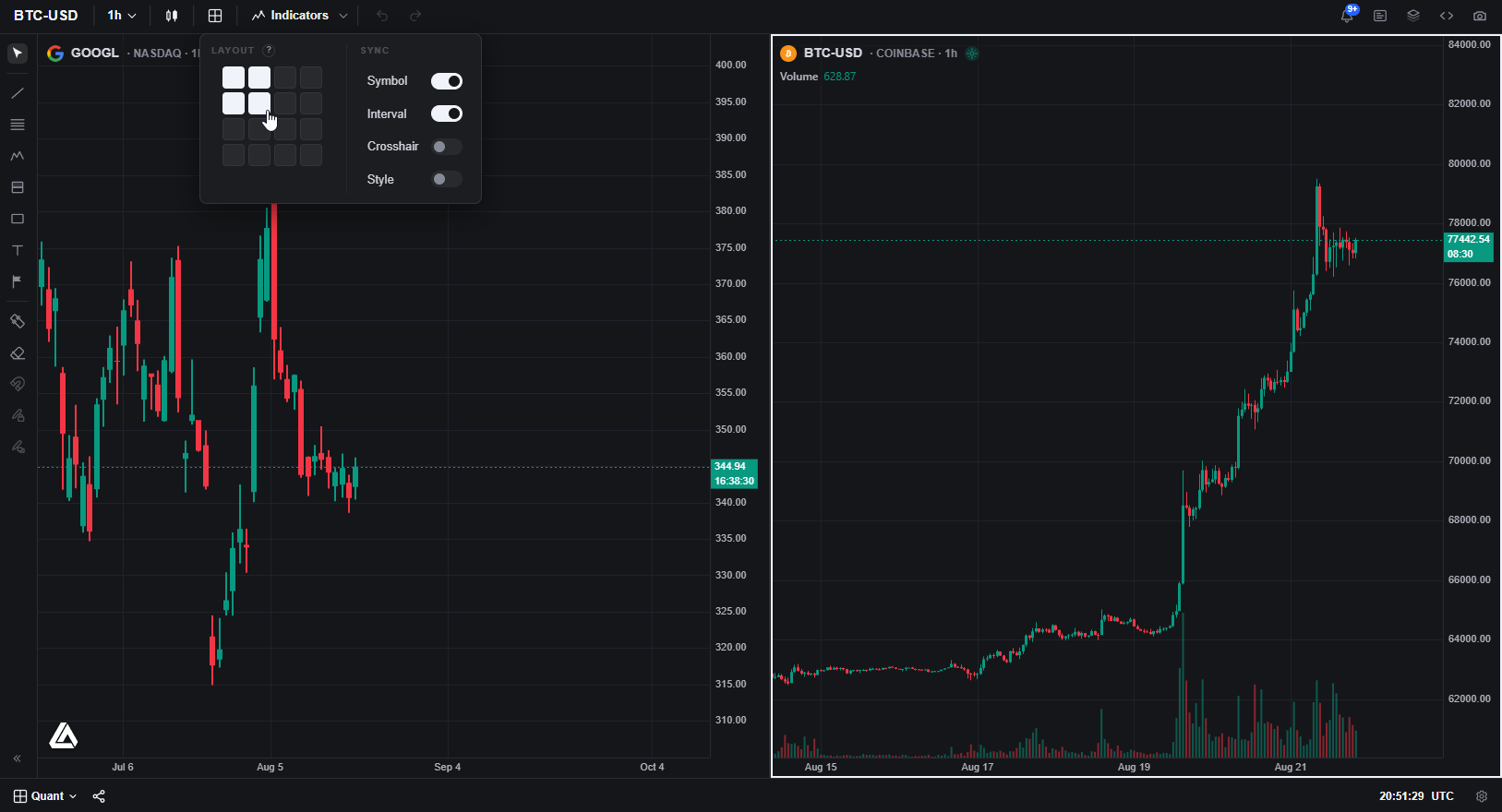
Start with the underlying in LuxAlgo. Compare the relevant timeframes, mark the level that invalidates the thesis, and select indicators that answer specific questions. The native multi-chart layout helps organize that context.
Ask Quant to help write and test explicit underlying-price rules. Inspect its code and trade log, and compare different assumptions without selecting only the most flattering historical result.
Example research prompt: “Help test my underlying-price exit condition with explicit timeframe, indicator inputs, confirmed-bar timing, and costs. Explain the limitations and keep the result separate from an options payoff or assignment simulation.”
An underlying backtest does not automatically model an option chain, Greeks, historical premium spreads, exercise, or assignment. Nor does it send BTC orders to a broker. If using broker conditional or OCO orders, verify supported products, triggers, quantities, and cancellation behavior independently.
Record the original thesis, intended exit, actual fills, costs, and remaining exposure. The LuxAlgo Journal can hold supported trade records and notes; confirm whether the available import or broker data includes the option fields and multi-leg details you need.
Buy to Close Exit Checklist
- Confirm the exact short option, quantity, and any assignment already recorded.
- Choose a premium, underlying-price, time, or event rule that fits the whole strategy.
- Review price instructions, costs, and the possibility of partial or missed fills.
- Verify execution and reconcile remaining orders and positions.
- Reassess any stock holding, spread leg, or short contract left after the close.
A useful exit process connects a clear decision with a verified change in the account. Treat the fill and resulting exposure as the evidence that the intended close occurred.
Read next