Concept
Cup & Handle
Cup & Handle, also known as inverted cup & handle, is a Chart & Candlestick Patterns concept. The Library holds 1 implementation — a working definition you can pull into Quant.
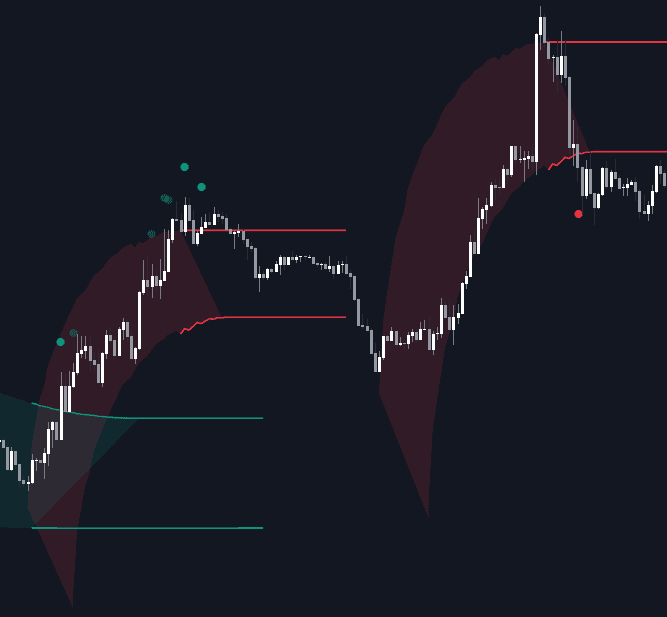
Top Cup & Handle indicator
The top custom implementation, built on the original standard Cup & Handle formula.
1 total
What is a Cup & Handle?
A cup and handle is a bullish continuation pattern popularized by William J. O'Neil, the founder of Investor's Business Daily, in his 1988 book How to Make Money in Stocks. After an advance, price carves a rounded, U-shaped basin (the cup), recovers toward the prior high, then drifts back in a shallower pullback (the handle) before resolving higher. The rounded base matters: a sharp V-shaped recovery lacks the gradual hand-off from sellers to buyers the pattern is meant to capture. In the common reading the handle forms in the upper part of the cup, holds well above the cup's low, and ideally drifts down on shrinking volume.
O'Neil treated the shape as the footprint of institutional accumulation and published specific guidelines for growth stocks on weekly charts: a meaningful prior uptrend, a base at least seven weeks long, a cup correcting roughly 12% to 33% from its high (more in volatile markets), and a handle in the upper half of the base that drifts down along its lows on contracting volume. Handles that sag into the lower half, or wedge steeply upward instead of drifting, count as flaws in his framework. Applied to other markets and timeframes, those numbers are usually treated as proportions rather than laws.
The pattern completes on the breakout above the handle high (the pivot), and the measure rule projects the cup's depth upward from that point as an objective. An inverted cup and handle is the bearish mirror: a rounded dome, a weak bounce, then a breakdown through the bounce low. Without the handle, the base is simply a rounding bottom, which is why the handle is best understood as the trigger mechanism, a final shakeout that clears impatient holders just below the prior high before the move continues.
Volume gives the shape its meaning. The cup's left side is profit-taking, the quiet rounded low is shares changing hands at stable prices, and the right side is renewed demand; activity should dry up through the base and handle, then expand notably on the breakout. That signature, contraction into the pattern and expansion out of it, mirrors the demand logic read into structures like the ascending triangle, and its absence is a common reason textbook-looking cups fail.
How to identify a Cup & Handle
The pattern is defined by sequence and proportion, so check the pieces in order instead of matching the silhouette by eye.
- 1Confirm the prior advance: the left rim of the cup should sit at the top of a meaningful rally, since the pattern continues a trend rather than starting one.
- 2Trace the cup: a rounded, U-shaped decline and recovery whose rims sit near the same price. Two sharp probes of one low with a rally between them is closer to a double bottom.
- 3Watch the handle: a gentle pullback contained in the upper part of the cup that holds well above its low, with shrinking volume and narrowing candles, sometimes a run of inside bars.
- 4Mark the pivot: the handle's high is the buy point, and the pattern stays incomplete until price decisively clears it, ideally on expanding volume.
- 5Reject weak variants: a V-shaped base, a handle sagging below the cup's midpoint, or a listless breakout on quiet volume all downgrade the setup in the classic reading.
How traders use it
- As a continuation entry: a buy stop above the handle high catches the breakout, with the protective stop under the handle low so a failed break exits quickly.
- As a target framework: the cup's depth projected upward from the pivot gives a measured objective, often used as a first scale-out level rather than a fixed exit.
- As a quality filter: shallow handles that drift down on drying-up volume are preferred; a handle that gives back most of the cup, or forms in its lower half, weakens the setup in the classic reading.
- As a volume framework: dry-up through the handle followed by wide-range bars on the breakout is the preferred sequence, and its absence argues for smaller size or a pass.
- As a confluence component: a pivot that coincides with other evidence, such as a completed gap fill just below the handle or a hammer at the handle low, gives the breakout a location rationale beyond the pattern alone.
Cup & Handle vs. similar patterns
Double Top/bottom: A double bottom tests one low twice with a sharp rebound between probes, while the cup rounds through a single smooth basin; both trigger on a breakout, but the cup's quiet base and handle shakeout tell a more gradual accumulation story.
Ascending/descending/symmetrical Triangle: Triangles compress price between converging straight trendlines, whereas the cup and handle is a curve plus a shallow pullback; a tight handle can itself resemble a miniature triangle just before it breaks.
Rising/falling Wedge: A falling wedge is a standalone converging pattern often traded as a reversal, while the handle's downward drift is one component inside a larger bullish base rather than a pattern traded on its own.
Related concepts · Continuation chart patterns
Concept family
Chart & Candlestick Patterns
84 concepts mapped · 84 in the Library
Cup & Handle FAQ
Is a cup and handle bullish or bearish?
The standard cup and handle is a bullish continuation pattern: it forms after an advance and resolves upward on the breakout above the handle. The inverted cup and handle is its bearish mirror, a rounded top with a weak rebound that breaks down. Either way the pattern is a scenario that still requires the breakout to actually hold; failed breaks happen.
How long does a cup and handle take to form?
There is no fixed duration. In O'Neil's stock-market work the pattern is a base tracked on daily or weekly charts, with a minimum of about seven weeks in his rules and often three to six months or more, the handle far shorter than the cup. Traders apply the same geometry intraday, where it forms proportionally faster. The rounded shape and the handle's position matter more than any specific bar count.
What is the price target after a cup and handle breakout?
The conventional objective adds the cup's depth, rim to low, to the pivot price. Most traders treat it as a first scale-out area rather than a promise, trimming earlier when prior highs or heavy supply sit below the measured level and letting strong trends run beyond it.
What makes a handle valid?
In the classic reading the handle forms in the upper half of the cup, holds above its midpoint, drifts down or sideways on shrinking volume, and takes far less time than the cup did to build. Handles that plunge into the lower half of the base, or rally steeply before the breakout, are treated as flaws.
What invalidates a cup and handle?
Before the breakout, a handle that collapses below the cup's midpoint, and certainly below its low, ends the setup. After the breakout, the common line is a decisive close back below the pivot: shallow retests are normal, but a failed break that traps buyers is exactly what the stop under the handle low is meant to cap.
What is an inverted cup and handle?
The bearish mirror: price rounds over in a dome, attempts a weak bounce (the inverted handle), then breaks down through the bounce low. It is traded with a sell stop under that low and the dome's depth projected downward, and the same quality tests apply in reverse: a rounded top, a shallow bounce, and expansion on the breakdown.
Build Cup & Handle your way.
Quant writes, tests, and refines it with you — then it runs on LuxAlgo charting or ports to TradingView.