Concept
Wide-range Bar
Wide-range Bar, also known as close-location value conventions, is a Chart & Candlestick Patterns concept. The Library holds 1 implementation, a working definition you can pull into Quant.
Top Wide-range Bar indicator
The top custom implementation, built on the original standard Wide-range Bar formula.
1 total
This Wide-range Bar implementation is strategy-ready: open it in Quant, set your rules, and it backtests automatically.
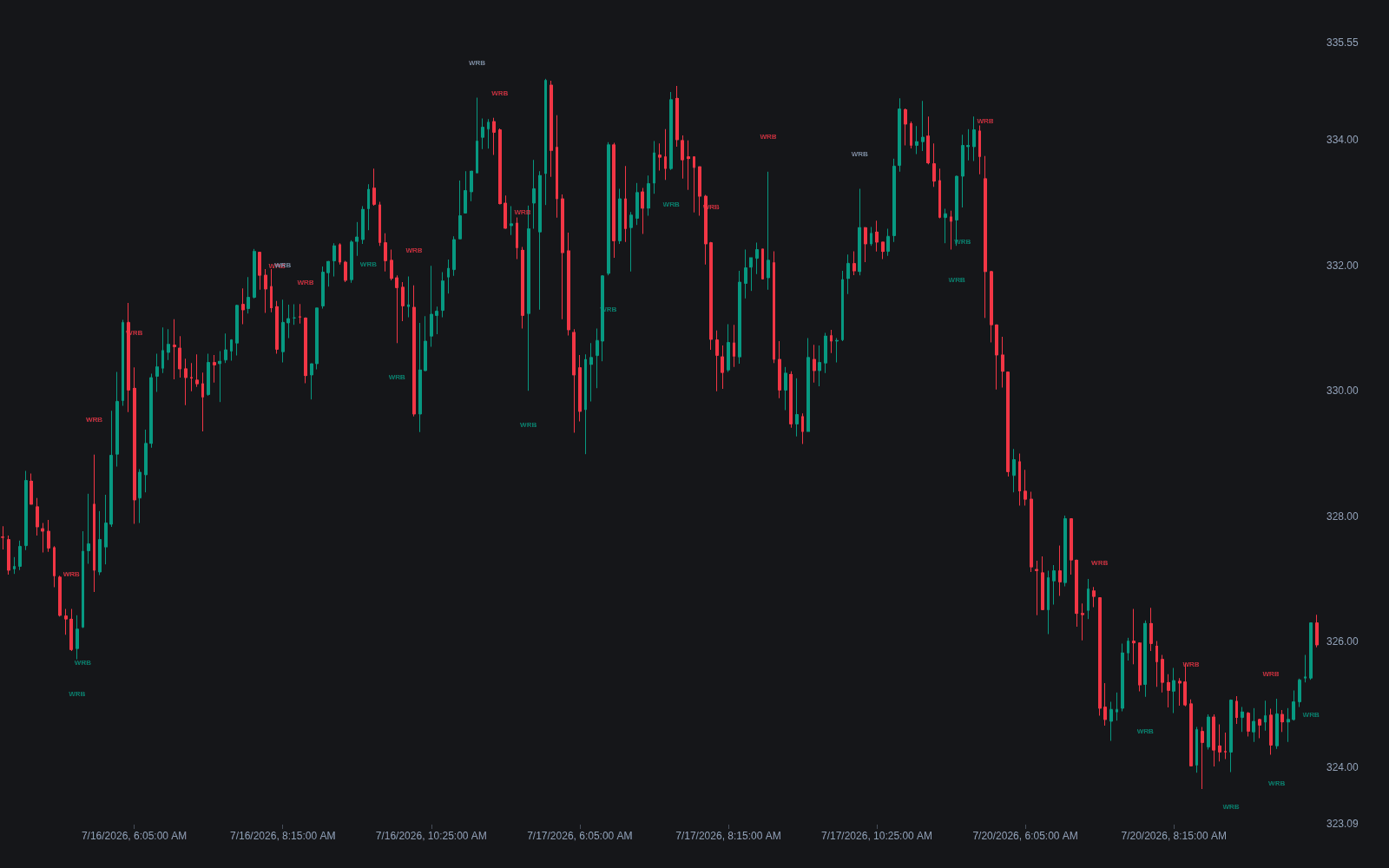
What is a Wide-range Bar?
A wide-range bar (WRB) is a bar whose high-to-low span is unusually large for its context. There is no single threshold: common conventions flag the largest range of the last N bars, or a range beyond some multiple of recent average range or ATR (average true range). Whatever the rule, the object measured is the same: a bar on which the market traveled far more than it typically does.
Range expansion typically marks the arrival of initiative participation, so a WRB usually appears where something changed: the thrust out of compression, the acceleration of a trend, or the climax that ends one. The close's location inside the bar is the standard tiebreaker; some conventions score it explicitly as a close-location value within the bar's low-to-high span. A close pinned near an extreme reads as one-sided conviction; a wide bar closing mid-range records a fight rather than a winner.
The vocabulary comes from short-term futures research of the late 1980s and 1990s: Toby Crabel's opening-range-breakout studies measured each session's range against its recent neighbors and treated contraction and expansion as alternating phases, with narrow-range days such as NR4 and NR7 on one side, wide-spread days on the other. Later pattern work, including the momentum-candle detectors indexed here, kept the same test: compare a bar's travel to a trailing baseline, flag the outliers.
A WRB is the size dimension of bar analysis, silent about shape. A doji is a vanishing body, a marubozu a body filling the whole candle, a pin bar a dominant wick, an outside bar a range swallowing its predecessor; a WRB can be any of these, or none, and a marubozu can be small. That independence makes it useful in combination: a wide-range engulfing bar through a level says more than either alone, and size folds naturally into broader candlestick patterns reading.
How to identify a wide-range bar
Identification is a measurement against recent context rather than a shape match; the first step is choosing the baseline.
- 1Pick a definition: the widest high-to-low span of the last N bars (7 is common, mirroring NR7), or a span exceeding a multiple of the trailing average range or ATR.
- 2Scan for bars that satisfy it, letting the threshold float with the instrument's volatility; fixed point sizes do not transfer across symbols.
- 3Score the close's location within the span, near the high, the low, or mid-range; this assigns the directional read.
- 4Place the bar in its move: emerging from compression such as narrow bars or an inside bar, extending an established trend, or erupting after a long advance or decline.
- 5Cross-check participation and structure: expanding volume strengthens the read on session markets; note whether the bar cleared a level, completed a two-bar reversal, or left a gap inviting a later gap fill.
How it's calculated
Flags bars whose high-to-low range is unusually large relative to recent bars, with the close's position inside the range giving direction.
There is no single universal threshold; k, n, and the CLV cutoffs are conventions that vary by author and platform.
The WR-N idea parallels Toby Crabel's range studies, where WS7 (wide spread 7) marks the widest range of the last 7 days and NR7 the narrowest.
CLV is the same close location value used inside the accumulation/distribution line.
How traders use it
- As breakout validation: a WRB that closes near its extreme while clearing a level is the textbook signature of an initiative break, and many breakout systems require one, often with volume expansion, before trusting the move.
- As an exhaustion flag: a WRB late in an extended trend, especially one closing well off its extreme, is a candidate for climactic action; the same bar shape means opposite things at the start and end of a move.
- As a volatility event for risk management: a WRB inflates ATR, which widens ATR-based stops and shrinks volatility-scaled position sizes on subsequent bars, so some systems treat it as a regime input rather than a trade signal.
- As the release in contraction-expansion setups: after narrow bars, an inside-bar sequence, or a hikkake trap, the first wide-range bar sets the directional tone many traders trade with rather than against.
- As a pattern qualifier: requiring the trigger candle of a bullish or bearish engulfing or the third candle of a morning star to also be wide-range filters out weak instances.
Wide-range Bar vs. related bar concepts
Engulfing Bar: An engulfing bar is measured against the prior bar's range; a WRB is measured against a trailing baseline. A bar can be wide-range without engulfing anything, and vice versa.
Outside Bar: An outside bar is defined relationally: its high and low exceed the prior bar's. It is often also wide-range but need not be; one test compares against the prior bar, the other against recent typical travel.
Inside Bar: The inside bar is the contraction that often precedes the expansion: a range contained entirely within the prior bar. The two form a natural volatility-cycle sequence: compression as setup, the wide-range bar as release.
Concept family
Chart & Candlestick Patterns
84 concepts mapped · 84 in the Library
Wide-range Bar FAQ
Turn Wide-range Bar into a trading strategy.
Take the implementation from this page into Quant, then build on it, backtest it on real data, and keep refining it in conversation.