Concept
Channel Continuation
Channel Continuation is a Chart & Candlestick Patterns concept. The Library holds 1 implementation, a working definition you can pull into Quant.
Top Channel Continuation indicator
The top custom implementation, built on the original standard Channel Continuation formula.
1 total
This Channel Continuation implementation is strategy-ready: open it in Quant, set your rules, and it backtests automatically.
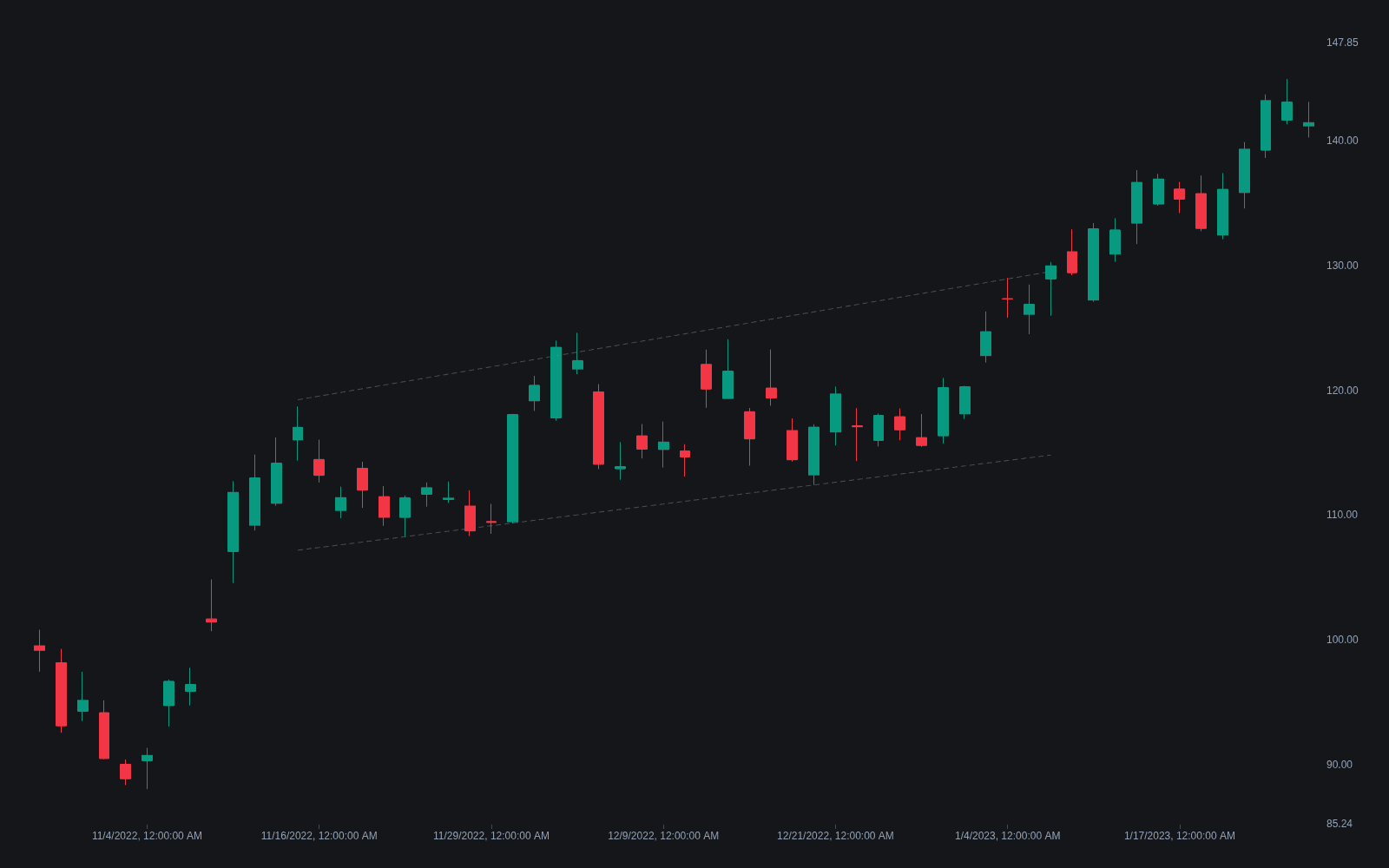
What is a Channel Continuation Pattern?
Channel continuation is the reading of a sloped parallel channel as a pause in a larger trend rather than a trend of its own. The classic form is a channel sloping against the prevailing move: after an advance, price drifts lower inside two parallel lines, and the expectation is a break out of the channel's upper boundary and resumption of the advance. It is the same logic as a bull or bear flag, extended in time, with the countertrend drift lasting long enough to develop multiple clean touches on both parallels.
The pattern exists because corrections are often orderly. When profit-taking is steady rather than panicked, the retreat organizes into a measured, contained grind between parallels, and that orderliness itself is information: the countertrend flow is corrective, not initiative. The eventual break in the trend direction shows the correction has been absorbed.
Chartists have traded channels this way since the classical literature, where the guideline was that sloped channels tend to break against their own slope when they form as corrections within a larger trend. The honest caveat is that a channel is also a functioning trend structure in its own right, and nothing obliges it to break the right way; a downward channel after an advance sometimes simply becomes the new trend. Position within the larger structure, not the channel itself, carries the directional argument.
How to identify a continuation channel on a chart
The pattern needs both a genuine channel and a genuine prior trend; either alone is not the setup.
- 1Establish the prior trend: a clear impulse whose continuation the channel is supposed to interrupt.
- 2Draw the channel from at least two touches on each parallel; a trendline with one echo is not yet a channel.
- 3Prefer channels sloping against the prior trend, the classical corrective shape; a channel sloping with the trend reads as the trend itself, not a pause within it.
- 4Watch proportion: a correction retracing most of the prior impulse, or lasting far longer than it, weakens the continuation case.
- 5Volume conventionally contracts during the channel and expands on the break; drift on rising volume is a warning.
- 6Define the trigger in advance: a decisive close through the channel boundary in the trend direction, with a return inside the channel as the failure signal.
How traders use it
- Breakout entry: enter on a close through the channel boundary in the prior trend's direction, invalidate on acceptance back inside, and take the channel's width or the prior impulse as the projection base, the latter being the measured move approach.
- Anticipatory entry inside the channel: some traders buy the channel's lower parallel in an uptrend correction, getting a better price at the cost of acting before the continuation is confirmed.
- Trend filtering: a channel against the higher-timeframe trend is treated as a pullback zone, and traders align entries with that larger trend rather than trading every rotation inside the channel.
- Managing the failure mode: continuation channels break the wrong way often enough that a channel break against the prior trend, especially on expanding volume, is best respected as a possible trend change rather than dismissed as noise, and a false breakout back into the channel warrants a fast exit.
Channel continuation vs. related structures
Bull/bear Flag: A flag is the same corrective-drift idea compressed into a brief pattern after a sharp pole; a continuation channel is larger and slower, with enough touches to define both parallels properly.
Rectangle: A rectangle is a horizontal consolidation with no slope; the continuation channel slopes, typically against the trend, and that slope is part of its corrective character.
Linear Regression Channel: A regression channel is fitted statistically around a trend to frame it; the continuation pattern is a hand-drawn corrective channel traded for its break, not for containment.
Concept family
Chart & Candlestick Patterns
84 concepts mapped · 84 in the Library
Channel Continuation FAQ
Turn Channel Continuation into a trading strategy.
Take the implementation from this page into Quant, then build on it, backtest it on real data, and keep refining it in conversation.