Concept
Inside Bar
Inside Bar, also known as ID/NR4, is a Chart & Candlestick Patterns concept. The Library holds 1 implementation, a working definition you can pull into Quant.
Top Inside Bar indicator
The top custom implementation, built on the original standard Inside Bar formula.
1 total
Want to trade Inside Bar? The implementation below is one prompt away from a backtested strategy in Quant.
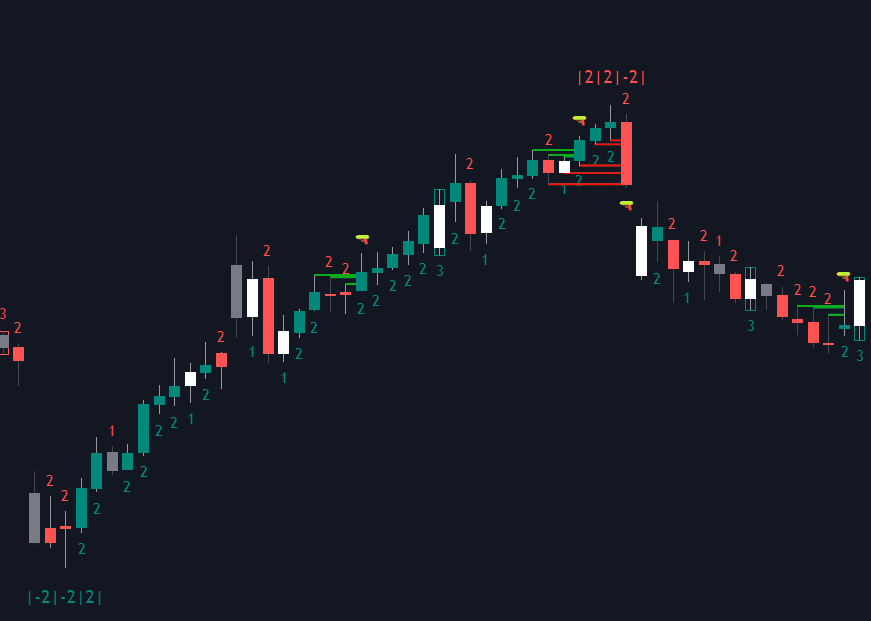
What is an Inside Bar?
An inside bar is a bar whose entire range sits within the range of the bar before it: a lower high and a higher low than the preceding 'mother bar'. It records contraction. For one full period the market failed to test either extreme of the previous bar, so the auction is coiling rather than traveling. Consecutive inside bars deepen the compression, each new bar nesting inside the last, and the structure only resolves when price finally breaks one side of the mother bar's range.
The pattern itself is direction-neutral; the breakout supplies the direction. Two standard readings follow from context. Inside a trend, an inside bar is a pause, a one-bar flag that often precedes continuation. At major levels, a cluster of inside bars is pre-breakout compression, the bar-level cousin of a volatility contraction pattern. The alias ID/NR4 comes from Toby Crabel's day-trading research: an inside day that is also the narrowest-range day of the last four, a compression screen for next-day breakout plays. The honest caveat is that inside-bar breaks fail routinely; the false breakout of the pattern is common enough to have its own named counter-pattern.
How to identify an Inside Bar
Detection is a strict range comparison; the judgment is in the context.
- 1Compare extremes with the prior bar: the high must be below the mother bar's high and the low above its low. Strict definitions exclude equal highs or lows; some coded versions allow them, so pick one rule and keep it.
- 2Count the compression: note whether it is a single inside bar or a nested series, and whether the mother bar itself was unusually wide, which makes the containment less meaningful.
- 3Read the context: an inside bar after an impulse leg in a trend leans continuation, while one sitting on a major level is a coiled breakout candidate in either direction.
- 4Mark the triggers: the mother bar's high and low are the conventional breakout levels for entries, stops, or both.
How traders use it
- As a breakout trigger: stop orders beyond the mother bar's extremes, sometimes bracketing both sides, with the market's break choosing the direction and the opposite extreme serving as the invalidation.
- As a with-trend continuation entry: in an established trend, traders take only the break in the trend's direction, often adding a higher-timeframe trend filter so counter-trend breaks are ignored.
- As a volatility screen: ID/NR4 and NR7 style scans use inside bars and narrow ranges to shortlist symbols primed for range expansion, in the spirit of Crabel's opening range breakout work.
- As the seed of failure plays: because early breaks of the coil often trap, the hikkake pattern explicitly fades a failed break of the inside bar's range within the next few bars.
Inside Bar vs similar patterns
Harami: The harami compares real bodies (the second body inside the first), while the inside bar compares full ranges including wicks. Neither strictly implies the other: an inside bar's body can sit outside the prior candle's body, and a harami's shadows can poke beyond the prior candle's range.
NR4/NR7 Narrow-range Bars: NR bars measure relative narrowness, the smallest range of the last four or seven bars, without requiring containment; the inside bar requires containment without requiring narrowness. Crabel's ID/NR4 is the deliberate intersection: contained and unusually narrow.
Hikkake: The hikkake starts from an inside bar: price breaks one side of the inside bar's range, fails within a few bars, and comes back through the other side. It is the inside bar's false-break sequel rather than a competing pattern.
Concept family
Chart & Candlestick Patterns
84 concepts mapped · 84 in the Library
Inside Bar FAQ
Turn Inside Bar into a trading strategy.
Take the implementation from this page into Quant, then build on it, backtest it on real data, and keep refining it in conversation.