Concept
Gradient Boosting
Gradient Boosting is a Machine Learning concept. The Library holds 1 implementation, a working definition you can pull into Quant.
Top Gradient Boosting indicator
The top custom implementation, built on the original standard Gradient Boosting formula.
1 total
The Gradient Boosting implementation below can become a backtested trading strategy — describe your rules and Quant writes the code.
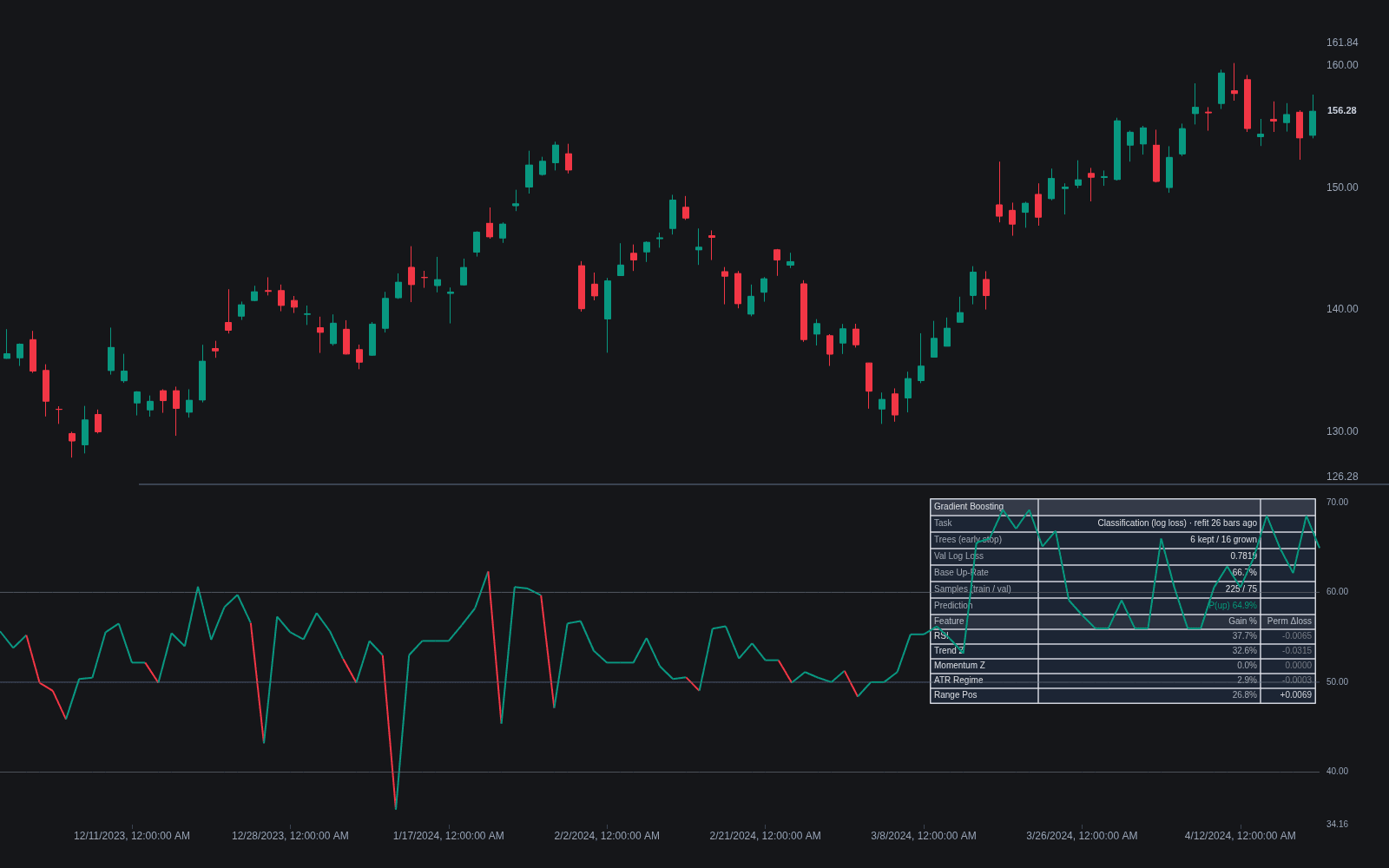
What is gradient boosting?
Gradient boosting builds a strong model as a sum of many weak ones, usually shallow decision trees, added one at a time. Each new tree is fitted to the errors of the ensemble so far: formally, to the negative gradient of the loss function with respect to the current predictions. A learning rate shrinks each tree's contribution so the model improves in small, correctable steps. Jerome Friedman formalized the general procedure around 2001, and modern implementations in the XGBoost and LightGBM style added regularization, histogram-based splitting, and speed that made boosted trees the default strong learner for tabular data.
Traders reach for boosting because trading features are exactly the kind of data it dominates: modest-sized tables of numeric inputs with nonlinear thresholds and interactions. Boosted models often beat random forests in tuned benchmarks. The flip side is that the sequential error-chasing that gives boosting its power also makes it eager to chase noise, and financial labels are mostly noise. On market data the gap between a tuned boosted model and a forest is often smaller than the extra overfitting risk, so conservative settings, strong regularization, and strict train/validation discipline matter more here than in most applications.
How it's calculated
The standard form builds the model stagewise, fitting each tree to the loss gradient of the current ensemble.
XGBoost-style variants add second-order gradient information and explicit regularization terms on tree size and leaf weights.
Subsampling rows and columns per round (stochastic gradient boosting) is standard and further reduces overfitting.
How traders use it
- Directional classification: engineered features feed a boosted classifier predicting the label defined by the prediction horizon, with early stopping on a chronologically later validation slice rather than a random one.
- Taming it for markets: practitioners lower depth (2 to 4), lower the learning rate, subsample rows and features, and stop early; default library settings are tuned for cleaner data than markets provide.
- Meta-labeling and filtering: a boosted model predicts whether an existing strategy's signal will succeed, letting the base strategy provide direction while the model gates participation.
- Reading feature importance cautiously: gain-based importances flatter high-cardinality features and split credit erratically among correlated inputs, so permutation importance on held-out data is the safer read.
- Calibrating outputs: boosted probability estimates are often distorted toward the middle, so checking a probability calibration curve before sizing on the probabilities is standard practice.
Gradient boosting vs. neighboring methods
Random Forest: A forest grows independent trees in parallel and averages them; boosting grows dependent trees sequentially. Boosting usually wins tuned benchmarks, while forests are harder to break with default settings, a real virtue on noisy data.
Decision Trees: The single tree is the weak learner boosting is built from. Alone it is readable but unstable; boosted, hundreds of shallow trees form an accurate but opaque committee.
Neural Networks: On modest tabular datasets boosted trees usually match or beat networks with far less tuning. Networks pull ahead on very large datasets or unstructured inputs like text and order-book sequences.
Concept family
Machine Learning
32 concepts mapped · 32 in the Library
Gradient Boosting FAQ
Turn Gradient Boosting into a trading strategy.
Take the implementation from this page into Quant, then build on it, backtest it on real data, and keep refining it in conversation.