Concept
Ensemble Voting of Signals
Ensemble Voting of Signals are Machine Learning concepts. The Library holds 1 implementation, a working definition you can pull into Quant.
Top Ensemble Voting of Signals indicator
The top custom implementation, built on the original standard Ensemble Voting of Signals formula.
1 total
From studying Ensemble Voting of Signals to trading it: take the implementation below into Quant and backtest it instantly.
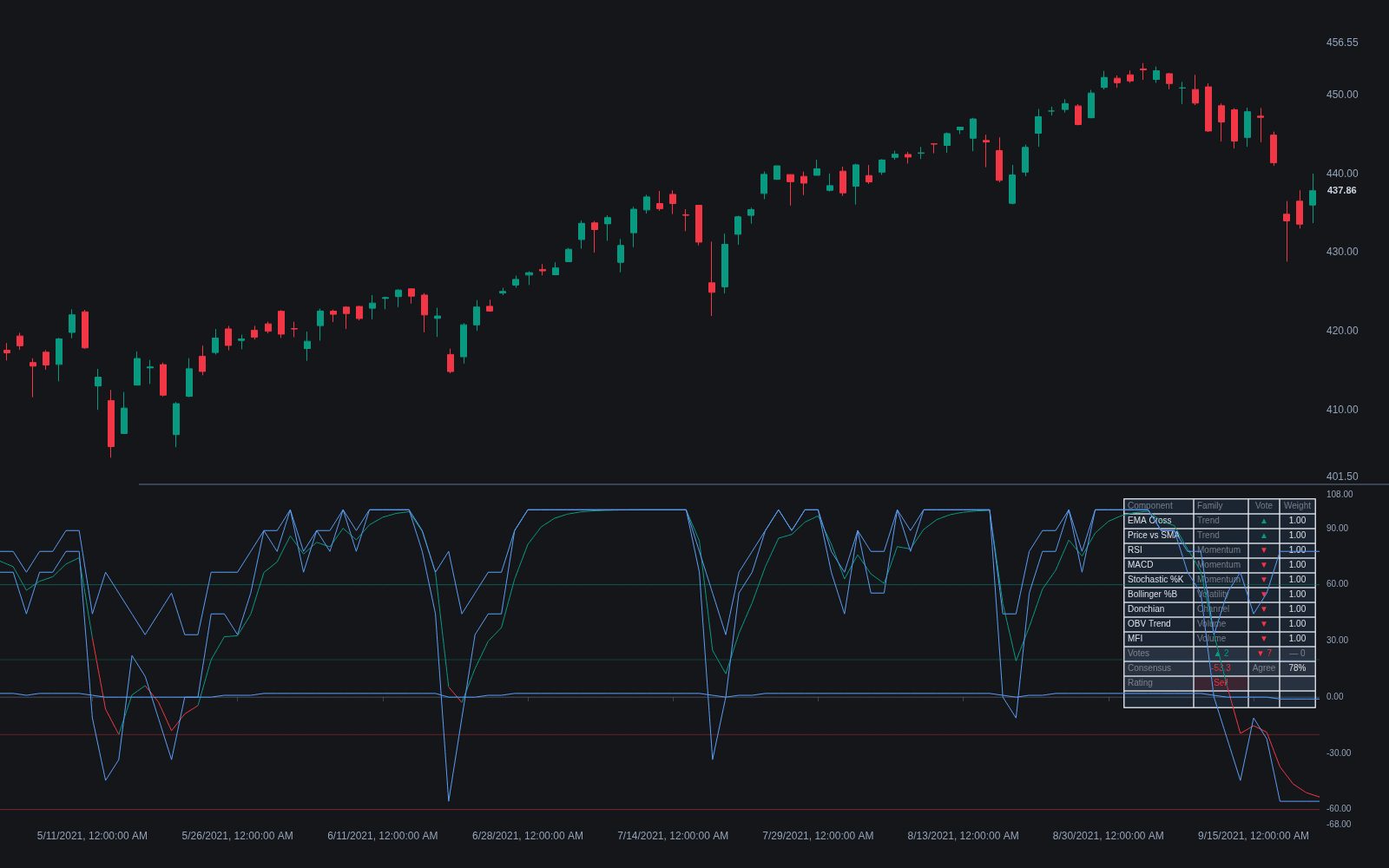
What is Ensemble Voting of Signals?
Ensemble voting of signals combines several independent signals or models into a single output by letting them vote. The mechanics vary: a simple majority of buy versus sell flags, a weighted vote where more trusted inputs count for more, or an average of normalized scores that is then thresholded. The idea is borrowed from ensemble learning: when individual signals make partly uncorrelated errors, aggregating them cancels some of the noise, so the combined output tends to be steadier than any single input.
The intuition is old: Condorcet's 1785 jury theorem showed that a majority of independent voters, each slightly better than chance, grows more reliable as the panel grows, and that the logic reverses when voters are wrong on average. Machine learning formalized the idea in the 1990s through bagging and boosting, and Leo Breiman's random forest, published in 2001, made averaging many randomized trees mainstream. Trading platforms adopted the polled-indicator form: TradingView's Technical Ratings tallies buy, neutral, and sell verdicts from a fixed roster of moving averages and oscillators into one aggregate reading.
The catch is diversity. Voting only helps when inputs disagree for informative reasons. A panel of ten moving-average crossovers votes almost in unison, so it behaves like one indicator with extra steps. Ensembles built across families, for example trend, momentum, and volume measures, are the ones whose errors have a chance to offset. This is the machine-learning cousin of the discretionary confluence checklists traders have always kept, formalized so the aggregation rule is explicit and testable.
Weighting is where designs diverge. Equal votes are robust but treat a stale input the same as a sharp one; performance-weighted votes adapt but chase noise if the evaluation window is short. Some designs down-weight correlated inputs so near-duplicates cannot dominate the tally, a problem feature engineering and dimensionality reduction such as PCA address before the vote is taken. The output can stay a raw count, be scaled to a bounded score, or be passed through logistic signal calibration so the tally reads as an estimated probability rather than an arbitrary number.
How to Identify Ensemble Voting in an Indicator
Ensemble tools rarely announce themselves; the tell is an output assembled from a roster of sub-signals:
- 1Open the settings or source and count the inputs: a genuine ensemble lists multiple distinct components, often with per-component toggles or weights.
- 2Check the output format: vote counts, a bounded consensus score, or a rating gauge all point to aggregation rather than a single formula.
- 3Look for family diversity: note whether components span trend, momentum, volume, and volatility, or are mostly one calculation at different lengths.
- 4Compare the composite to its components: if the aggregate shadows one dominant input rather than flipping only when several agree, the voting is cosmetic.
- 5Find the threshold: the tally required to print a signal controls how conservative the whole tool is.
How traders use it
- As an aggregate rating: many indicators are polled into buy, neutral, and sell counts, and the net tally becomes a single directional score.
- As a trade filter: entries require a supermajority of agreeing inputs, and disagreement is read as a stand-aside condition rather than a weak signal.
- As a wrapper on learned models: predictions from several classifiers are averaged or majority-voted, the same principle that makes a random forest an ensemble of trees.
- As regime-aware weighting: trend inputs count for more when a regime model such as Hidden Markov switching flags a trending phase, and mean-reversion inputs take over in ranges.
- As an uncertainty gauge: near-split panels read as low conviction and argue for smaller size even when the majority leans one way.
- As a continuously updated committee: weights are re-fit as outcomes arrive via online learning, so decaying components lose influence without manual re-optimization.
Ensemble Voting vs related concepts
Random Forest: Ensemble voting built in: hundreds of decorrelated decision trees vote on each prediction. Signal-level voting applies the same aggregation to hand-picked indicators and models instead of automatically grown trees.
Bayesian Classifiers: A Bayesian classifier combines evidence multiplicatively through likelihoods and priors, producing a posterior probability. Voting is a blunter, assumption-light aggregation: it counts agreement rather than modeling how the inputs relate.
Logistic Signal Calibration: Calibration turns a raw score, including a vote tally, into an estimated probability by fitting it against realized outcomes. Voting produces the consensus; calibration tells you what that consensus has historically been worth.
Concept family
Machine Learning
32 concepts mapped · 32 in the Library
Ensemble Voting of Signals FAQ
Turn Ensemble Voting of Signals into a trading strategy.
Take the implementation from this page into Quant, then build on it, backtest it on real data, and keep refining it in conversation.