5-0
 By LuxAlgoJun 20, 2026
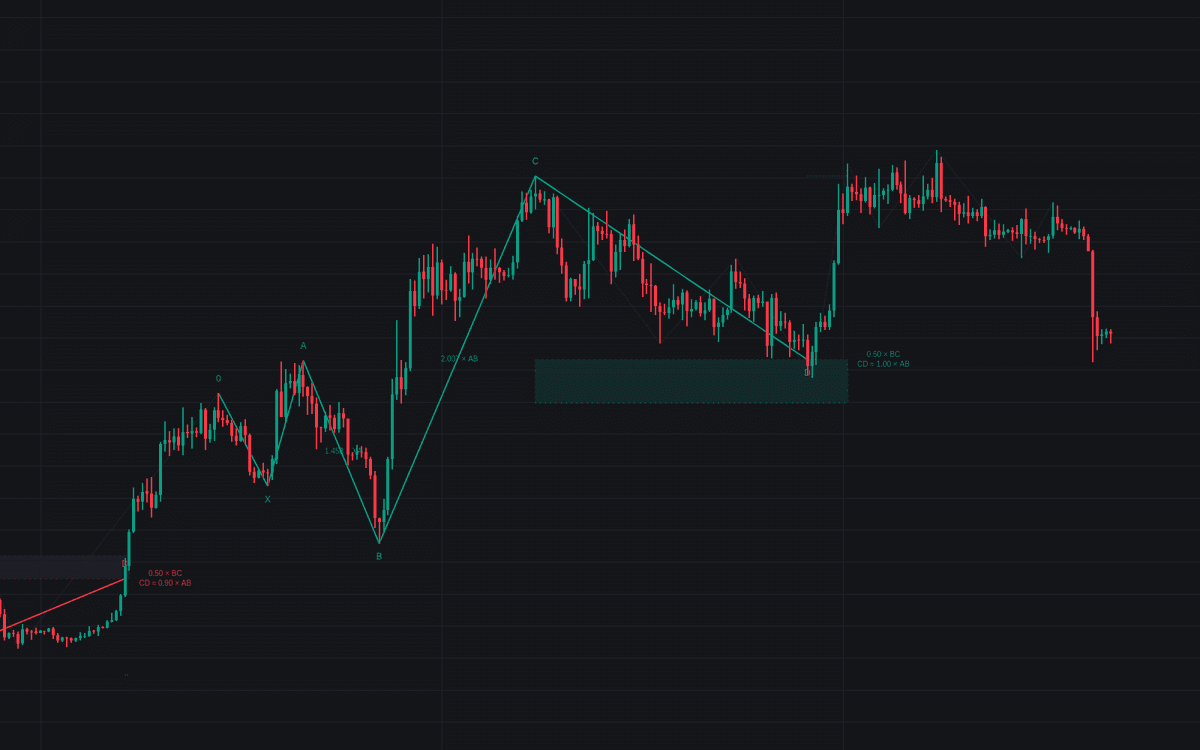

5-0 is the first faithful implementation of the 5-0 pattern in the library, built strictly on the structure's defining ratios. Confirmed swings assemble the 0-X-A-B-C sequence: an initial swing into X, an AB leg reaching 1.13–1.618 of XA beyond X, a BC leg stretching 1.618–2.24 of AB, then a D zone projected at BC's 0.50 retracement, the number the pattern is named for. Each structure draws its legs, points and ratios, and boxes the D zone.
How to Trade the 5-0?
- Completion: price trading into the D zone completes the pattern, the risk-defined entry area.
- Reaction: a close back in the BC direction while the zone holds, the confirmation read.
- Invalidation / target: a decisive close through the Invalidation Retracement voids the setup; the dotted line at the C extreme marks the objective.
Completions inside the pivot confirmation lag are back-filled; a projection is dropped as stale once price runs beyond C without touching the zone. Like the rest of the harmonics family, it is a reversion structure: trade the measured zone, not a prediction.
5-0 Settings
- Swing Length (default 8): pivot length for the swings forming 0 through C; larger finds larger, rarer structures.
- AB / XA Range (default 1.13 to 1.618): AB's allowed extension of XA; AB must travel beyond X.
- BC / AB Range (default 1.618 to 2.24): BC's allowed extension of AB.
- Invalidation Retracement (default 0.618): the BC retracement whose decisive close invalidates the D zone.
- Reciprocal AB=CD Check (default on) with Reciprocal Tolerance % (default 15): requires the projected CD leg to roughly equal AB.
- Require C Beyond Point 0 (default off): demands BC break the pattern origin before the zone is trusted.
- Display toggles: Point Labels, Ratio Labels, Target Line and Show Swings (all on by default).
Frequently Asked Questions

The Library is free. Quant makes it yours.
Pull any concept or indicator into Quant: rebuild it, retune it, or turn it into a backtested strategy of your own.