Potential Reversal Zone
 By LuxAlgoMay 30, 2026
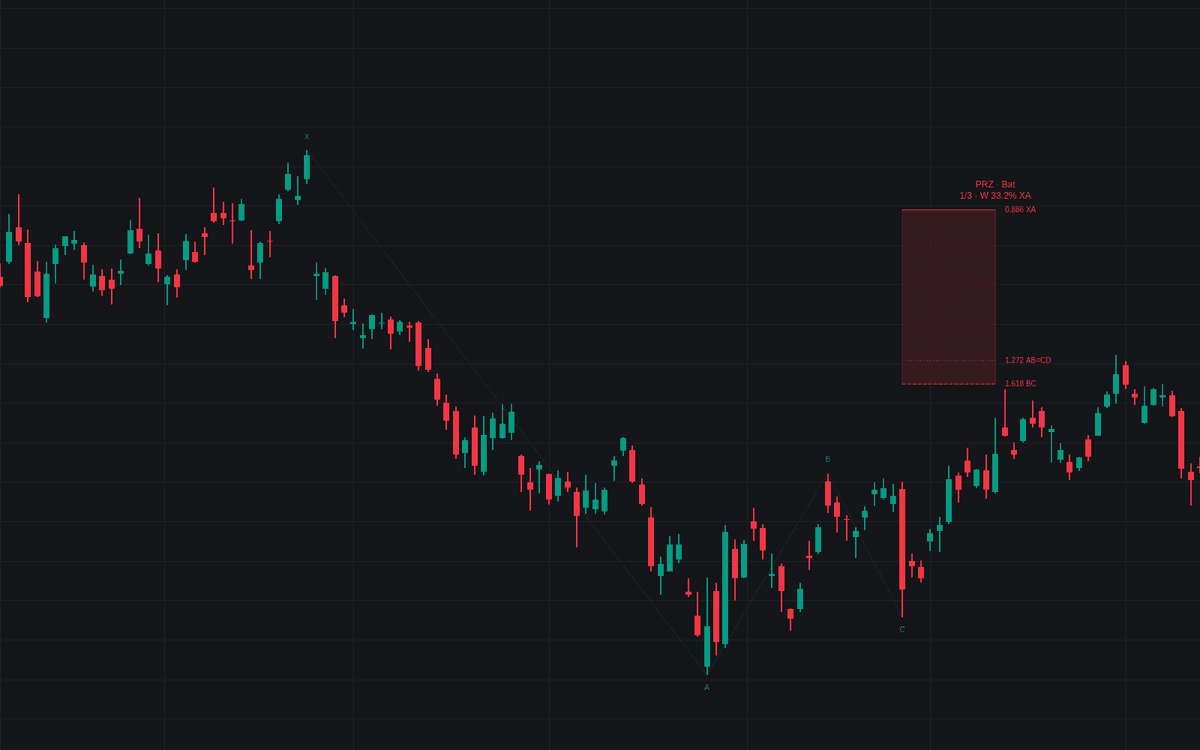

Potential Reversal Zone projects a harmonic pattern's completion window before price arrives: from the last four alternating swings (X, A, B, C) it measures D from the XA ratio, the BC projection, and the embedded AB=CD, drawing the band where the three converge. The definitive clean build of the Potential Reversal Zone auto-fits the Gartley, Bat, Butterfly, and Crab templates from the measured B retracement, scores each zone by measurement clustering, and manages the lifecycle through invalidation.
How to Trade the Potential Reversal Zone?
- Zone projected: a scored box appears beyond the C pivot with template name, score, and width; fresh reads supersede same-direction pending zones.
- Price enters the zone: the 0.382 / 0.618 AD retracements draw as initial targets.
- Rejection confirmed: a close back through the near edge after a test, the reversal evidence the tool frames.
- Invalidation: a decisive close through the far edge (or the X point, if selected) fails the pattern; stops conventionally sit beyond it.
All eight lifecycle events alert.
Potential Reversal Zone Settings
- Swing Length (default 10): confirmation bars each side of a swing; larger values read bigger structures.
- Ratio Template (default Auto (Best Fit)): a named set, or whichever best fits the measured B.
- Ratio Tolerance (default 0.05): margin around the ideal ratios and the confluence score's price tolerance.
- BC Projection (r_BC) (default Auto (Reciprocal of C)): snapped to the standard harmonic set unless fixed.
- AB=CD Ratio (r_CD) (default Auto (Template)): 1.0 or the 1.272 / 1.618 alternates.
- Minimum Confluence Score (default 1): zones scoring below are skipped.
- Invalidation Reference (default Zone Far Edge), Measurement Levels, AD Retracement Targets, XABC Structure (all default enabled), Show Last Zones (default 3), and Event Markers (default disabled): drawing controls.
Frequently Asked Questions

Original indicatorBuilt in-house by LuxAlgo
The Library is free. Quant makes it yours.
Pull any concept or indicator into Quant: rebuild it, retune it, or turn it into a backtested strategy of your own.