ABCD
 By LuxAlgoMay 6, 2026
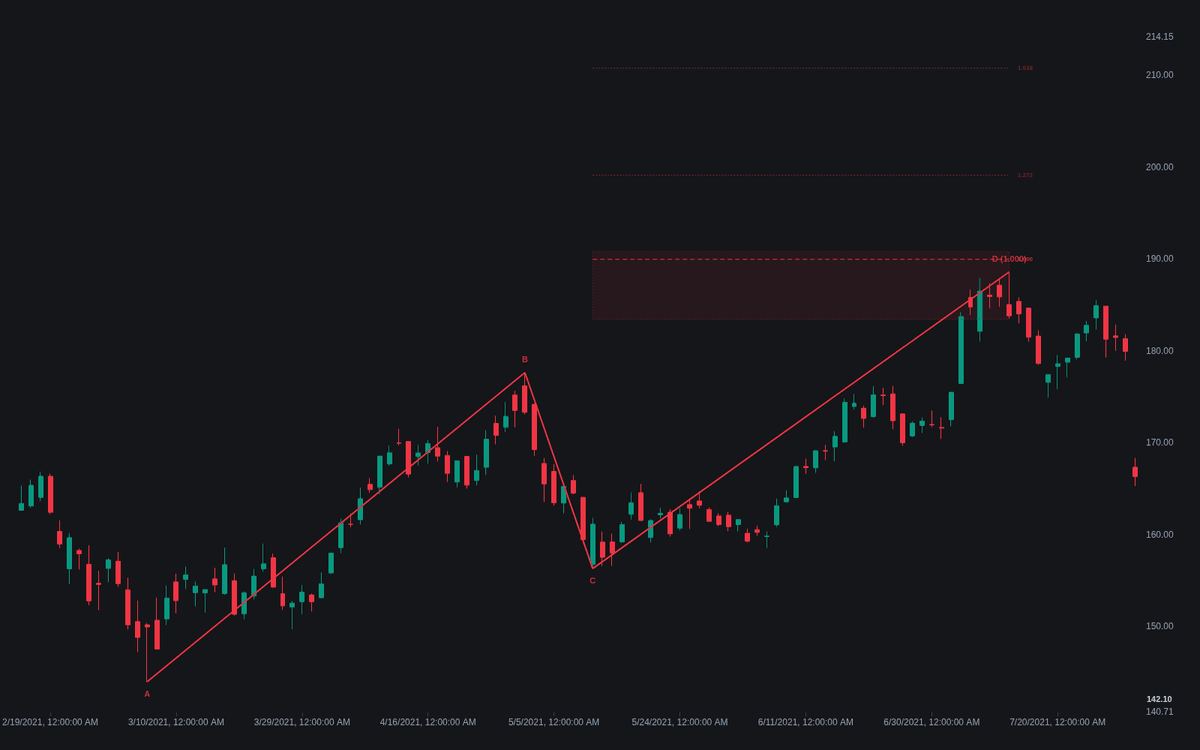

ABCD detects the simplest harmonic structure from confirmed swing points and projects its completion before price gets there. When alternating swings produce an A-B-C sequence whose C retracement lands inside the valid window, the build draws the legs, a dashed line at the classic AB=CD completion where CD equals AB, and, optionally, dotted lines at the 1.272 and 1.618 extended variants plus a shaded BC extension zone. Completion is declared only when a confirmed swing lands within tolerance of a tracked ratio; the D label reports the matched ratio, full measurements in its tooltip.
How to Trade the ABCD?
- Projection in advance: with A, B and C confirmed, the 1.000 line and the BC zone mark where a reaction is worth evaluating, and agreement between the two upgrades the level.
- D Reached vs Completed: price touching the 1.000 projection is information, not a pattern. Completion requires the next confirmed swing to match a tracked ratio.
- Voids: a move beyond point A, an overshoot past the furthest tracked ratio plus tolerance, or a second swing printing after the D candidate removes the structure.
ABCD Settings
- Swing Length (default 10): bars on each side confirming a swing; larger values find bigger, later patterns.
- C Retracement Min (default 0.618): lower bound of the valid C retracement of AB.
- C Retracement Max (default 0.786): upper bound; C may never exceed A.
- Completion Ratio Tolerance (default 0.05): accepted CD-to-AB deviation. 0.95 to 1.05 times AB completes the classic form.
- Extended Variants (1.272 and 1.618) (default on): also project and match the extended completions.
- BC Extension Zone (1.272 to 1.618) (default on): shade the second way of projecting D.
- Style: Leg Line Width (default 2) and Point Labels (A, B, C) (default on); the D label always shows.
Frequently Asked Questions

Original indicatorBuilt in-house by LuxAlgo
The Library is free. Quant makes it yours.
Pull any concept or indicator into Quant: rebuild it, retune it, or turn it into a backtested strategy of your own.