Harami
 By LuxAlgoMay 28, 2026
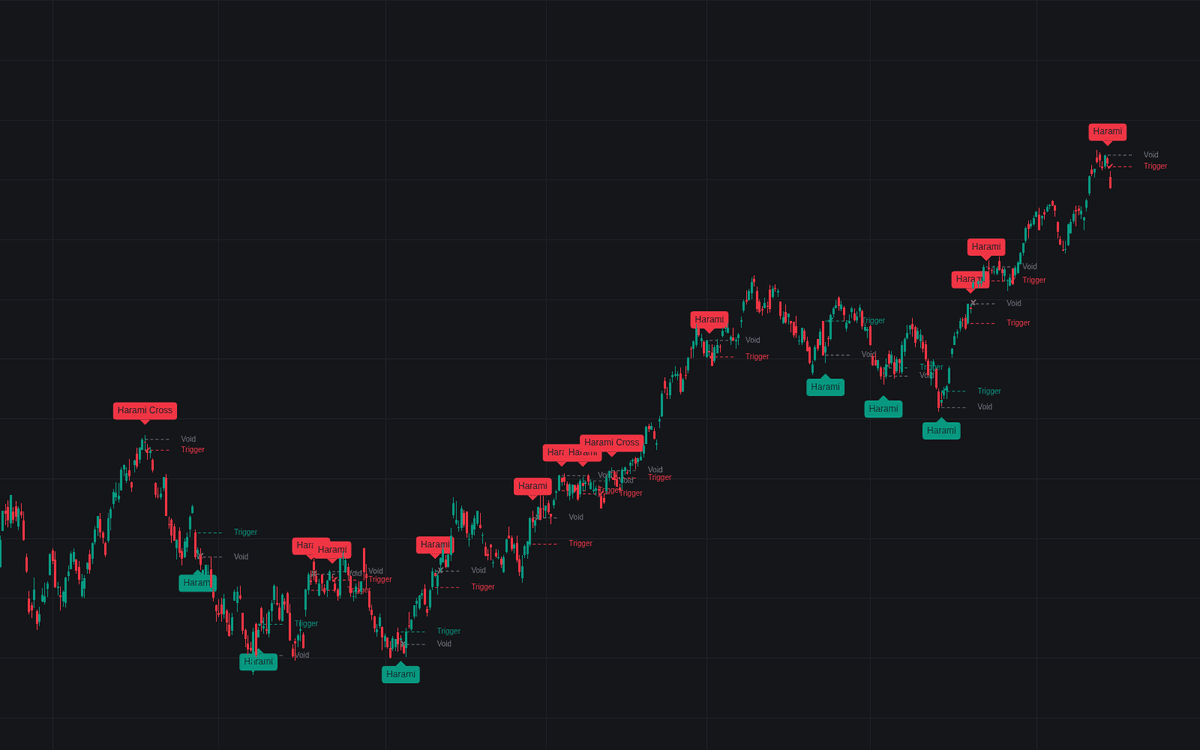

Harami is the definitive clean detector for the harami: a wide-bodied candle followed by one whose real body holds entirely inside it. Containment is measured on real bodies (wicks may protrude) and quality filters demand a wide first body, a capped inner body and a directional leg feeding the pattern. Each pattern draws two dashed levels: the trigger a close must beat to confirm the reversal, and the void level whose closing break cancels it as continuation.
How to Trade the Harami?
- Harami label prints: hesitation, not a completed reversal. The wide move met a candle that failed to extend it.
- Close beyond the trigger level: the pattern confirms in the reversal direction, marked with a check and alerted.
- Close through the void level: hesitation resolved as continuation, cancelling the pattern.
A doji inside candle prints as Harami Cross, the limit case of the contraction; label tooltips grade each pattern's contraction and containment.
Harami Settings
- Wide First Body (default enabled) with Multiple (default 1.0) and Length (default 14): the first body must exceed the trailing average body.
- Max Inner Body % (default 50): largest inside body allowed relative to the first.
- Doji Body % of Range (default 5): the body limit that counts as a doji.
- Harami Cross Only (default disabled): keep only doji-inside patterns.
- Trend Context Filter (default enabled) with Trend Basis (default SMA) and Length (default 50): bullish patterns only below the average, bearish only above.
- Resolution Range (default First Candle Body): resolve on the first body or the full two-candle range.
- Trigger & Void Levels (default enabled), Levels Extension (default 10), Resolution Markers (default enabled).
- Style toggles: labels and candle coloring on by default; the trend MA plot off.
Frequently Asked Questions

Original indicatorBuilt in-house by LuxAlgo
The Library is free. Quant makes it yours.
Pull any concept or indicator into Quant: rebuild it, retune it, or turn it into a backtested strategy of your own.