Matching Low/high
 By LuxAlgoMar 24, 2026
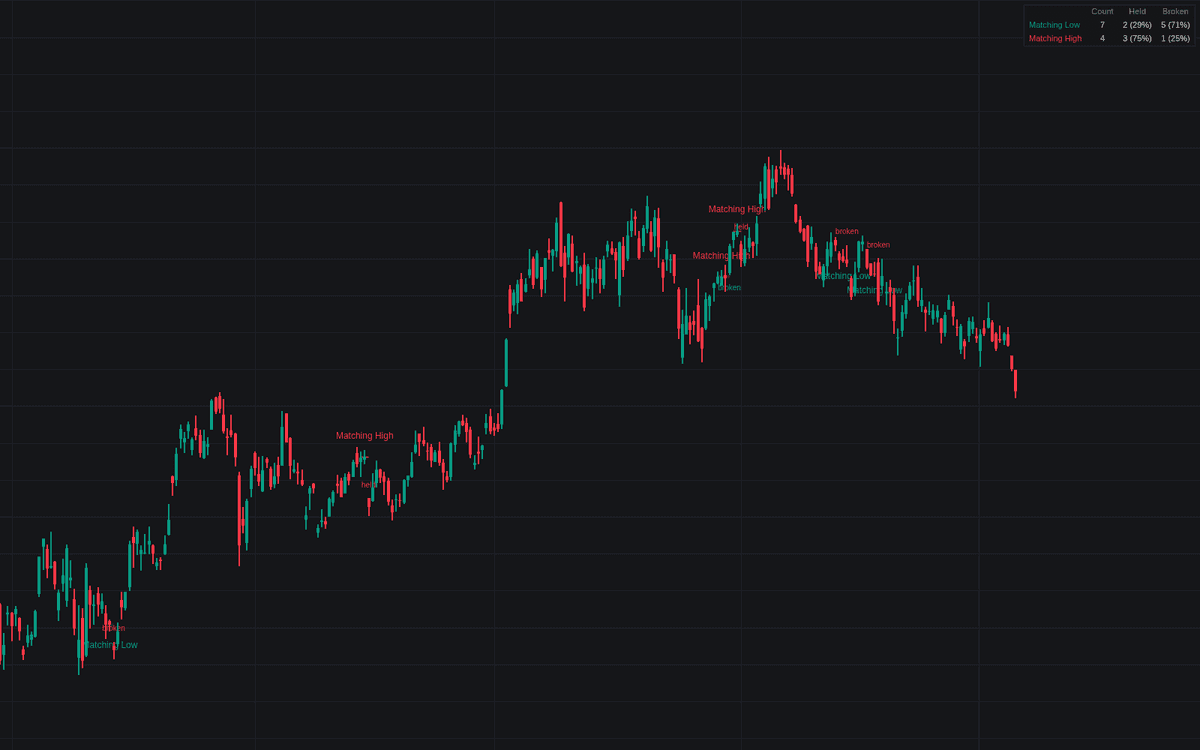

Matching Low/high detects the two-candle patterns built on a repeated close, the matching low and matching high, then makes the chart grade them. Two adjacent bearish closes agreeing within tolerance after a decline print a matching low; two bullish closes after an advance print the mirror. The matched level, the midpoint of the two closes, extends forward inside its tolerance band until the first decisive close beyond the band settles it: a confirming close on the reversal side turns it solid, a close through it retires it dotted as continuation.
How to Trade the Matching Low/high?
- Wait for resolution: the pattern label is a hypothesis; the held or broken mark is the tradable information, with the natural stop just past the matched closes.
- Resolution Statistics: the dashboard tallies held versus broken for each side. The split on your chart is the honest baseline.
Matching Low/high Settings
- Trend Context (default Moving Average) with Trend Length (default 14): the required preceding decline or advance. Two equal closes inside a trading range are noise.
- Close Match Tolerance (default % of ATR, value 5): maximum distance between the closes, in the selected unit. Results are sensitive to it.
- Volatility Length (default 14): the ATR behind the tolerance and the average body behind the body filter.
- Second Candle Pulls Away From Level (on): requires the textbook intrabar attempt that failed back to the same price.
- Long First Candle Body (off) with Long Body Multiplier (default 1.2): restrict to the classic long-first-candle form.
- Resolution Window (default 10): bars a level is tracked before it stops extending undecided.
- Dashboard and style toggles: Resolution Statistics, Pattern Labels, Tolerance Band and Resolution Marks (on); Highlight Pattern Candles and Show Trend Basis (off).
Frequently Asked Questions

Original indicatorBuilt in-house by LuxAlgo
The Library is free. Quant makes it yours.
Pull any concept or indicator into Quant: rebuild it, retune it, or turn it into a backtested strategy of your own.