Concept
Matching Low/high
Matching Low/high is a Chart & Candlestick Patterns concept. The Library holds 1 implementation, a working definition you can pull into Quant.
Top Matching Low/high indicator
The top custom implementation, built on the original standard Matching Low/high formula.
1 total
From studying Matching Low/high to trading it: take the implementation below into Quant and backtest it instantly.
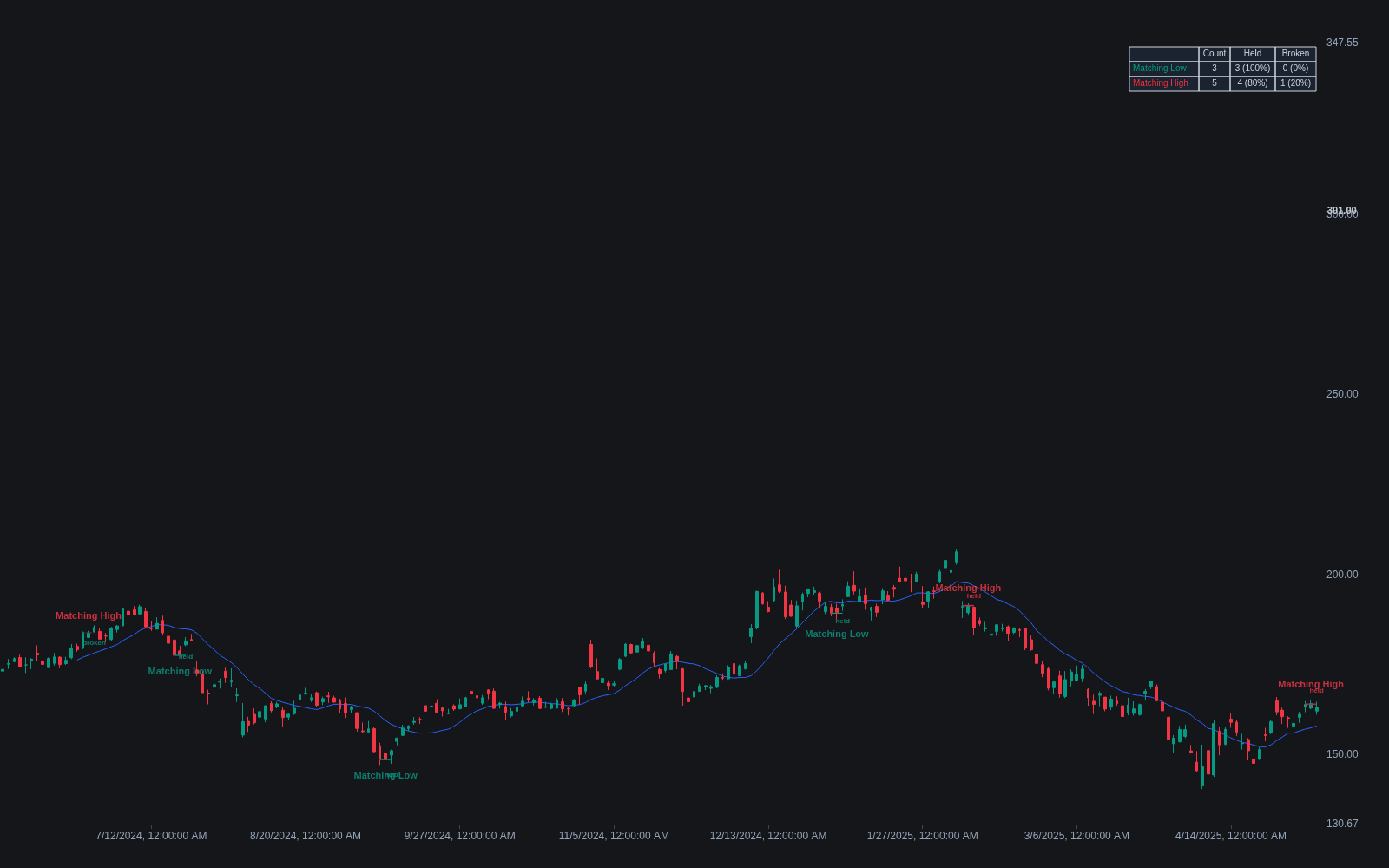
What is a Matching Low or Matching High?
The matching low is a two-candle pattern from the Japanese candlestick catalog. After a decline, two bearish candles close at the same level, or very nearly so. The first is typically a long dark body; the second opens higher, sells off, and finishes exactly where the first finished. The matching high is the mirror at the top of an advance: two bullish candles closing at the same price. In both cases the repeated close marks a price the market tested twice and could not push through.
The traditional reading treats the matching low as a bullish reversal signal, on the logic that the second close failing to break lower reveals support at that exact price. The empirical record is less tidy: pattern researchers who have tested it on large stock samples report that the matching low frequently acts as a continuation instead, with price often breaking down through the matched closes. That split between the classical label and the tested behavior is worth knowing before trading it.
What survives either reading is the level itself. Two identical closes create an unusually precise reference price, and traders on both sides tend to key off it: a hold and upward confirmation argues for the reversal case, while a decisive close through it converts the pattern into a breakout of a freshly defined support level or, for the matching high, a resistance level.
How to identify a matching low or high
The defining feature is the repeated close, not the candle bodies around it.
- 1Confirm the trend context: a matching low needs a preceding decline, a matching high a preceding advance; two equal closes inside a range are just range noise.
- 2Check candle direction: both candles are bearish for a matching low, both bullish for a matching high.
- 3Compare the closes: they should match exactly or within a small tolerance appropriate to the instrument's tick size and volatility.
- 4Prefer a second candle that opened away from the matched level and traveled back to it, showing an intrabar attempt that failed at the same price.
- 5Wait for resolution: a confirming close in the reversal direction supports the classical reading, while a close through the matched level argues for continuation.
How traders use it
- As a precise level generator: the matched close becomes a reference price for entries, stops, and alerts, useful regardless of whether the eventual resolution is reversal or continuation.
- As a conditional reversal setup: traders who take the classical reading typically require a confirming candle closing higher (for a matching low) before entering, with the stop just beyond the matched closes.
- As a breakout trigger in the other direction: given the tested tendency toward continuation, some traders treat a close through the matched level as the actionable event, effectively trading the pattern's failure.
- As a scanner condition with a tolerance parameter: exact equality is rare in decimalized and continuously traded markets, so implementations usually match closes within a fraction of ATR or a fixed percentage, and results are sensitive to that choice.
Matching low/high vs nearby patterns
Tweezer top/bottom: Tweezers match the extremes (equal highs or equal lows, usually via shadows) and the two candles typically oppose each other; the matching low/high matches the closes with both candles in the same direction.
Double top/bottom: A double top or bottom is the same twice-tested-price logic played out over swings separated by days or weeks; the matching low/high compresses it into two adjacent candles.
Equal highs/lows as liquidity: Order-flow frameworks read repeated equal extremes as resting stop liquidity likely to be swept rather than respected, a useful counterweight to the classical support reading.
Concept family
Chart & Candlestick Patterns
84 concepts mapped · 84 in the Library
Matching Low/high FAQ
Turn Matching Low/high into a trading strategy.
Take the implementation from this page into Quant, then build on it, backtest it on real data, and keep refining it in conversation.