NRTR
 By LuxAlgoJun 12, 2026
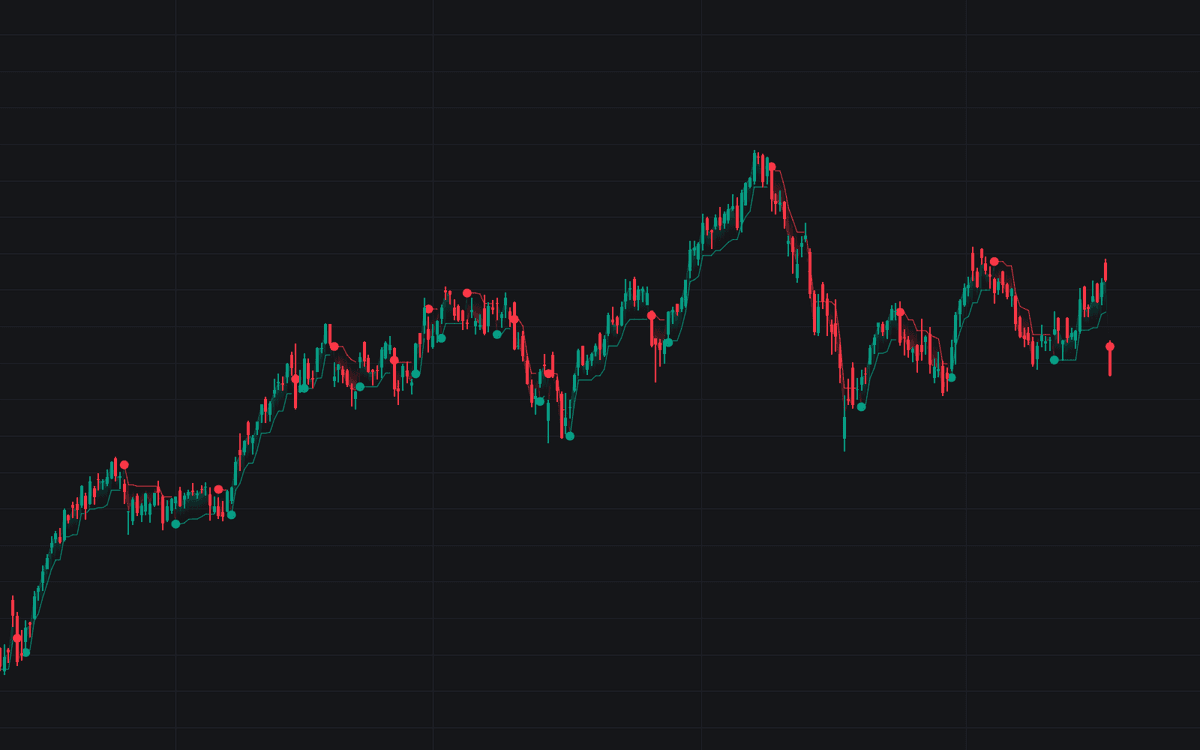

NRTR draws the Nick Rypock Trailing Reverse exactly as the construction intends: one trailing line that gives the trend a constant allowance and reverses when that allowance is spent. While the state is up, the line holds a fixed deviation (2% of the extreme by default) beneath the highest source price printed since the state began, ratcheting only upward; a down state mirrors the construction above the lowest price. When the source crosses the level in force, the state flips and the line reappears on the opposite side of price. An optional ATR mode sizes the offset in Average True Range multiples instead.
How to Trade the NRTR?
- Line below price: up state: a ready-made trailing stop that tightens as new highs print and never loosens.
- Line above price: down state, the mirror for shorts or for standing aside.
- Flips: a cross of the level in force is the stop-and-reverse event; Bullish, Bearish, and Any Reversal alerts cover it.
- A flat line is information: the offset hangs from the trend extreme rather than current price, so sideways trade leaves the line stationary instead of creeping toward price.
The gradient fill between price and the line visualizes the room left before a reversal.
NRTR Settings
- Source (default close): series used to track extremes and detect crosses.
- Offset Mode (default Percentage): the fixed-percentage 2001 original, or the later ATR Multiple variant.
- Percentage Deviation (%) (default 2): the constant allowance; wider survives deeper pullbacks at the cost of later exits.
- ATR Length (default 14) and ATR Multiplier (default 3): the volatility yardstick and its multiple in ATR mode.
- Style inputs cover reversal markers (on), the gradient trail fill (on), state colors, and line width (1).
Frequently Asked Questions

The Library is free. Quant makes it yours.
Pull any concept or indicator into Quant: rebuild it, retune it, or turn it into a backtested strategy of your own.