Concept
NRTR
NRTR, also known as Nick Rypock trailing reverse, is a Trend concept. The Library holds 1 implementation, a working definition you can pull into Quant.
Top NRTR indicator
The top custom implementation, built on the original standard NRTR formula.
1 total
Want to trade NRTR? The implementation below is one prompt away from a backtested strategy in Quant.
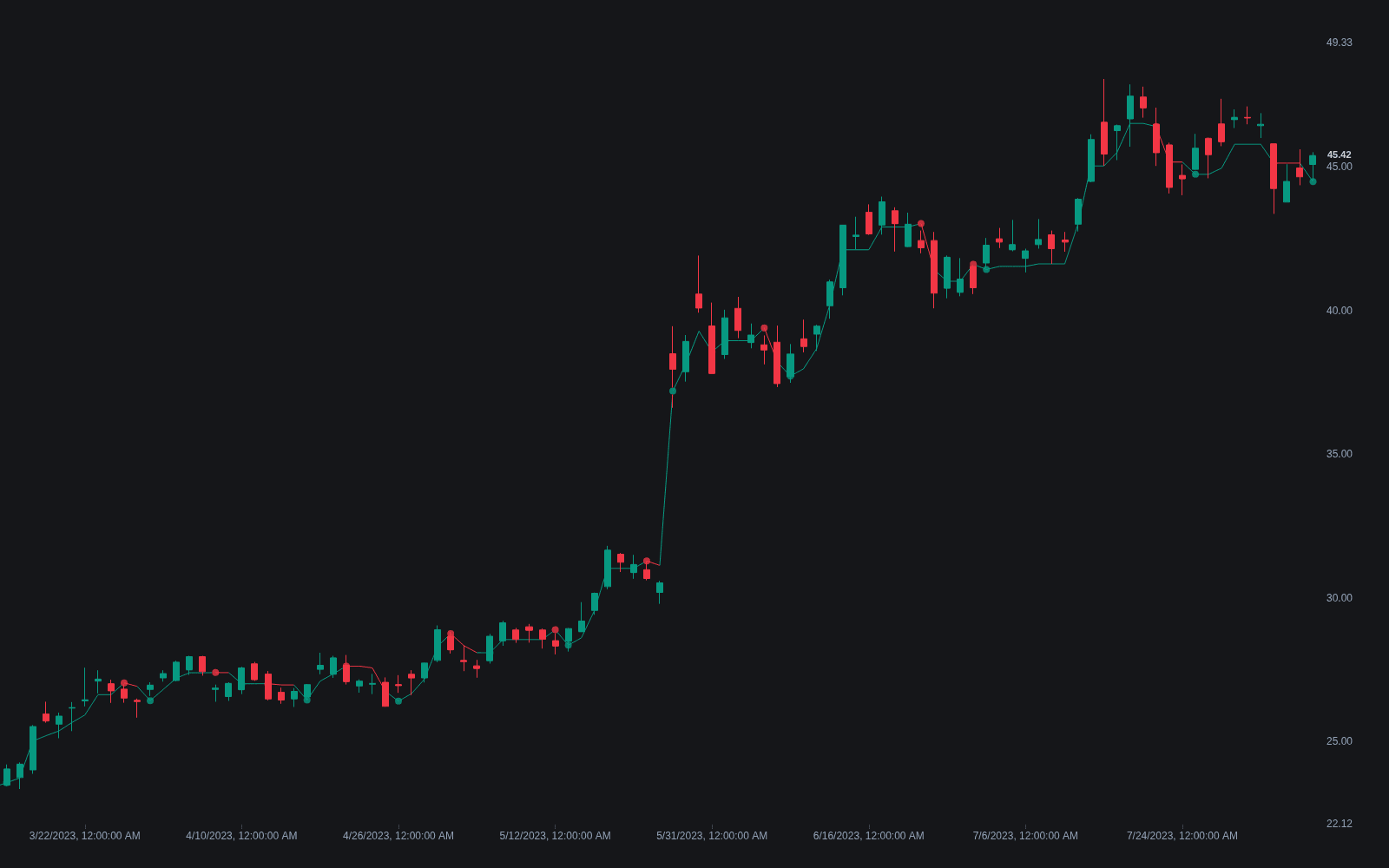
What is NRTR?
NRTR (Nick Rypock Trailing Reverse) is a trailing stop-and-reverse line developed by Konstantin Kopyrkin and published in 2001. In an up state the line sits a fixed deviation below the highest price reached since the trend began, expressed as a percentage in the original version or an ATR multiple in later variants, and it only ratchets upward. In a down state it sits the same deviation above the lowest price and only ratchets down. When price crosses the line, the state reverses and the line flips to the other side of the market.
The defining trait is the constant offset. Unlike Parabolic SAR, which tightens as its acceleration factor grows, NRTR keeps the same distance from the trend extreme throughout, so it tolerates pullbacks of the same size at any stage of a trend and sits flat while price chops sideways inside the band rather than creeping toward it.
The flat-in-chop property deserves its own sentence, because it is the design's quiet advantage: the line is anchored to the trend's extreme, not to current price, so when no new extreme prints the line simply does not move. A sideways market therefore drifts inside a stationary band instead of being stalked by a tightening stop, and the only way out is a genuine crossing of the fixed deviation. The offset is the entire personality: percentage versions keep a constant proportional tolerance, ATR versions retune that tolerance as volatility regimes shift, and both express one decision, how much adverse movement disqualifies the trend.
The design's descendants dominate its modern usage. KivancOzbilgic's Optimized Trend Tracker wraps NRTR-style trailing logic around a smoothed baseline with a tuned offset, plus a band variant, and range-filter constructions apply kindred fixed-tolerance state logic to smoothed price. Deployment follows the family pattern: the line's side is a regime call, the line itself is a trailing exit, and the calibration trade-off is eternal, offsets too tight whipsaw in normal noise while offsets too wide donate large fractions of every trend back. A regime filter in front of the flips remains the standard chop defense.
How to identify NRTR
One offset, one ratchet, one flip rule: the whole indicator is three sentences of logic.
- 1Choose the deviation: a percentage of price in the original form, or an ATR multiple in volatility-adaptive variants.
- 2In the up state, plot the line at the highest price since the trend began minus the deviation, never letting it fall.
- 3In the down state, plot it at the lowest price plus the deviation, never letting it rise.
- 4Flip states when price crosses the line, the crossing being simultaneously the old trend's exit and the new one's entry in stop-and-reverse use.
- 5Read the two outputs separately: the line's side is the regime, the line's level is the trailing risk point.
How traders use it
- As an always-in stop-and-reverse system: long above the line, short below it, with every cross both closing the old position and opening the new one.
- As a plain trailing stop for discretionary positions, sized by the percentage or ATR offset rather than by chart structure.
- As a trend filter: the line's side, not its crosses, gates which direction faster entry signals may be taken.
- In descendant form: optimized-tracker variants trail the offset around a smoothed baseline instead of raw extremes, trading some of the ratchet's purity for steadier behavior in noise.
- Stacked by timeframe: a higher-timeframe NRTR supplies the permitted direction while a faster one, or another entry tool, times execution inside that permission.
NRTR vs related trailing regimes
Supertrend: Supertrend recomputes its band from each bar's median price and ATR, so the line tracks price continuously; NRTR anchors to the trend's extreme and moves only on new extremes. Supertrend follows the market around the room, NRTR stands still until progress or failure actually happens.
Parabolic SAR: SAR's acceleration factor tightens the stop as the trend ages, guaranteeing an eventual exit and punishing long consolidations; NRTR's constant offset grants the same tolerance forever. SAR encodes impatience by design, NRTR encodes patience, and which wins depends on how trends end in your market.
EMA: An EMA is a continuous baseline that bends through every fluctuation and never holds a state; NRTR is a stateful ratchet that ignores everything except new extremes and crossings. The average grades the trend continuously, the trail adjudicates it binarily, and the two roles pair rather than compete.
Concept family
Trend
100 concepts mapped · 100 in the Library
NRTR FAQ
Turn NRTR into a trading strategy.
Take the implementation from this page into Quant, then build on it, backtest it on real data, and keep refining it in conversation.