Overnight & ETH Levels
 By LuxAlgoApr 27, 2026
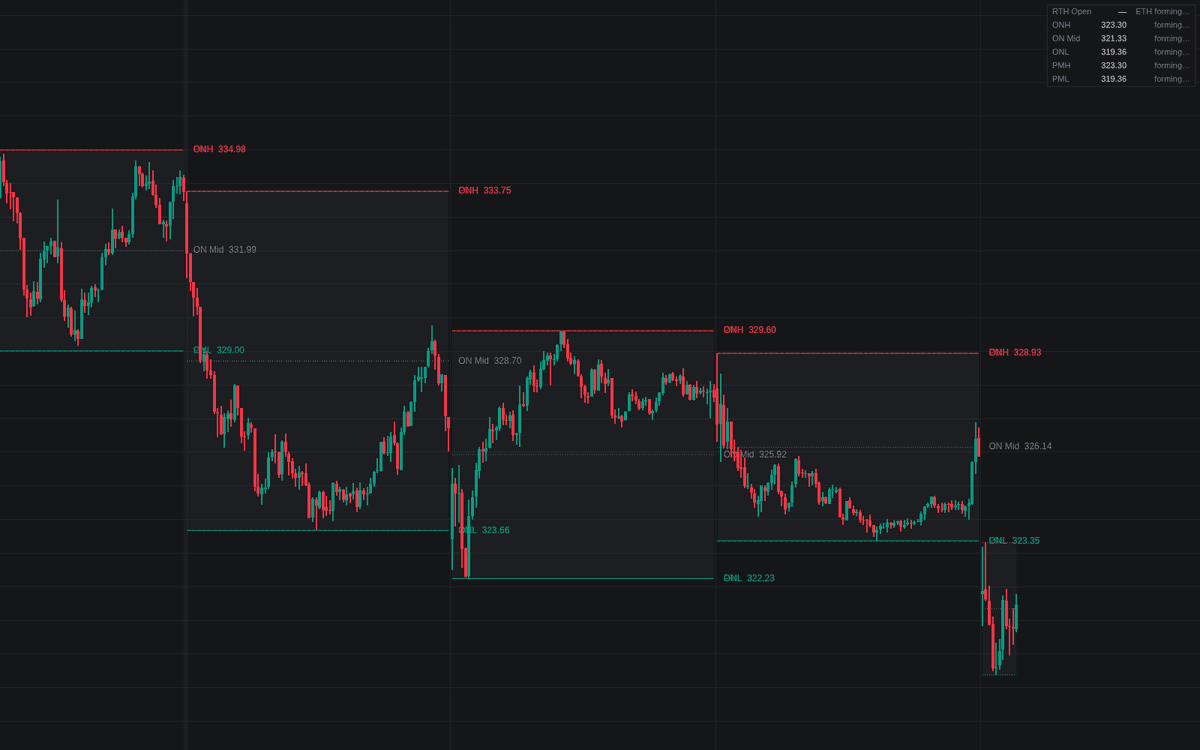

Overnight & ETH Levels freezes the overnight and ETH levels (the extremes formed outside regular hours) at the regular-session open and extends them across the day. The overnight window (18:00–09:30 New York time by default) supplies the overnight high, low, and midpoint (ONH, ONL, ON Mid); an optional pre-market window adds PMH and PML. While a window forms, its running extremes draw as dotted developing lines, and a dashboard classifies where the regular session opened relative to the overnight range and walks every level through untested, tested, broken, and faded states.
How to Trade the Overnight & ETH Levels?
- Open above ONH / below ONL: an out-of-range open: watch for acceptance or the fade back inside; both open-location alerts fire at the bell.
- Broken: a close beyond a level is acceptance in the break's direction.
- Faded: a close back inside after a break is the failed-break read, the classic cue for rotation back across the range.
- ON Mid reached: overnight inventory corrected back to the middle of the range.
Each level carries test and break alerts, the overnight extremes add fade alerts, and the midpoint has a touch alert.
Overnight & ETH Levels Settings
- Timezone (default America/New_York): the clock the session windows run on; Exchange uses the symbol's own timezone.
- Overnight (ETH) Session (default 1800-0930): the US index futures convention; the stock equivalent is 1600-0930.
- Regular Session (RTH) (default 0930-1600): where the levels freeze and are tracked.
- Pre-Market Session (default enabled, 0400-0930): also track PMH and PML.
- Display toggles: Overnight High / Low, Overnight Midpoint, Developing Levels, Fill Overnight Range, Level Labels, Show Dashboard, all enabled by default.
- Style inputs set per-level colors, the range fill color, and Line Width (default 1).
Frequently Asked Questions

The Library is free. Quant makes it yours.
Pull any concept or indicator into Quant: rebuild it, retune it, or turn it into a backtested strategy of your own.