Concept
Overnight & ETH Levels
Overnight & ETH Levels, also known as ONH/ONL, RTH vs ETH, are Support/Resistance & Levels concepts. The Library holds 1 implementation, a working definition you can pull into Quant.
Top Overnight & ETH Levels indicator
The top custom implementation, built on the original standard Overnight & ETH Levels formula.
1 total
Want to trade Overnight & ETH Levels? The implementation below is one prompt away from a backtested strategy in Quant.
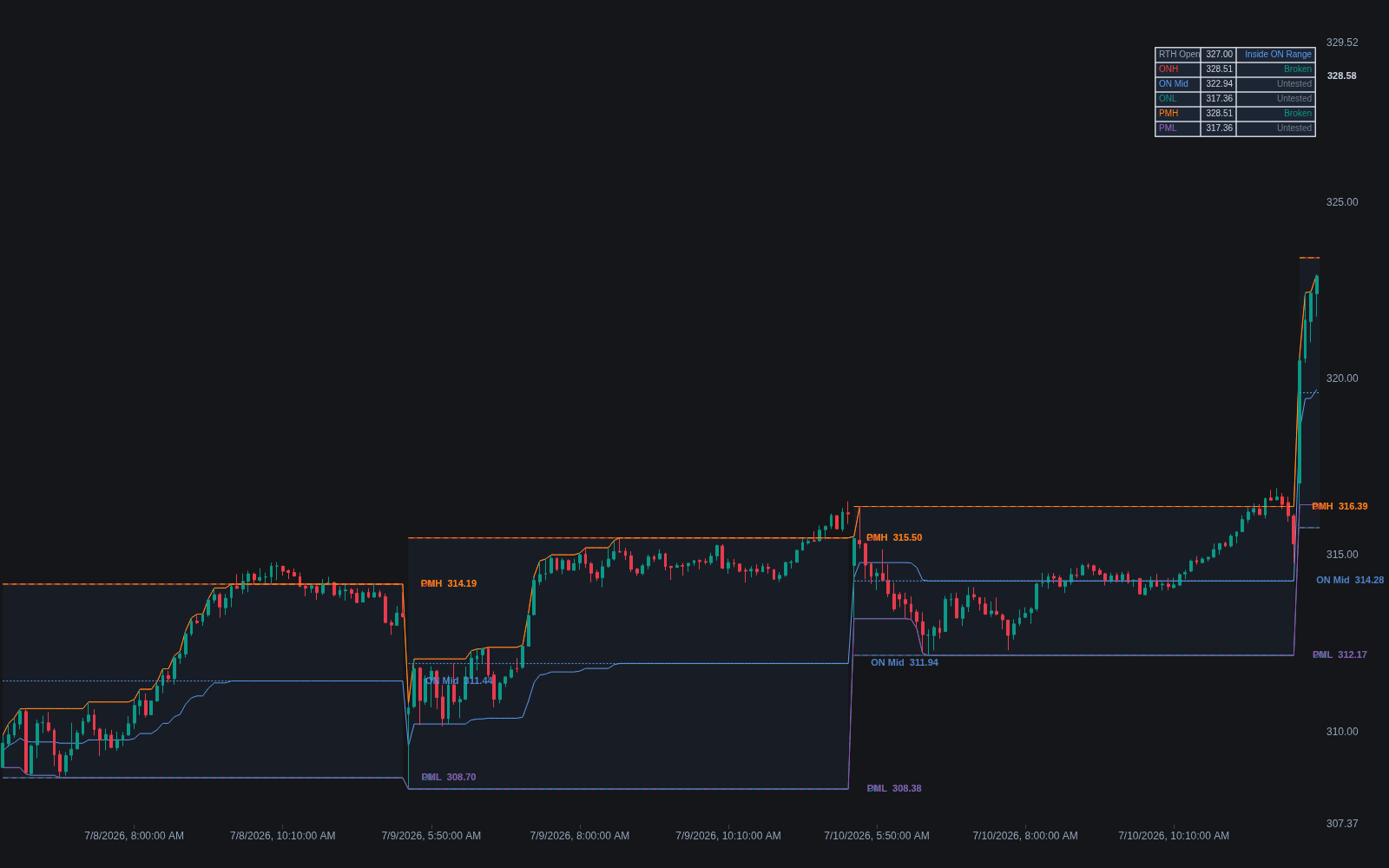
What are Overnight & ETH Levels?
Overnight and ETH levels are reference prices formed outside the regular session: the overnight high and low (ONH/ONL) built during a futures contract's extended electronic hours, and the pre-market high and low in stocks. Splitting the day into regular and extended sessions is its own charting decision (the RTH vs ETH choice); these levels are what the extended session leaves behind. Because overnight trade runs on thinner volume and narrower participation, its extremes are prices set without the full crowd, and the regular-session open routinely revisits and re-judges them.
The split is a product of market structure. CME's Globex platform launched in 1992 and stretched futures trading toward a 24-hour day while the regular session kept its status as the reference auction. The Market Profile tradition descending from J. Peter Steidlmayer's 1980s work at the Chicago Board of Trade formalized the habit of treating regular hours as the session of record and overnight activity as inventory to be resolved, and equities followed once electronic communication networks opened pre-market trading to a broad audience in the late 1990s.
That makes ONH, ONL, and the pre-market extremes the first working map of a trading day: the open either rotates inside the overnight range or breaks an overnight extreme, and what happens at those levels shows whether the early move is being accepted or faded. Stops also collect just beyond the overnight extremes, which is why sweeps of the ONH or ONL are a recurring intraday event.
In practice the overnight session contributes a small family of references: the ONH and ONL, the overnight midpoint, and for stocks the pre-market high and low, all layered onto the same map as prior period levels such as yesterday's high, low, and settlement, plus the day's period opens. Each is then a candidate support or resistance level whose meaning is settled by how price behaves on arrival, the same acceptance-versus-rejection reads covered by level interaction rules. Confluence upgrades a level: an ONH sitting on yesterday's high or a floor pivot is watched harder than either alone.
How to mark overnight and ETH levels
The levels take a minute to mark once the session boundaries are set:
- 1Turn on extended-hours data, or the overnight session will not exist on the chart: futures need the full ETH feed, stocks the pre-market and after-hours prints.
- 2Define the overnight window: for US index futures, conventionally everything between the regular close and the next regular open; for stocks, the pre-market span your platform uses.
- 3Mark the highest and lowest prices of that window as the ONH and ONL (or pre-market high and low), and optionally the midpoint between them.
- 4Extend the levels across the regular session and watch the first interactions: acceptance beyond an extreme argues for range extension, an immediate reclaim argues for a fade.
How traders use it
- To frame the open: where the regular session opens relative to the overnight range (inside it, above the ONH, below the ONL) sets the day's first bias, and interaction with the opening range shows whether that bias holds.
- For breakout-or-fade decisions: a push through the ONH that holds is treated as range extension, while a poke through it that immediately returns inside is a classic fade back toward the other side of the overnight range.
- As a liquidity map: resting stops beyond overnight extremes make the ONH and ONL common sweep targets, so liquidity-focused frameworks watch them for stop-runs before the day's more durable move.
- As confluence input: overnight extremes that land on yesterday's high or low, a Camarilla band, or a supply or demand zone mark spots where separate methods agree, and those earn priority over lone levels.
- As an inventory read: a night spent trending one way leaves overnight participants positioned one way, and profile-influenced traders watch for the early session to correct that inventory back toward the overnight midpoint before the day's real auction begins.
Overnight & ETH Levels vs other daily references
Prior Period Levels: Yesterday's high, low, and close formed with full regular-session participation; overnight extremes formed on thin trade. Both carry forward, but many traders weight the regular-session set more and treat overnight extremes as newer, less-tested evidence.
Period Opens: An open is a single print that starts a period; overnight levels are the extremes a whole session left behind. The daily open usually sits inside the overnight range, and the relationship between the two frames the first hour.
Floor Pivots: Pivots are computed from yesterday's OHLC by formula, so they exist even where no trade occurred; overnight levels are actual traded extremes. Where a formula level and a traded extreme coincide, the spot earns extra attention.
Concept family
Support/Resistance & Levels
38 concepts mapped · 38 in the Library
Overnight & ETH Levels FAQ
Turn Overnight & ETH Levels into a trading strategy.
Take the implementation from this page into Quant, then build on it, backtest it on real data, and keep refining it in conversation.