Shortening of the Thrust
 By LuxAlgoOct 9, 2026
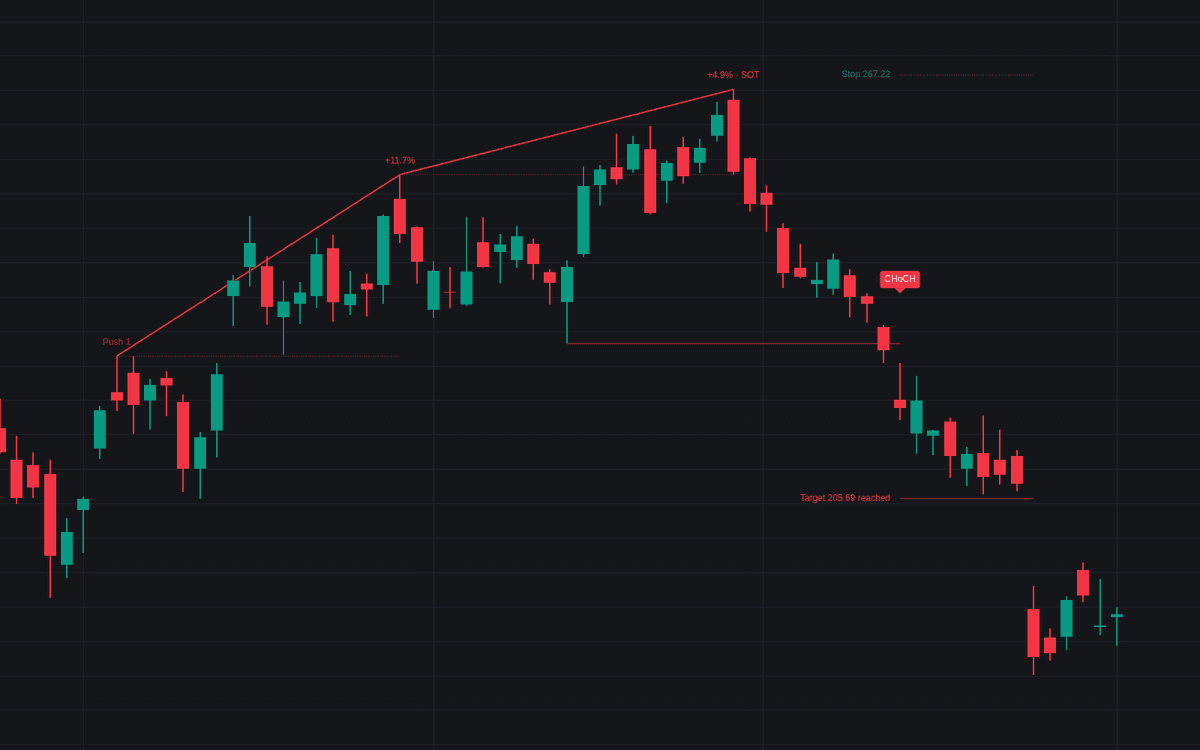

Shortening of the Thrust is a technical analysis tool designed to identify potential trend reversals by detecting momentum exhaustion. It monitors price action to determine when successive impulses fail to clear previous extremes by a meaningful margin, signaling that the current trend is losing steam. By providing visual confirmation of weakening price moves and identifying specific Change of Character levels, this indicator helps traders anticipate potential turning points before they fully manifest in the market.
How to Trade the Shortening of the Thrust?
To effectively trade using this indicator, you should look for the completion of a multi-push sequence where each subsequent drive into a new extreme covers less ground than the one before it. The indicator highlights these sequences with visual labels and lines, detailing the percentage gain of each push.
A valid setup follows these stages:
- Identification: The indicator flags a series of at least three pushes where each new extreme is smaller than the last. This creates a visual representation of price deceleration.
- The Trigger: Wait for a Change of Character (CHoCH). This occurs when the price breaks back through the last reaction extreme that preceded the final push. If enabled, this confirms the loss of momentum with a move on significant volume.
- Execution: Once the CHoCH is confirmed, the indicator plots a Target and a Stop. The target is typically set at the initial reaction extreme where the sequence began, while the stop is placed just beyond the final push of the trend.
- Monitoring: Keep the trade open until the price hits the defined target or the stop loss. The indicator provides a set window of bars to watch these levels before the opportunity is considered expired.
Shortening of the Thrust Settings
Thrust Detection
- Swing Length: Defines the number of bars to the left and right that a high or low must dominate to be considered a pivot point.
- Minimum Pushes: Sets the number of consecutive pushes required to identify a sequence; sequences must have at least three pushes to be evaluated.
- Shrink Factor: Determines the strictness of the shortening requirement. Lower values demand clearer deceleration in the gains of each consecutive push.
- Minimum First Gain (ATR): Ensures the sequence begins from a significant price move by requiring the first gain to clear the prior extreme by a minimum ATR multiple.
- ATR Length: The period used for the Average True Range calculations.
Change of Character
- Require Expanding Volume: If enabled, the Change of Character event must occur on volume above the moving average, providing stronger confirmation of a trend break.
- Volume Average Length: The lookback period for calculating the average volume.
- Change of Character Window (bars): The time limit after the last push for the price to break through the reaction level.
Trade Levels
- Stop Buffer (ATR): An ATR-based offset for the stop-loss level, placed beyond the final trend extreme.
- Trade Watch (bars): The duration the indicator tracks the active setup to see if the target is reached.
Style
- Rising/Falling Thrusts: Toggle the visibility of detected bull or bear thrust sequences.
- Bullish/Bearish/Neutral Colors: Customizes the colors used for labels and lines to distinguish between reversal types and structural elements.
Frequently Asked Questions
Free on Vela
Run it on Vela. Go further with a paid plan.
- Up to 500 strategy alerts, with webhook automation
- Up to 10× the chart history of Free
- Orderflow lookback up to full history
- Up to 100,000 monthly credits for Quant to customize it
- Futures data alongside crypto, stocks, forex and commodities

Run it on Vela. Make it yours with Quant.
Open this indicator free on Vela, our next-generation charting platform. Then ask Quant, our coding agent built into Vela, to retune it or turn it into a backtested strategy of your own.