Nine Buying/selling Tests
 By LuxAlgoJun 1, 2026
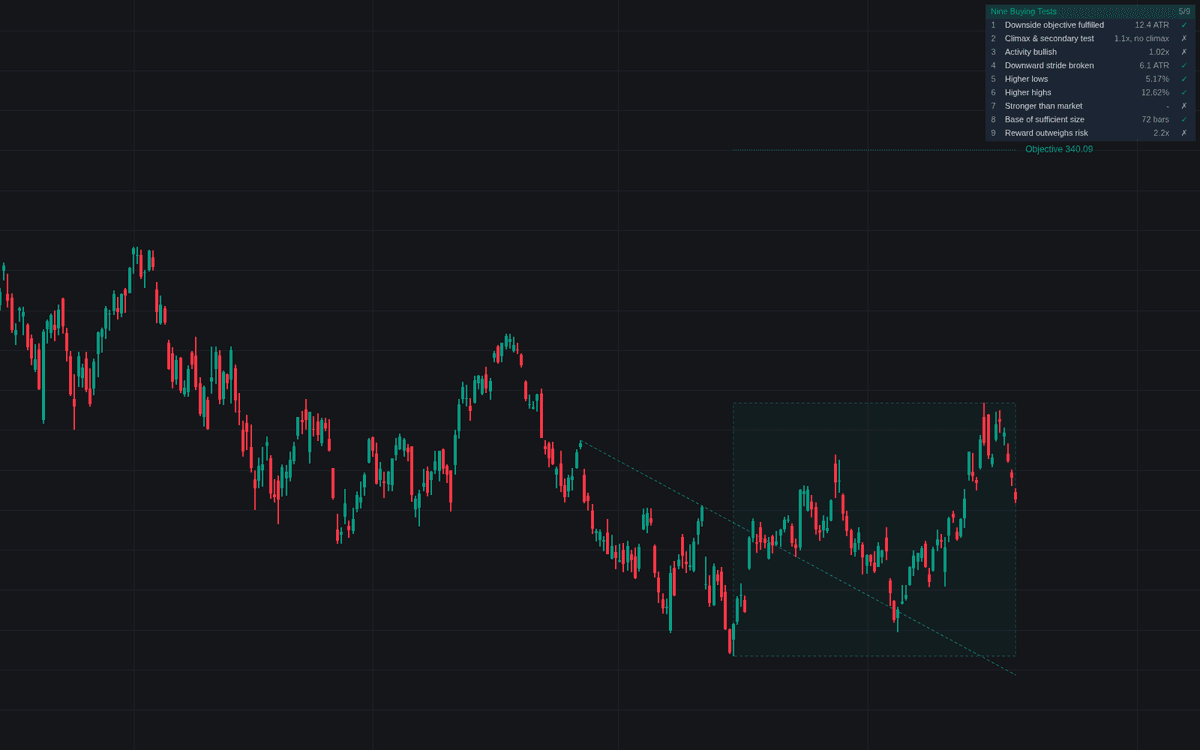

Nine Buying/selling Tests turns the Wyckoff tradition's pre-entry gate into a live, scored checklist. The build anchors a trading range at the scan window's extreme, measures the trend into it, and grades the nine buying and selling tests continuously, each row showing reading, pass/fail state and exact rule, the score in the header. The range box, stride line and projected objective are drawn on the chart.
How to Trade the Nine Buying/selling Tests?
- Score accumulating: the checklist is convergent evidence, not a trigger. The Wyckoff family tradition asks for most or all tests before committing; threshold and 9/9 alerts mark both stages.
- Auto side selection: a window that fell from its high into its low is audited as accumulation, the mirror as distribution; Test Set can force either side.
- Stride break + stepping structure: a dedicated alert marks this pairing some practitioners use to stage a starter position early.
Nine Buying/selling Tests Settings
- Test Set (default Auto), Scan Lookback (Bars) (default 250), Swing Length (default 5) and ATR Length (default 14): the audit window and its pivots.
- Minimum Prior Trend (xATR) (default 3.0) and Extreme Hold (Bars) (default 10): the fulfilled-objective test.
- Climax Volume Multiple (default 2.0), Volume Average Length (default 20), Secondary Test Volume Ratio (default 0.75) and Secondary Test Proximity (xATR) (default 1.5): test 2.
- Activity Ratio (default 1.1), Benchmark (default SP:SPX) and Relative Strength Length (default 50): tests 3 and 7.
- Minimum Cause (Bars) (default 40), Objective (x Range Height) (default 1.0), Minimum Reward/Risk (default 3.0) and Score Alert Threshold (default 7): cause and payoff.
- Checklist position/size, plus Range Box, Stride Line, Objective Level (on) and Climax / Test Markers (off).
Frequently Asked Questions

Original indicatorBuilt in-house by LuxAlgo
The Library is free. Quant makes it yours.
Pull any concept or indicator into Quant: rebuild it, retune it, or turn it into a backtested strategy of your own.