Sell to Close: Best Exit Strategies

Sell to Close (STC) means selling an option you own to reduce or eliminate that long option position. It can realize a profit or a loss. A useful exit plan defines what should trigger the decision, which contracts to sell, how to control the execution price, and how to verify the remaining position.
Start with the underlying market in LuxAlgo’s native charts. Use Quant to help express testable exit rules, then verify the actual option and order in your broker’s platform. A plotted signal, an order submission, and a completed sale are three different events.
Sell to Close Basics
Use STC for a purchased call or put. Buying a put is a long option position even when it expresses a bearish view of the stock. To exit an option you wrote, the corresponding action is Buy to Close. Selling stock or offsetting a long futures position follows the relevant broker’s product-specific controls; do not assume every ticket uses identical labels.
Match the account, option type, strike, expiration, and adjusted contract terms. If you own three contracts and one sells, two remain. Review pending orders before submitting another exit so you do not duplicate the intended quantity.
Suppose a hypothetical standard 100-share call was bought at $7.50 and sold at $10.00. The gross profit is ($10.00 − $7.50) × 100 = $250 per contract, before entry and exit costs. The $2.50 change is per quoted share. Verify the actual multiplier and deliverable; the Options Industry Council’s contract overview explains standard terms. Our opening and closing order guide covers the four actions.
Compare Exit Order Instructions
| Instruction | What it controls | Main limitation |
|---|---|---|
| Market | Seeks execution at available prices | Does not guarantee the last quote or trade price |
| Limit | Minimum acceptable sale price | May remain unfilled or fill partly |
| Stop-market | Triggers a market sale under specified conditions | Fill can occur below the trigger |
| Stop-limit | Triggers a limit sale | May not execute after a gap |
| Trailing stop | Adjusts a trigger as the reference price rises | Broker rules and the resulting order determine execution |
Check whether the broker supports the instruction for your option, how it defines the trigger, and when it is active. A limit controls price, not profit or certainty of an exit. A stop helps implement a decision but cannot guarantee a loss cap. See our order-types guide for the tradeoffs.
Building an Exit Plan
Define the Target and Its Units
Distinguish an underlying-price target from an option-premium target. A stock reaching resistance does not imply that an option will reach a particular sale price: time remaining, implied volatility, and other pricing inputs also matter.
A planned 3:1 reward-to-risk ratio might compare a $300 gain target with a $100 planned loss. It does not mean risking 5% of an account to make 15%, and it does not guarantee the intended loss or gain. There is no universal minimum ratio that makes every strategy viable; evaluate win rate, costs, and the distribution of outcomes together.
Use support, resistance, moving averages, or retracement levels as explicit research inputs. Specify how the level is selected before the decision. A level chosen after seeing the reversal does not provide an honest test of the exit rule.
Anchor Volatility Rules to Price
ATR measures a range, not an exit price. A price-based trailing rule might subtract a chosen multiple of ATR from a defined high-water mark. State the instrument, timeframe, ATR period, multiplier, and whether the trail can move only upward. Comparing price directly with “the ATR’s closing value” mixes different quantities.
An ATR calculated on the underlying is in underlying-price units. It cannot be copied into an option-premium stop without a separately specified method. Test candidate distances instead of assuming a particular percentage or multiplier is best for day trades or swing trades.
Interpret Signals in Context
RSI above 70 and a touch of the upper Bollinger Band can occur during a continuing uptrend. They do not establish an imminent reversal. Likewise, a moving-average or MACD crossover depends on its settings and decision timing. Several indicators derived from similar prices may repeat the same information rather than provide independent confirmation.
For a long put, a rising stock can undermine the thesis; for a long call, a falling stock can do so. Use the actual position’s exposure and premium behavior, not a generic instruction to sell whenever price falls.
Compare Exit Methods
Trailing Stops
Consider an explicitly hypothetical stock example: an entry at $235 with a 10% trailing trigger initially gives $211.50. A new high of $300 raises it to $270; a high of $350 raises it to $315. Selling at exactly $315 would produce $80 gross per share, but a gap or fast market can produce a lower fill. This is stock-price arithmetic, not a historical Tesla trade or an options payoff calculation.
For an option, check its own price, spread, supported broker controls, and trigger rules. A chart indicator showing a trail does not create a broker-held order. Review costs and slippage when comparing a trail with a fixed target.
Partial Exits
Scaling out can reduce remaining exposure while leaving some participation in a further move. It also changes the distribution of returns and incurs transaction costs. It is not automatically better than one complete exit.
For example, if you own three standard contracts bought at $2.00, selling one at $3.00 realizes $100 gross, and selling a second at $4.00 realizes another $200 gross. The final contract remains exposed. Whole-contract constraints matter: a one-contract position cannot be divided into thirds.
A stop moved to the entry price is not a guarantee of net break-even after fees or gaps. Reconcile quantities across working orders, and check the remaining position if the option is part of a spread or a hedge. Selling a protective long leg can leave a short leg with materially different risk.
Time and Thesis Exits
Define a review date, maximum holding period, or event rule alongside price conditions. A signal that never develops can justify reassessment even without a stop being touched. Near expiration, check exercise and settlement procedures and your broker’s deadlines.
Selling to close is different from exercising. A physically settled long option can create stock transactions and funding or delivery obligations if exercised. Confirm the actual close before assuming those consequences have been avoided.
Video: Comparing Exit Approaches
Research Exit Rules with LuxAlgo
Start in Native Charts and Quant
Use the native multi-chart layout to compare the entry timeframe with broader context. Mark invalidation levels and choose indicators with a clear role. Then ask Quant to help write the underlying-price strategy with explicit entries and exits.
Example research prompt: “Compare a fixed target, a price-anchored ATR trail, and a time exit while keeping entries and sizing consistent. Specify inputs and confirmed-bar timing. Include supported costs and explain what the simulation cannot model.”
Review the generated code, run it, and inspect individual trades alongside net profit, profit factor, drawdown, and trade count. Use editable inputs and the supported strategy properties to make comparisons reproducible. Validate outside the development sample rather than repeatedly tuning to the same period.
An underlying backtest does not automatically model an option chain, historical bid/ask premiums, Greeks, exercise, or assignment. Exported scripts also need validation in their destination environment. Neither Quant research nor a chart alert should be described as a guaranteed automated broker exit.
Use Indicators as Defined Inputs
Moving averages, RSI, and other studies can help express a repeatable decision. Check the actual rule and data used by any selected Library tool instead of assuming it continuously optimizes a strategy or controls live orders.
Review Decisions and Execution Separately
A written plan helps identify whether an exit followed the intended rule. It does not prove that the rule has an edge. Separate three questions: Was the strategy sensible, was the order entered correctly, and did the market provide the expected fill?
Record fear-driven changes, chasing, revenge trades, or reluctance to realize a loss when they occurred. Avoid assigning every poor result to psychology; faulty data, weak rules, costs, and liquidity can also explain it. There is no need for an unsupported universal trader-success percentage to make the review useful.
Trade Journal Analysis
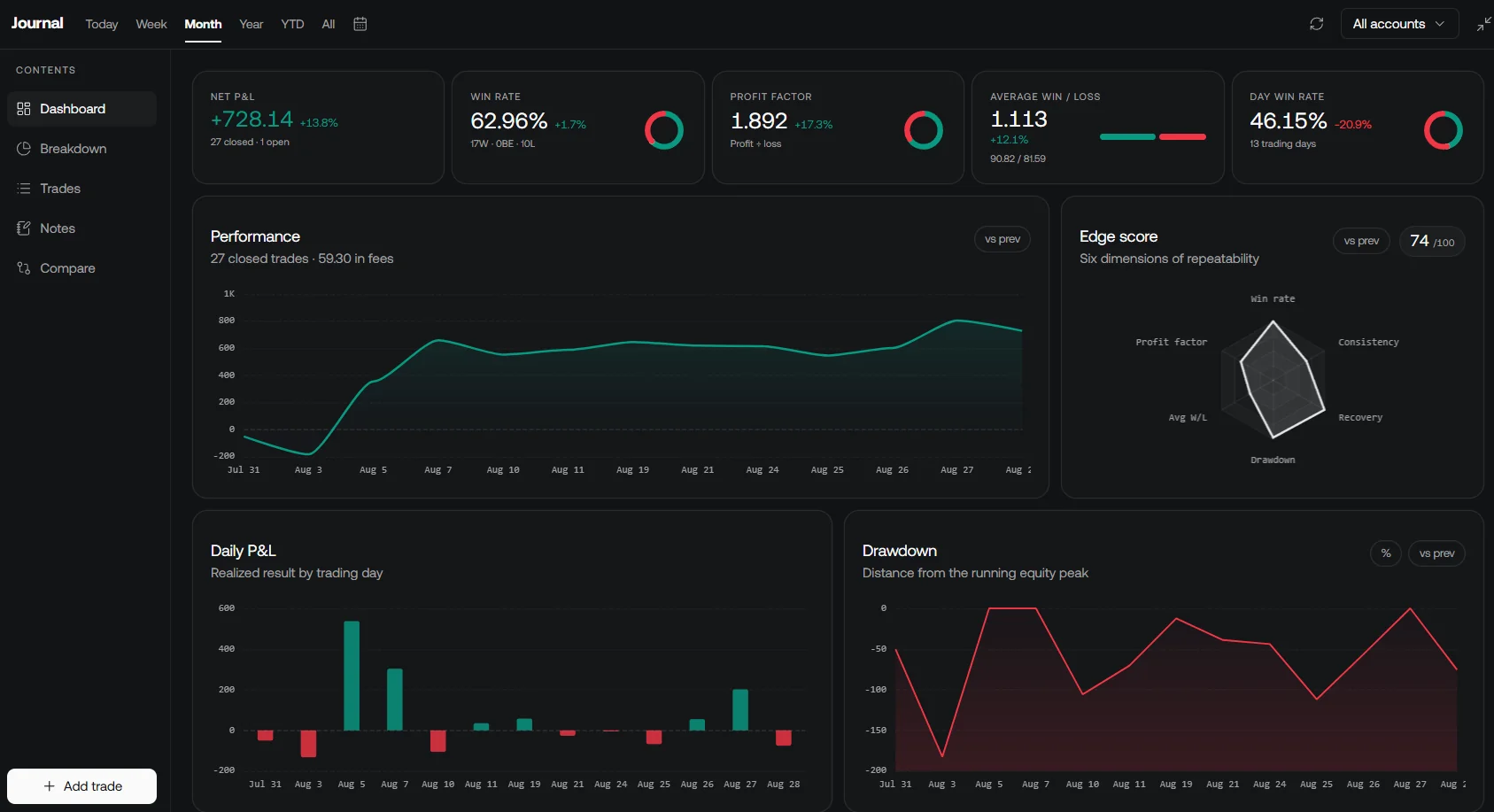
The LuxAlgo Journal supports trade records and notes. Confirm whether your supported broker or import format supplies the required options fields; supplement missing contract, exercise, or multi-leg details. Record the planned exit, actual fill, fees, remaining exposure, and reason for any deviation.
Compare patterns over a meaningful sample. A single trade that rose after your exit does not establish that holding longer is better. Any proposed change should face the same cost assumptions and out-of-sample evaluation as the original rule.
Sell to Close Checklist
- Verify the exact long option and quantity available to close.
- Define whether the trigger uses option premium, underlying price, time, or an event.
- Check order support, price limits, duration, costs, and existing working orders.
- Confirm actual fills and the remaining account exposure.
- Review the result against the plan before changing the rule.
The best exit for a strategy is an evidence-based choice under its constraints. Make the rule explicit, test its limitations, and use the position record to confirm that the intended sale occurred.
Read next