Concept
Scaling Out
Scaling Out, also known as partial TP ladders, runners, ½-at-1R geometry, is a Risk, Sizing & Exits concept. The Library holds 1 implementation, a working definition you can pull into Quant.
Top Scaling Out indicator
The top custom implementation, built on the original standard Scaling Out formula.
1 total
The Scaling Out implementation below can become a backtested trading strategy — describe your rules and Quant writes the code.
What is Scaling Out?
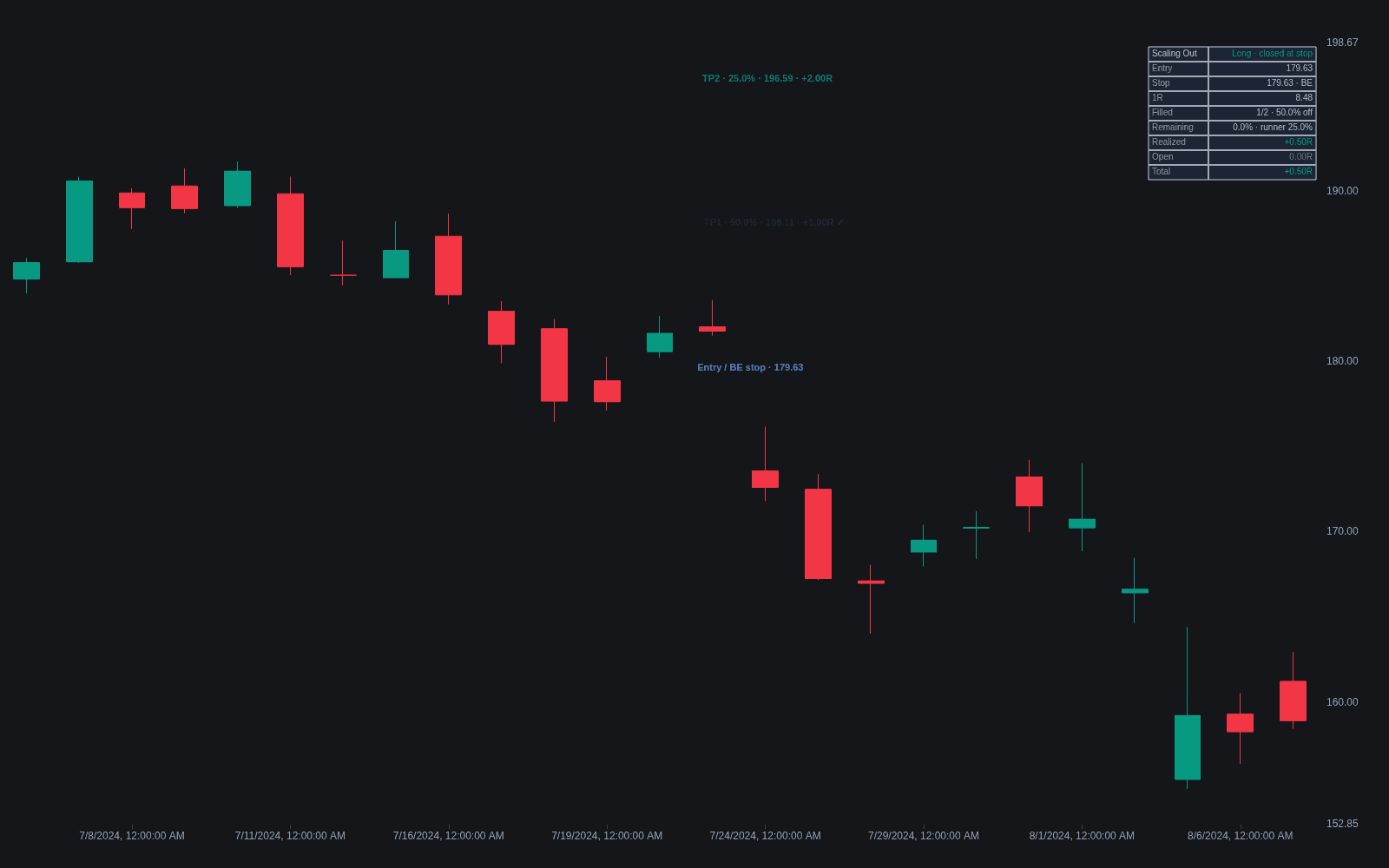
Scaling out is exiting a position in planned parts rather than all at once: a partial take-profit at the first objective, another at the next, and a final piece, the runner, left to trail for the larger move. A common geometry takes half off at +1R and moves the stop to entry, so the remainder cannot lose on paper; in practice a breakeven stop can still slip or gap, so risk-free is an approximation, not a fact.
The mechanics live in the R-multiple framework: the stop set at entry defines 1R, targets are expressed as multiples of it, and each tranche's share of the position is fixed before the trade rather than negotiated with it afterward. Execution is usually pre-placed as resting limit orders bracketing the position, standard order constructs on most platforms. Size has to cooperate too: a plan of thirds needs a position divisible by three after minimum lots, one reason ladders are designed together with position sizing rather than bolted on.
Partial exits reshape the outcome distribution; they do not improve it for free. Booking pieces early typically raises the share of trades that end positive and smooths the equity curve, but it shrinks exactly the winners that pay for losing streaks, because size is smallest when the move extends furthest. Whether that trade-off helps depends on how often your market keeps going after the first target, which is measurable in your own records rather than a universal rule. It is the mirror image of pyramiding, which adds size as a position works.
Much of the technique's payload is behavioral. A partial banked at the first objective makes the remainder easier to hold through noise, and a pre-committed ladder removes discretion at the exit, exactly where decisions are most emotional. The accounting still cuts both ways: the popular claim that a breakeven-stopped runner is a free trade ignores the capital, attention, and opportunity the position keeps consuming, and a laddered exit can underperform a single well-placed target in markets that rarely extend. It is a distribution choice to test, not a virtue in itself.
How to plan a scale-out ladder on the chart
The ladder is designed before entry, from the same chart that justifies the trade.
- 1Set the stop first, from structure or volatility (a structure stop or volatility stop), and measure 1R as the distance from entry to it.
- 2Mark the exit levels: prior swing points, measured objectives, or fixed R-multiples, and check the first target clears fees and typical slippage by a sensible margin.
- 3Assign a fraction to each level before entry, for example half at +1R, a quarter at the next structure, and the rest as the runner.
- 4Decide the runner's handling in advance: which trailing rule takes over, and whether the stop moves to entry after the first partial.
How traders use it
- As a ladder against pre-mapped objectives: partial exits at structure levels or measured targets (see the profit target taxonomy), with each tranche sized before entry rather than improvised.
- As a risk-neutralizing routine: a fixed fraction off at +1R, stop moved toward entry, and the runner managed by a trailing method until structure or volatility says the move is done.
- In inventory-style systems: grid bots build a ladder of entries and unload it in slices as price rotates back through the levels, which is scaling out applied mechanically.
- As an expectancy audit: replaying past trades in R terms under all-out versus laddered exits shows which version the strategy actually pays; the answer differs by market and is the honest basis for adopting the technique.
- As event risk trimming: partials taken ahead of scheduled news or a session close cut open exposure when stops are least reliable, a practical companion to broader loss-control rules.
Scaling Out vs related techniques
Pyramiding: The mirror image: pyramiding adds size as a position proves itself, concentrating exposure into strength, while scaling out sheds size into strength. One widens the best outcomes, the other smooths them; some plans add early and unload late, using both.
Averaging Down: Averaging down also transacts in parts, but on the losing side, adding to a position moving against you and growing risk without new proof. Scaling out only ever reduces exposure. The shared scaling language hides opposite risk behavior.
Trailing Method Taxonomy: Trailing the whole position is the main alternative: full size stays on for the big move and gives back more at the end. Partials bank certainty early and leave the trail less to manage. Many exit plans blend the two.
Concept family
Risk, Sizing & Exits
37 concepts mapped · 37 in the Library
Scaling Out FAQ
Turn Scaling Out into a trading strategy.
Take the implementation from this page into Quant, then build on it, backtest it on real data, and keep refining it in conversation.