Chaikin Money Flow
 By LuxAlgoApr 13, 2020
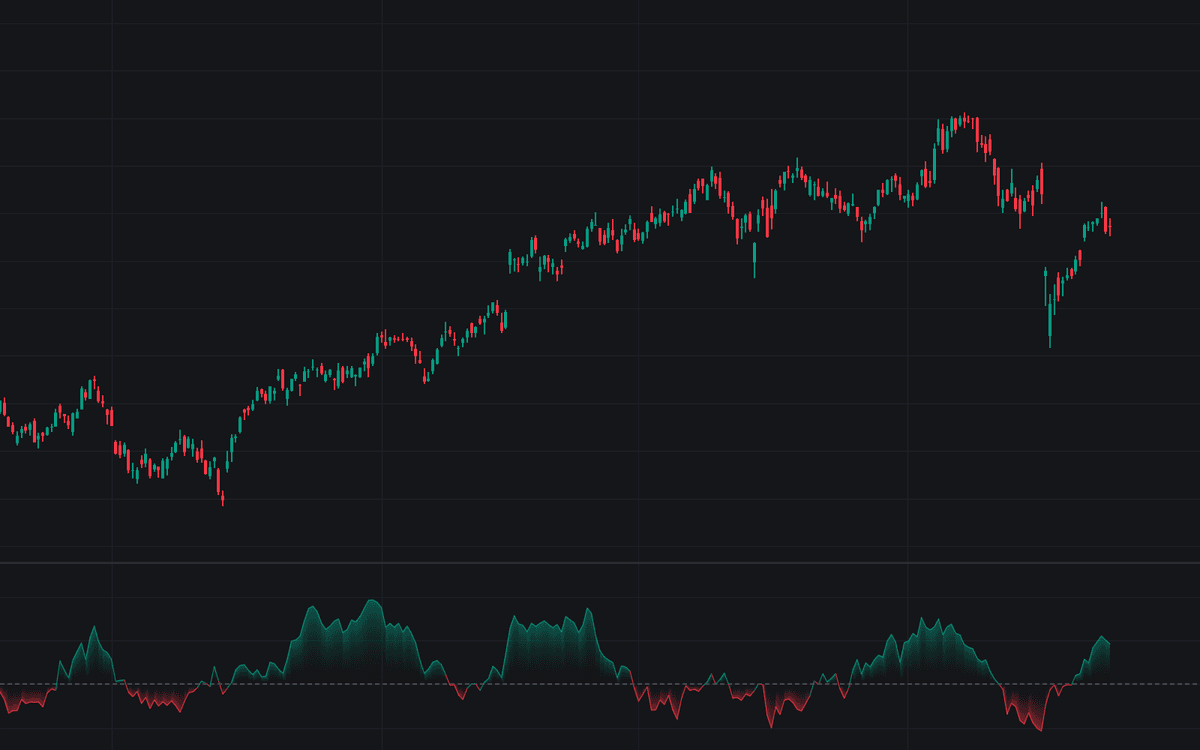

The Chaikin Money Flow is a volume oscillator that measures whether closes are consistently finishing in the upper or lower part of each bar's range, and how much volume stands behind that tendency. Each bar's close location value (+1 at the high, -1 at the low) is multiplied by volume, summed over a lookback window, and divided by the same window's total volume. The result oscillates around a dashed zero line inside a -1 to +1 bound. This build follows Marc Chaikin's standard formula directly, with the classic 20-period length and no smoothing or alterations.
How to Trade the Chaikin Money Flow?
- CMF above zero: closes keep landing in the upper half of their ranges with volume behind them: net accumulation, more persistent the longer it holds.
- CMF below zero: the opposite condition: closes clustering toward the lows, net distribution.
- Zero Line cross: the balance flipping. Crosses are noisy in ranging tape, so many traders demand a margin beyond zero or a few bars of follow-through.
- Divergence: fresh price highs while CMF sinks toward or under zero question the volume behind the advance; the mirror applies at lows.
CMF only sees where each close sits inside its own bar, so use it to confirm and filter price-structure signals rather than as a standalone trigger.
Chaikin Money Flow Settings
- Length (default 20): the lookback over which money flow volume and total volume are summed. Shortening it makes the line cross zero far more often; lengthening steadies it but registers shifts later.
Alerts
Two alert conditions ship with the script: Zero Cross Up, firing when CMF crosses above zero, and Zero Cross Down, firing when it crosses below.
Frequently Asked Questions

The Library is free. Quant makes it yours.
Pull any concept or indicator into Quant: rebuild it, retune it, or turn it into a backtested strategy of your own.