Concept
Chaikin Money Flow
Chaikin Money Flow is a Volume & Order Flow concept. The Library holds 1 implementation, a working definition you can pull into Quant.
CMF
The standard Chaikin Money Flow indicator
Chaikin Money Flow exactly as classically defined: the faithful reference build of the original formula, free to run in Quant.
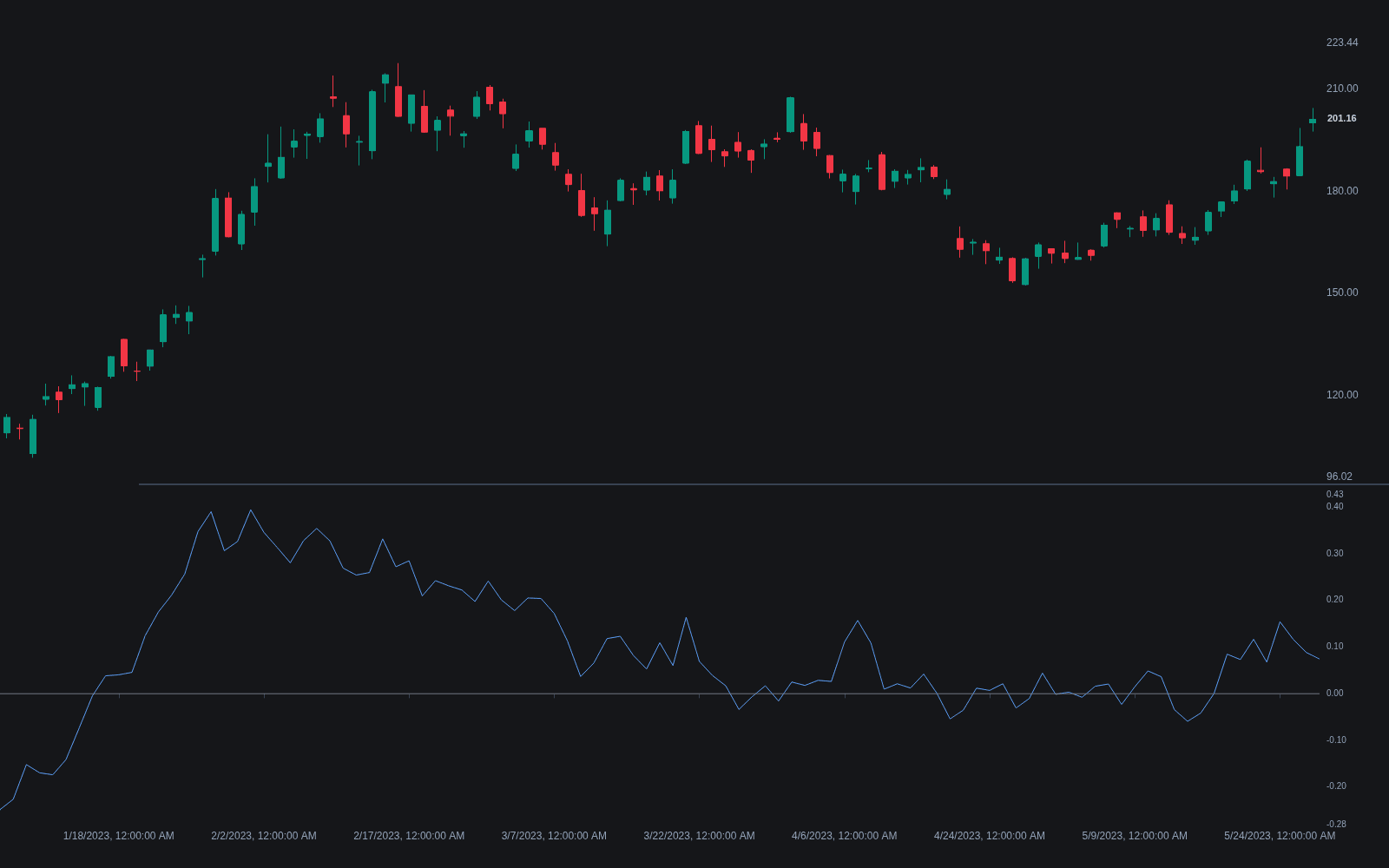
What is Chaikin Money Flow?
Chaikin Money Flow (CMF) is a volume-weighted oscillator developed by Marc Chaikin that measures buying and selling pressure over a rolling window, typically 20 or 21 bars. It builds on the same core idea as the Accumulation/Distribution Line: a close near the high of the bar's range suggests accumulation, a close near the low suggests distribution, and volume scales the conviction. CMF sums this signed money flow volume over the window and divides by total volume, producing a value that oscillates between -1 and +1, in practice usually inside roughly +-0.25.
The indicator exists to give the accumulation and distribution logic a bounded, comparable form. A cumulative line trends forever and can only be read by shape; CMF resets its context every window, so readings are comparable across time and, loosely, across instruments. Sustained positive values are read as persistent buying pressure, sustained negative values as persistent selling pressure, and the zero line as the balance point.
Traders care because CMF condenses a noisy question, whether volume is flowing in or out, into a single bounded number that can confirm trends, flag divergences, and filter breakouts. Its main structural weakness is inherited from its money flow multiplier: it uses the close's position within the bar range, not the change from the prior close, so gaps are invisible to it. A stock can gap up strongly and still print negative money flow if it closes in the lower half of its intraday range.
How it's calculated
CMF over an n-bar window is the ratio of summed money flow volume to summed volume.
When high equals low the multiplier is undefined; implementations typically set MFM to zero for that bar.
How traders use it
- Trend confirmation: CMF holding above zero during an advance, or below zero during a decline, is read as volume agreeing with the trend. Crosses of the zero line are watched but are noisy on their own.
- Threshold reads: many practitioners require CMF above roughly +0.05 to +0.10 before trusting a bullish signal, and the mirror below zero for bearish ones, to filter out marginal readings that flip constantly.
- Divergences: price making new highs while CMF weakens toward or below zero is treated as a warning of fading accumulation, similar in spirit to volume divergence reads.
- Breakout filtering: a breakout accompanied by strongly positive CMF is generally trusted more than one where CMF stays flat or negative.
- Limitations: the indicator ignores gaps entirely, lags by construction because it averages over a window, and short windows whipsaw badly. No CMF reading removes the need for a price-based trigger.
Chaikin Money Flow vs related flow measures
Accumulation/Distribution Line: The A/D Line is the cumulative, unbounded version of the same money flow volume; CMF is its windowed, bounded ratio. The A/D Line shows long-term shape, CMF shows current pressure.
Chaikin Oscillator: The Chaikin Oscillator is a MACD-style difference of two EMAs of the A/D Line, measuring the momentum of accumulation. CMF instead measures its level over a window.
Money Flow Index: MFI is a volume-weighted RSI built from typical price changes between bars, scaled 0 to 100. CMF is built from the close's position inside each bar's range, so the two often disagree around gaps.
Twiggs Money Flow: Twiggs Money Flow is a later variant that uses true range and exponential smoothing specifically to address CMF's gap blindness and window-drop effects.
Concept family
Volume & Order Flow
88 concepts mapped · 88 in the Library
Chaikin Money Flow FAQ
Turn Chaikin Money Flow into a trading strategy.
Take the implementation from this page into Quant, then build on it, backtest it on real data, and keep refining it in conversation.