Double Stochastic
 By LuxAlgoMay 11, 2026
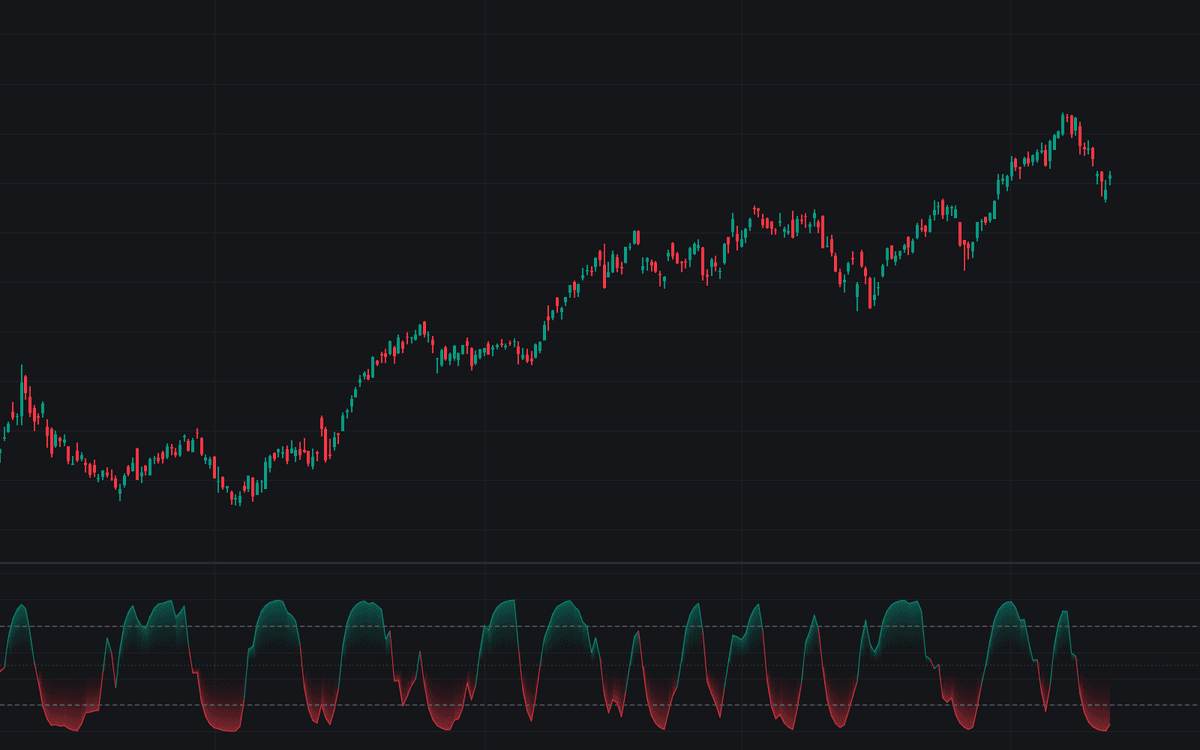

Double Stochastic runs price through the stochastic calculation twice (ranking it within its range, smoothing, then ranking and smoothing again) for a 0-100 oscillator markedly calmer than a single-pass %K while still reaching its extremes with conviction. This build carries both published recipes for the Double Stochastic: Bressert's two-pass %K (the default), and Blau's variant, which double-smooths the stochastic numerator and denominator before taking their ratio.
How to Trade the Double Stochastic?
- Trough at or below 20: a turn up out of the oversold zone is the swing-timing long read. In uptrends these visits gauge pullback depth.
- Crest at or above 80: the mirrored turn down from overbought; both turns carry alerts and optional markers.
- Level crossings: entries into and exits from the 80/20 zones fire their own alerts.
- Midline side: the plot colors bullish above 50 and bearish below, a quick momentum-bias read.
The double pass filters so much noise that extreme visits are rare enough to carry weight; the trade-off is a few bars of delay at real turns.
Double Stochastic Settings
- Variant (default Bressert (Two-Pass %K)): the two-pass recipe, or Blau's double-smoothed components.
- Source (default close): series ranked within the first pass's high/low range.
- First Stochastic Length (default 10): lookback of the first ranking pass.
- First Smoothing Length (default 3): EMA after the first pass (Bressert) or on the raw components (Blau).
- Second Stochastic Length (default 10): lookback of the second ranking pass (Bressert only).
- Second Smoothing Length (default 3): EMA of the second smoothing stage.
- Overbought Level (default 80) and Oversold Level (default 20): the extreme zones.
- Extreme Turn Markers (default disabled): circles at oversold troughs and overbought crests; alerts cover both.
Frequently Asked Questions

The Library is free. Quant makes it yours.
Pull any concept or indicator into Quant: rebuild it, retune it, or turn it into a backtested strategy of your own.