Stochastic Pop
 By LuxAlgoApr 9, 2026
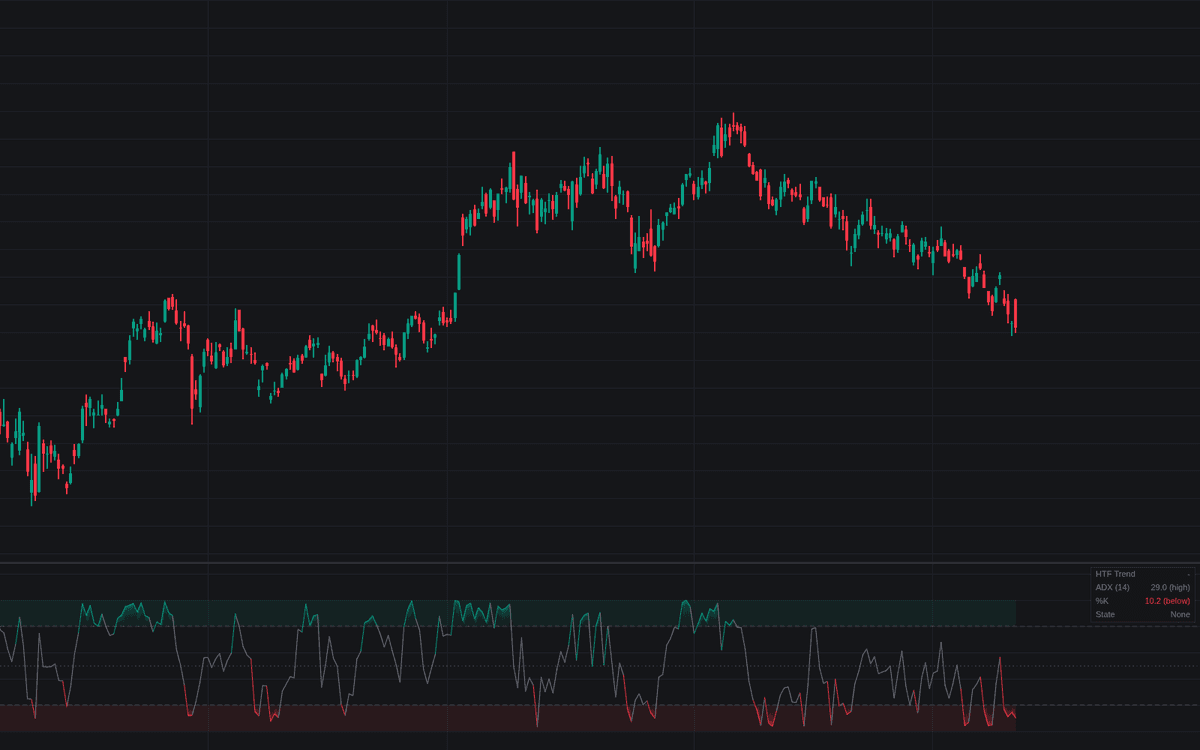

Stochastic Pop distills the stochastic pop tactic to its cleanest form: a fast %K whose surge through its ceiling is traded as ignition, not a stretch to fade. The pane draws %K over dashed Pop and Drop Thresholds, shades a gradient beyond either band and marks filtered triggers and exits, while a checklist dashboard reports each screen's state.
How to Trade the Stochastic Pop?
- %K crosses above the Upper Threshold: with every enabled screen aligned, a Bullish Pop Trigger prints and the state background switches on. Continuation is favored while %K holds above the line.
- %K plunges below the Lower Threshold: the mirrored Bearish Drop Trigger, read as downside ignition.
- %K hooks back through its threshold: the exit cross: the embedded reading is lost, the burst treated as spent.
The screens raise conviction: the ADX filter demands a market that has been resting rather than running, and the trend filter demands alignment with the higher-timeframe EMA. As with most momentum tools, the cleanest bursts erupt from a quiet backdrop.
Stochastic Pop Settings
- %K Length (default 14): lookback of the raw stochastic.
- %K Smoothing (default 1): SMA on %K; 1 keeps the raw line.
- Upper Threshold (default 80) and Lower Threshold (default 20): the ignition lines.
- ADX Contraction Filter (default enabled): triggers require ADX under the Below ceiling (default 20) at the ADX Length (default 14).
- Higher Timeframe Trend Filter (default enabled): alignment with an EMA (default 20) on the trend Timeframe (default W).
- Volume Expansion Filter (default disabled): trigger volume must exceed its Volume Average Length (default 20) average.
- Dashboard and style toggles cover the checklist table, markers, state background and colors.
Frequently Asked Questions

Original indicatorBuilt in-house by LuxAlgo
The Library is free. Quant makes it yours.
Pull any concept or indicator into Quant: rebuild it, retune it, or turn it into a backtested strategy of your own.